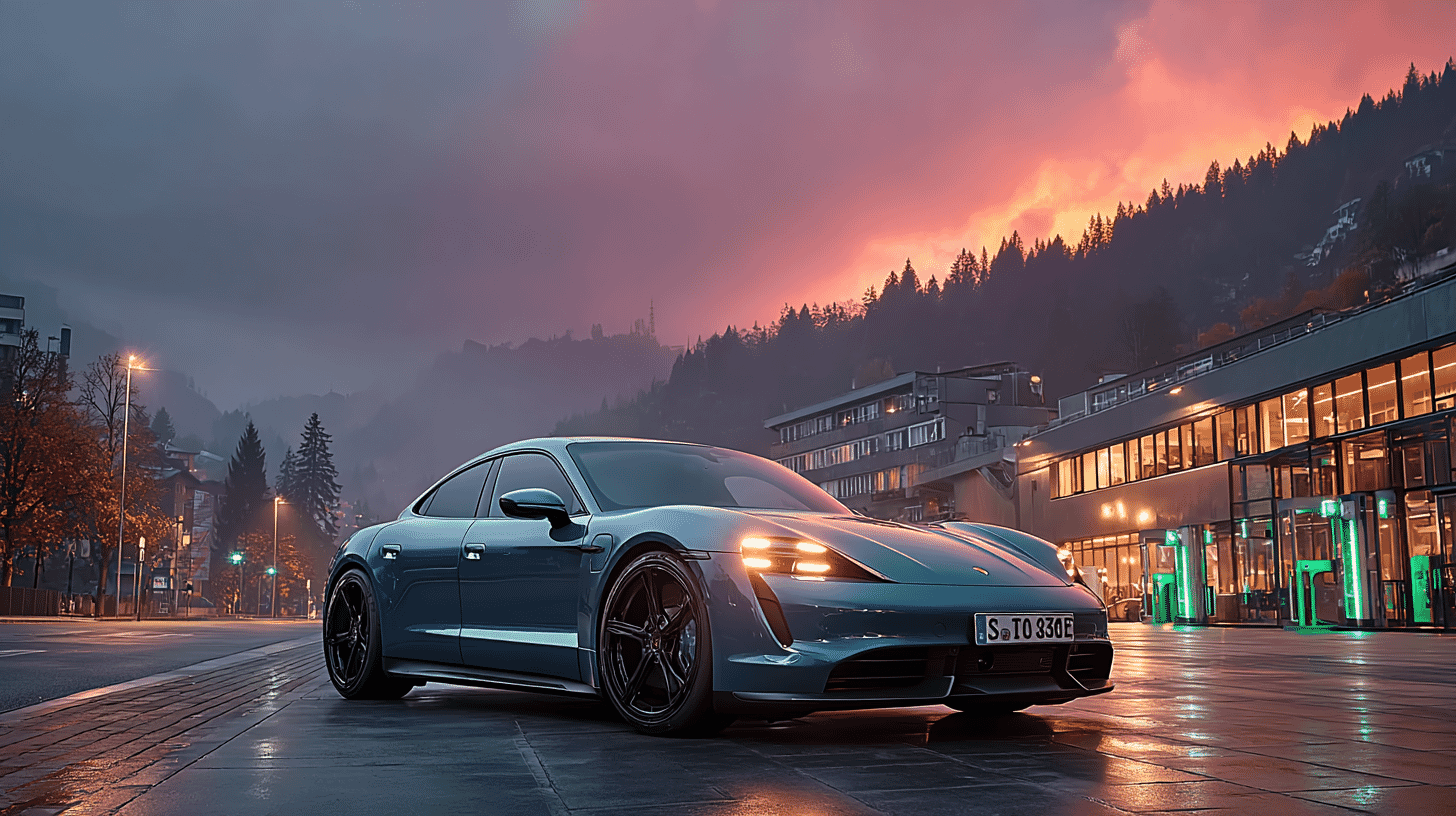
Global sales fell 10%, yet the electrification rate rose. Porsche's 2025 results are a set of numbers pointing in different directions. It recorded its steepest drop since the 2009 global financial crisis, yet the share of electrified vehicles reached 34.4% and the 911 set a new all-time delivery record. Here is what is happening at the front line of the luxury-car market and the EV shift.
Porsche's 2025 Sales Results: Fewer Cars, a Higher Electric Share
Porsche announced global deliveries of 279,449 vehicles in 2025, down about 10% from 310,718 the year before. That decline was the steepest in 16 years, since the 2009 global financial crisis.
But there is a side that cannot be dismissed simply as a "slump." The share of electrified vehicles (BEV and PHEV) rose 7.4 percentage points to 34.4%. Fully electric vehicles (BEV) alone accounted for 22.2% and PHEVs for 12.1%, reaching the upper end of the company's target range (20–22% BEV). In Europe (excluding Germany), the electrification rate hit 57.9%, the first time electrified vehicles outnumbered combustion models there.
Regional Trends: North America Steady, China in a Serious Slump
By region, the picture split clearly into light and shadow.
The North American market held roughly flat at 86,229 units, keeping its place as Porsche's largest sales region. The United States remained strong, underpinning North America as a whole.
Meanwhile, the Chinese market, once a growth engine, plunged 26% year on year to 41,938 units. Restrained spending by the wealthy amid the property crisis was compounded by the rise of Chinese brands in the luxury EV market, among them BYD, NIO, and the Huawei-affiliated AITO and Maextro.
Europe (excluding Germany) was down 13% at 66,340 units, and even the home market of Germany fell 16% to 29,968. A temporary suspension of supply of combustion Macan and 718 models due to EU cybersecurity regulations weighed on results.
By Model: The 911 Sets a Record, the Macan EV Does Well
By model, the standout is that the iconic 911 recorded an all-time delivery high of 51,583 units (up 1% year on year). Electrification that does not sacrifice driving fun, such as the 911 Turbo S with the "T-Hybrid" system introduced in 2024, is winning support.
The best-selling model was the Macan at 84,328 units. Notable is the breakdown: EV models accounted for more than half, at 45,367. It shows the strong performance of the Macan EV, fully redesigned in 2024.
On the other hand, the Cayenne (80,886 units, down 21%) and the Taycan (16,339 units, down 22%) struggled. The Taycan appears to have been affected by intensifying competition across the luxury EV market. The 718 Boxster and Cayman totaled 18,612 units (down 21%), with production of the combustion models ending in October 2025.
A Course Correction in EV Strategy
Porsche had originally set an ambitious target of raising its BEV share to 80% by 2030. But at the May 2025 shareholders' meeting, it formally announced the withdrawal of this target.
Former CEO Oliver Blume said, "Our product strategy should have been achievable. But given market developments, it is no longer realistic."
Porsche now adopts a three-pillar strategy of "combustion, hybrid, and full EV," shifting to a policy of responding flexibly to regional demand. In spring 2026, deliveries of the fully electric Cayenne, which had its world premiere in November 2025, will begin, and the new Cayenne series, spanning combustion, PHEV, and EV, will be complete on the market.
The Fate of the "Value over Volume" Strategy
Matthias Becker, executive board member for sales and marketing, commented, "After several record years, deliveries in 2025 were below the previous year. This is a result in line with our expectations." He explained that the main factors were the supply gap from the end of combustion 718 and Macan production, the slump in the Chinese market, and value-focused supply management.
Porsche plans to continue its "value over volume" strategy in 2026 as well. It has made clear its stance of prioritizing margin maintenance and not resorting to forced discount sales.
Under new CEO Michael Leiters (former CEO of McLaren Automotive), who took office in January 2026, the question is how Porsche handles this stretch.
Update: full-year 2025 results published in March 2026 showed net profit down 92%, driven by roughly €3.9 billion in extraordinary charges. Porsche's 2026 targets are a 24-26% BEV share and a 15-17% automotive EBITDA margin. First-half deliveries came in at 122,306 units, down 16.5%, with China off 32% at 14,501 units, below Germany's 14,938. The BEV share slipped to 19.4% from 23.5% a year earlier, though the full-year target was left unchanged. The 911 rose 19% to 30,534 units.
The Crossroads of Luxury Cars and the EV Shift
Porsche's 2025 was not a year in which electrification cost it volume. It was a year in which electric models could not fill the hole left when combustion supply stopped. More than half of Macans sold were electric, and the model that set a record was the 911, with an engine in it.
In Japan, Porsche has enduring popularity as an "aspirational brand you'd want to drive at least once," but opinions on going electric appear divided. While some fans love the sound of the engine, more and more voices highly rate the driving of the Taycan and Macan EV.
In your country, what are the views on luxury brands shifting to EVs?
References
- https://response.jp/article/2026/01/22/406393.html
- https://www.bloomberg.com/jp/news/articles/2026-01-16/T8YC4UKJH6V400
- https://www.just-auto.com/news/porsche-deliveries-fall-10-2025/
- https://carnewschina.com/2026/01/18/porsche-china-sales-slide-26-in-2025-to-42000-units-under-luxury-downturn-and-local-high-end-ev-competition-intensifies/






Global Discussion
15 comments