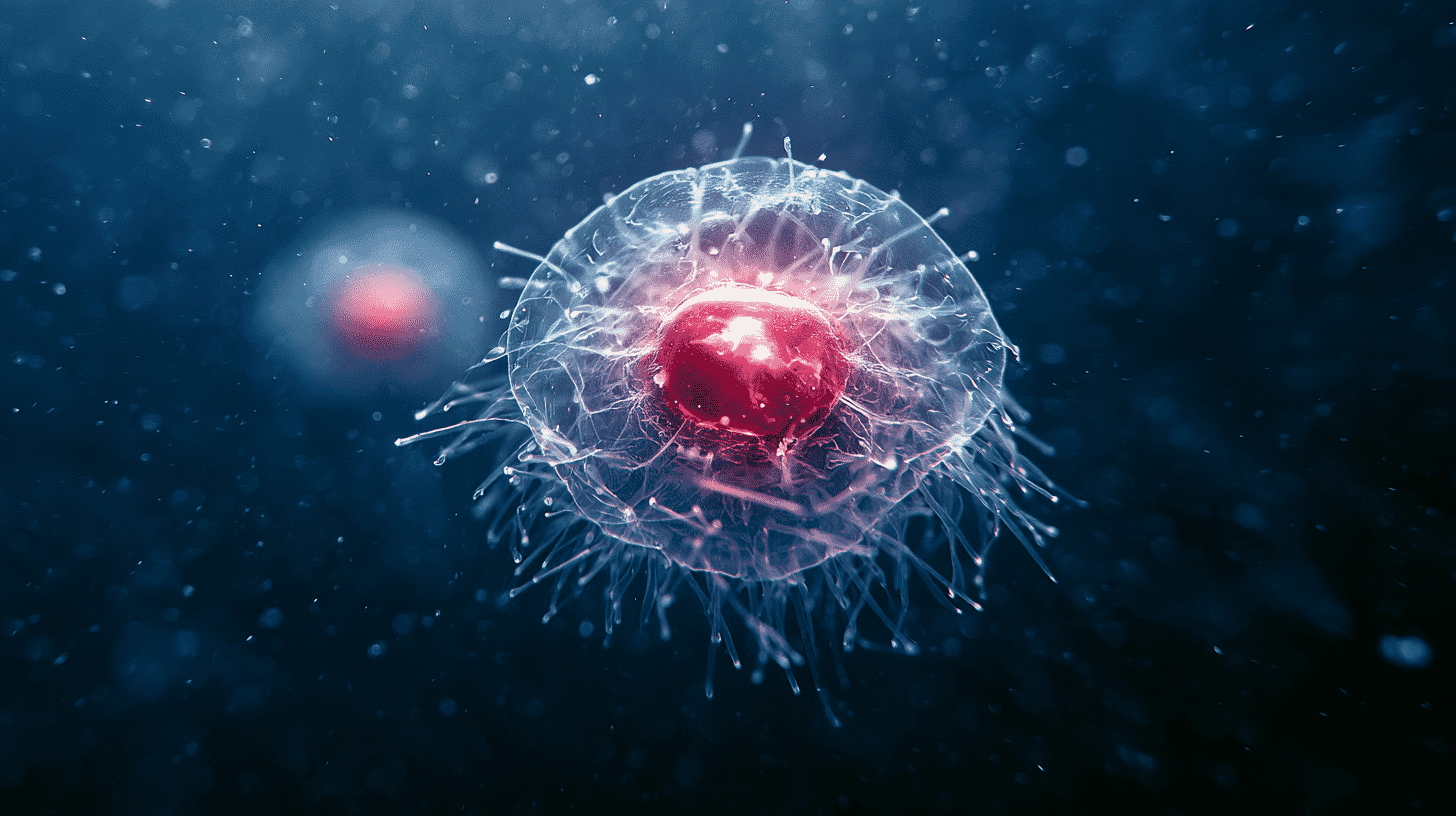
🪼 A jellyfish the size of a shirt button can wind itself back to childhood. That part is settled, and the logbooks that prove it were kept in a seaside lab in western Japan. What is not settled is whether the trick has anything to say to human medicine. The paper behind the "nature's own iPS cells" line was challenged the following year, and the challenge traces straight back to Japanese data the paper never cited.
A jellyfish in a Wakayama lab rewound itself ten times
In 2009, Shin Kubota pulled an immature Turritopsis dohrnii out of a plankton tow and put it in a dish at Kyoto University's Seto Marine Biological Laboratory in Shirahama, Wakayama. Natural seawater, temperature mostly at 27-29C. Nothing exotic.
The animal grew, reverted, and started over. On 25 June the reverted polyp formed a medusa bud; on 1 July a new immature medusa floated free, 0.70-0.75 mm across with eight tentacles. By 28 September the line had gone around four times.
Kubota kept going. Across two years he logged ten consecutive rejuvenations, the figure usually cited for this animal. The reversal itself is quick: about three days for a medusa to collapse into a lump and rebuild itself as a polyp colony. All of it happens in an animal whose bell is at most about 10 millimetres across.
That record did not come out of a sequencer. It came from someone willing to watch a speck in a dish, daily, for years. That unglamorous end of marine invertebrate biology is why the count belongs to Japan.
What the "just like Yamanaka factors" claim actually says
The comparison to Shinya Yamanaka's work is not invented by headline writers. It comes out of a genome paper.
On 29 August 2022, a team led from the University of Oviedo in Spain, with Maria Pascual-Torner and Carlos Lopez-Otin among the authors, published in PNAS. They sequenced Turritopsis dohrnii alongside its congener Turritopsis rubra, with Hydra vulgaris, Clytia hemisphaerica and Aurelia aurita as outgroups, and combed through about 1,000 genes tied to ageing and DNA repair. They reported 28 copy-number variations and 10 variants that were unique to one Turritopsis or the other.
The headline finding was not a gene, though. It was a pattern: during life-cycle reversal, targets of polycomb repressive complex 2 are silenced and pluripotency targets are switched on. Among the genes moving were SOX7, SOX14 and MYC.
Those family names run through the iPS story. The reprogramming recipe uses four genes: Oct3/4, Sox2, Klf4 and c-Myc. Mouse cells in 2006, human cells in November 2007, and the 2012 Nobel Prize in Physiology or Medicine "for the discovery that mature cells can be reprogrammed to become pluripotent."
Read at face value, the resemblance is real at the level of machinery. A SOX factor and a MYC factor turn up on both sides, and both stories are about chromatin repression lifting so that a pluripotency programme can start. The difference is who is doing it. Yamanaka's method is an intervention: push four genes into a cell and force it backwards. The jellyfish does it on its own, in seawater, when it is starving or injured.
The fight over the premise runs through Japanese data
Six months later the comparison ran into trouble. On 9 March 2023, PNAS published a short letter from Maria Pia Miglietta of Texas A&M University at Galveston. Her objection went to the foundation of the whole exercise. The Spanish team's logic was that T. rubra cannot regenerate after reproduction, so comparing its genome with the immortal species should reveal what makes the difference. Miglietta wrote that this assertion is incorrect, and that the paper cited in support of it had studied a different animal entirely, the Chinese T. sp. 5, and had never tested T. rubra.
The articles that did evaluate rejuvenation in T. rubra, Miglietta noted, looked at Japanese Turritopsis that were probably T. rubra, and concluded that it can rejuvenate before breeding and after it too, at a lower frequency. Those papers were not cited. If both species can rejuvenate, both carry the machinery, and comparing their genomes cannot isolate the keys to rejuvenation.
Her other objections are technical. Reversal in the study was induced by inconsistent methods, chloride caesium in some cases and spontaneously in others, which can move gene expression around on its own. The stage the paper labels as failing to revert is, on her reading, probably just a slow reverter, and there is no way to tell the two apart in advance. And Turritopsis is a genus riddled with cryptic species and introductions, so misidentification is common. "The burden of showing that the species whose genomes are sequenced are correctly identified falls on the authors," she wrote. The paper named no identifier, no method, no voucher specimens. A correction to the original paper followed on 27 March 2023.
The Oviedo team replied in the same issue. Pascual-Torner and Victor Quesada wrote that their manuscript uses the formula "no reported evidence of postreproductive rejuvenation" for T. rubra throughout, and that the blunter phrase appears once, for reasons of space. The papers Miglietta pointed to, they said, deal with subadult rather than mature medusae, or with undefined Turritopsis species. They also reported testing reversal in T. rubra medusae themselves and finding the two species clearly different after reproduction. The dispute narrows to a question a taxonomist would ask: were the Japanese jellyfish that reverted after breeding actually mature, and actually T. rubra?
The exchange doubles as a map of who works on this animal. Italy opened it: S. Piraino, F. Boero and colleagues reported in June 1996, in The Biological Bulletin, that every stage of the medusa, from newly liberated to fully mature, can transform back into a colonial hydroid, and that the reversal depends on differentiated cells of the exumbrellar epidermis and the gastrovascular system. The animal they described went under the name Turritopsis nutricula; the genus has been slippery since the opening paper. Spain brought the genome. The United States brought expression analysis and taxonomy. Japan brought the animals and the years.
Miglietta has published her own numbers. In Genome Biology and Evolution, in July 2021, she and Yui Matsumoto found 224 genes unique to the cyst stage, where the transdifferentiation happens. Of the top 50 of them, 44 percent had no functional annotation at all. Nearly half the shortlist for "how immortality works" is still unreadable.
What a jellyfish can do that a human cannot
Turritopsis does not make an old body young. It dismantles the body. The medusa balls up, dissolves its own organisation and reassembles as a colony of polyps: a different life stage with a different shape, no gonads and no swimming. There is no brain to preserve, no skeleton, no vasculature, and arguably no individual left that anyone would call the same one.
Run the same programme in a mammal and the failure mode is well known. Cells that lose their tissue identity do not politely become young cells. They become tumours. c-Myc, one of the four Yamanaka factors, is a known oncogene, which is why Kyoto's CiRA established a method that swaps it for L-Myc to lower the risk. The very gene that makes the jellyfish comparison compelling is also the one that makes it dangerous.
And "immortal" is a media word. These animals are eaten, infected and dredged like anything else in the plankton. Having a reset button is not the same as not dying.
Naked mole rats and Greenland sharks have the same problem
Turritopsis is one entry in a longer list of animals that embarrass the standard model of ageing, and each one thins out at the same point: the step to humans.
Naked mole rats live more than 37 years, extraordinary for a rodent. On 11 July 2023, Yoshimi Kawamura and Kyoko Miura at Kumamoto University's Graduate School of Life Sciences reported in The EMBO Journal that in this species, senescent cells themselves die, killed by a species-specific serotonin metabolism and a vulnerability to hydrogen peroxide. Senescent cells never pile up because the animal disposes of them.
Greenland sharks go further in raw years. Radiocarbon dating of the eye lenses of 28 by-caught females put their lifespan at least 272 years. Sexual maturity arrives around 156.
The bridges that exist are short. Vera Gorbunova and Andrei Seluanov at the University of Rochester moved the naked mole rat's hyaluronan synthase 2 gene into mice and reported in Nature, on 23 August 2023, that median lifespan rose by roughly 4.4 percent: a real crossing, one species wide. From the reprogramming side the crossing is longer. Life Biosciences, in Boston, has a gene therapy carrying three Yamanaka factors with c-Myc left out. As reported in April 2026, it was due to enter testing during the year in up to 12 glaucoma patients and up to 6 with NAION. Follow-up runs five years. Neither route runs through a jellyfish.
What the exchange over Turritopsis adds is a warning about how such bridges get built. Sequencing a non-model organism without knowing its biology, without a taxonomist checking the species, produces confident-looking gene lists that may be answering the wrong question. Marine invertebrate basic biology connects to regenerative medicine through husbandry and taxonomy, or it does not connect at all.
Is ageing a disease? The code and the budget
While the biology argues with itself, the institutions have been quietly deciding what ageing is.
On 2 July 2018, the WHO added an extension code, XT9T, meaning ageing-related, to ICD-11. Supporters argued that once a condition carries a code, drugs aimed at it can go through clinical evaluation and approval, and insurers can pay for them. Around the same classification, the plan to list old age as a diagnosis was withdrawn after criticism that it would entrench ageism; Kiran Rabheru and colleagues set out how that happened in The Lancet Healthy Longevity.
Money has been less stable than the codes. In its FY2026 congressional justification, published in June 2025, the US National Institute on Aging carried a President's Budget request of $2.69 billion, which the document itself scores as a 40.5 percent cut from FY2025. Congress did not go along. The appropriation signed on 3 February 2026 gave NIA $4.518 billion, about $10 million above FY2025 by the institute's own account. Both numbers are true, and the distance between them is the story: a request to gut ageing research, and a legislature that declined it.
Japan's bet is structural rather than defensive. The Cabinet Office's Moonshot Goal 7 aims, by 2040, to prevent and overcome major diseases and build a medical and care system that lets people enjoy life to 100 without health anxiety. One project manager is Haruhiko Koseki of the RIKEN Center for Integrative Medical Sciences, whose project is titled A world with zero cancer risk through rejuvenation using cell fate conversion. Koseki's team studies how polycomb proteins bind specifically to unmethylated CpG sequences, the same repression system the jellyfish paper pointed at. Another, Makoto Nakanishi, works on clearing senescent cells.
So Japan is spending public money, from the mammalian side, on the kind of cell-fate reversal a 10 mm animal performs for free in Wakayama seawater. It gets there by a route no mammal can take. And the field is still arguing about whether that animal's genome was read correctly.
A question, then, for readers outside Japan. In your country, is there public money for ageing itself, as opposed to cancer, dementia and heart disease treated one at a time? Would you want there to be?
References
- https://www.pnas.org/doi/10.1073/pnas.2118763119
- https://www.pnas.org/doi/10.1073/pnas.2216683120
- https://www.pnas.org/doi/10.1073/pnas.2303228120
- https://www.pnas.org/doi/10.1073/pnas.2217389120
- https://doi.org/10.1093/gbe/evab136
- https://www.journals.uchicago.edu/doi/10.2307/1543022
- https://fserc.kyoto-u.ac.jp/wp/blog/archives/1242
- https://www.shinkawa.co.jp/times/2019_08column_turritopsis-spp
- https://www.cira.kyoto-u.ac.jp/j/faq/faq_ips.html
- https://www.nobelprize.org/prizes/medicine/2012/summary/
- https://www.kumamoto-u.ac.jp/whatsnew/seimei/20230711
- https://www.sciencedaily.com/releases/2016/08/160811143218.htm
- https://www.science.org/doi/10.1126/science.aaf1703
- https://www.rochester.edu/newscenter/gene-transfer-hmw-ha-naked-mole-rats-extends-mice-lifespan-565032/
- https://www.scientificamerican.com/article/this-method-to-reverse-cellular-aging-is-about-to-be-tested-in-humans/
- https://www.eurekalert.org/news-releases/601057
- https://www.thelancet.com/journals/lanhl/article/PIIS2666-7568(22)00102-7/fulltext
- https://www.nia.nih.gov/sites/default/files/2025-06/nia-budget-fy2026.pdf
- https://www.nia.nih.gov/about/naca/directors-status-report-may-2026
- https://www8.cao.go.jp/cstp/moonshot/sub7.html
- https://www.amed.go.jp/program/list/18/03/001_01.html
- https://www.riken.jp/research/labs/ims/dev_genet/
- https://tradingeconomics.com/japan/currency
- https://news.yahoo.co.jp/articles/60413d808a10fa9483fdf407d7f9847d19fa52dc









Global Discussion
4 comments