
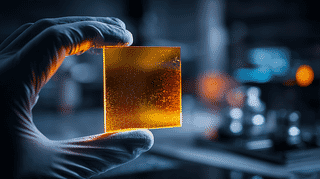
⚗️ There is a material at the Institute of Science Tokyo that releases its electrons more easily than cesium, the most generous electron donor among all metals. A surface that reactive should be destroyed by open air within moments. This one is not, and the reason is almost too neat: the nitrogen molecule it exists to attack lands on the surface first and seals it shut. Feed the sealed surface hydrogen, and the lid walks away as ammonia.
That trick, reported by a team led by Hideo Hosono and Masaaki Kitano, produced ammonia at 300°C and 9 atmospheres of pressure. The industrial process it hopes to undercut has been running at 400–500°C and 100–300 atmospheres for a little over a century.
The reaction that feeds half the world
Ammonia is not a glamorous molecule. It is the base of nitrogen fertilizer, and roughly 80% of the 170 million tonnes made each year ends up in a field somewhere. By common estimate, about half the nitrogen in your body was fixed in a chemical plant rather than by anything alive.
The plant runs the Haber-Bosch process, patented in the years before the First World War. It takes nitrogen from the air, hydrogen from natural gas, and forces them together over an iron catalyst under brutal heat and pressure. Nitrogen is stubborn: the triple bond holding N₂ together is one of the strongest in chemistry, and cracking it is what all the heat is for.
The bill is enormous. Ammonia production consumes 1–2% of global energy and 3–5% of the world's natural gas, and depending on which accounting you accept, it releases somewhere between 1% and 3% of humanity's carbon dioxide. Most of that CO₂ does not come from the ammonia reaction itself. It comes from stripping hydrogen out of methane to feed it.
Swap that hydrogen for hydrogen split from water using wind or solar, and the carbon disappears. This is "green ammonia," and it is the whole point of the field. But renewable electricity arrives in fits and starts, from wherever the wind happens to be blowing, and a Haber-Bosch plant is a cathedral of steel that wants to run flat out, forever, at enormous scale. The two do not fit together. You need a catalyst that works gently enough for a small plant to be worth building.
A crystal with a skin of loose electrons
Hideo Hosono's group has been circling this problem for over twenty years. In 2003, writing in Science, they reported the first stable electride: a material in which electrons themselves occupy the sites where negative ions normally sit. No atomic nucleus, no orbital home. Just electrons, loose in the lattice, waiting to be given away.
That property is measured by the work function: the energy needed to pull an electron out of a material. The lower it is, the more freely the material donates. Ammonia catalysts love electron donors, because handing electrons to N₂ is what loosens its triple bond in the first place. In 2012 the same group showed an electride made an unusually good support for a ruthenium ammonia catalyst, and in 2017 a startup, Tsubame BHB, was spun out to sell the idea.
The ideal version of this material has a name: electrene. Think of graphene, but instead of a single sheet of carbon, the outermost layer is a sheet of electrons. Catalysis happens on surfaces, so putting the electrons exactly where the reaction is should be as good as it gets. Until now, the only way to make one was to peel a layered electride apart, one flake at a time.
The Tokyo team went at it differently. They started with BaSiN₂, a barium silicon nitride chosen because it is strongly polarized perpendicular to its surface, and heated it in oxygen. Near the surface, some nitrogen ions were swapped out for oxygen, which dumped spare electrons into the top layer. The measured density of those surface electrons, around 5×10¹⁸ per square meter, comes close to the density of the barium atoms themselves.
Then they measured the work function: 1.5 eV. Cesium, the lowest of any metal, sits at 1.9 eV.
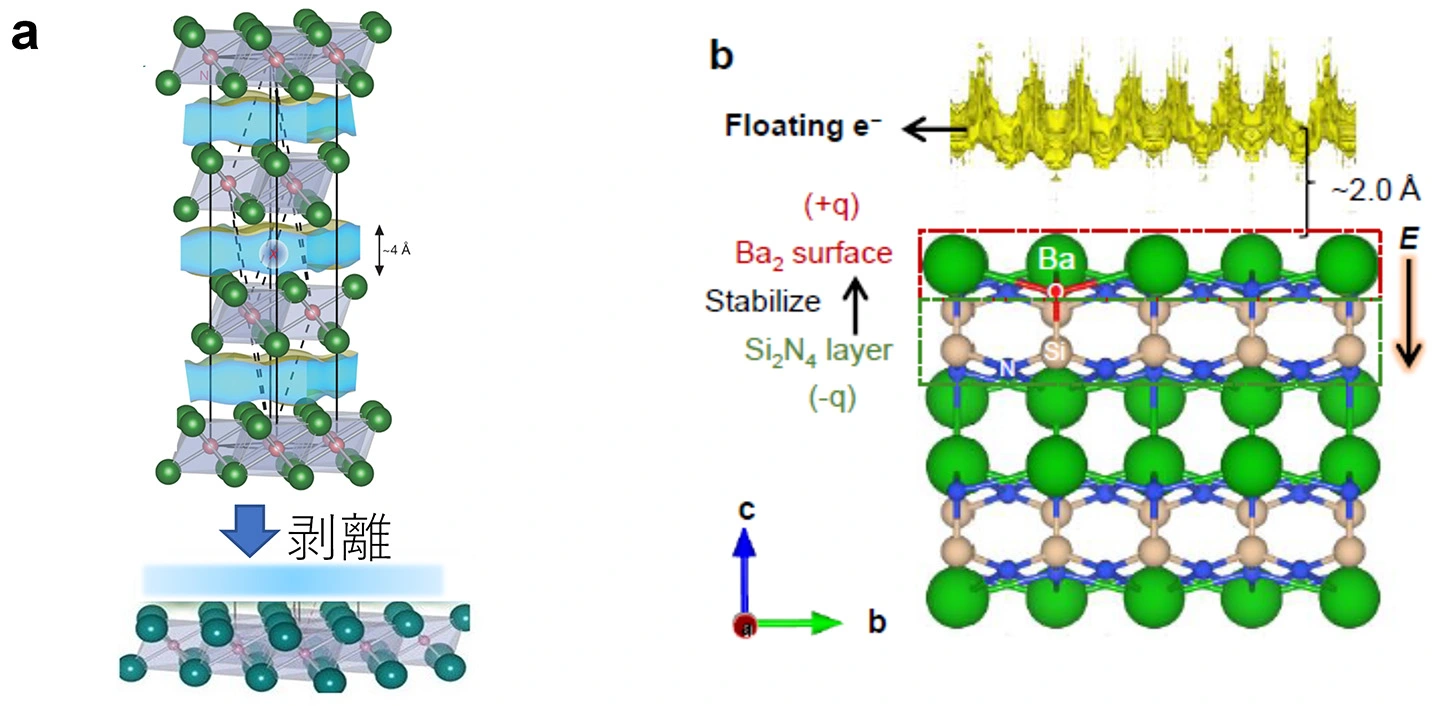
Source: Institute of Science Tokyo press release
Why the best catalysts die in air
Here is the trap that has kept electrenes in the laboratory. A surface covered in loose, weakly bound electrons is, from a chemist's point of view, a surface begging to be oxidized. Oxygen and water vapor take those electrons instantly.
Activity and stability had been a straight trade. You could have a spectacular catalyst that had to live in a glovebox, or a durable one that did not do much. Industrial chemistry, which involves pipes and valves and people, has limited patience for the first option.
The nitrogen brings its own lid
Expose the doped BaSiN₂ to nitrogen gas and the work function climbs steadily, from 1.5 eV to 3.5 eV. The surface electrons have not been destroyed. They have been picked up by N₂ molecules, which stick to the surface as negatively charged nitrogen ions. The reactive skin is now covered by a monolayer of the very molecule it was built to attack, and in that state the material can be handled in ordinary air.
Then comes the part that makes it a catalyst rather than a curiosity. Run hydrogen over the capped surface, and the adsorbed nitrogen reacts and leaves as ammonia. The work function drops back to 1.5 eV. The electrene has regenerated itself. The protective layer and the product are the same thing.
With ruthenium dispersed on top to activate the hydrogen, the full cycle ran at 300°C and 9 atmospheres. The formation rate matched the best figures ever reported for low-temperature ammonia catalysts, including the air-sensitive hydrides and electrides that only work under laboratory conditions. It did so despite a comparatively small surface area, which for a catalyst is like winning a race while carrying weight.
The work was published in Nature Communications on June 23, by Zhujun Zhang, Shiyao Wang, Jiang Li, Masato Sasase, Masaaki Kitano and Hosono. Zhang, the first author, has since moved to Nanjing Tech University in China. The research was funded by Japan's science agency and by joint research with Tsubame BHB, the company that stands to commercialize it.
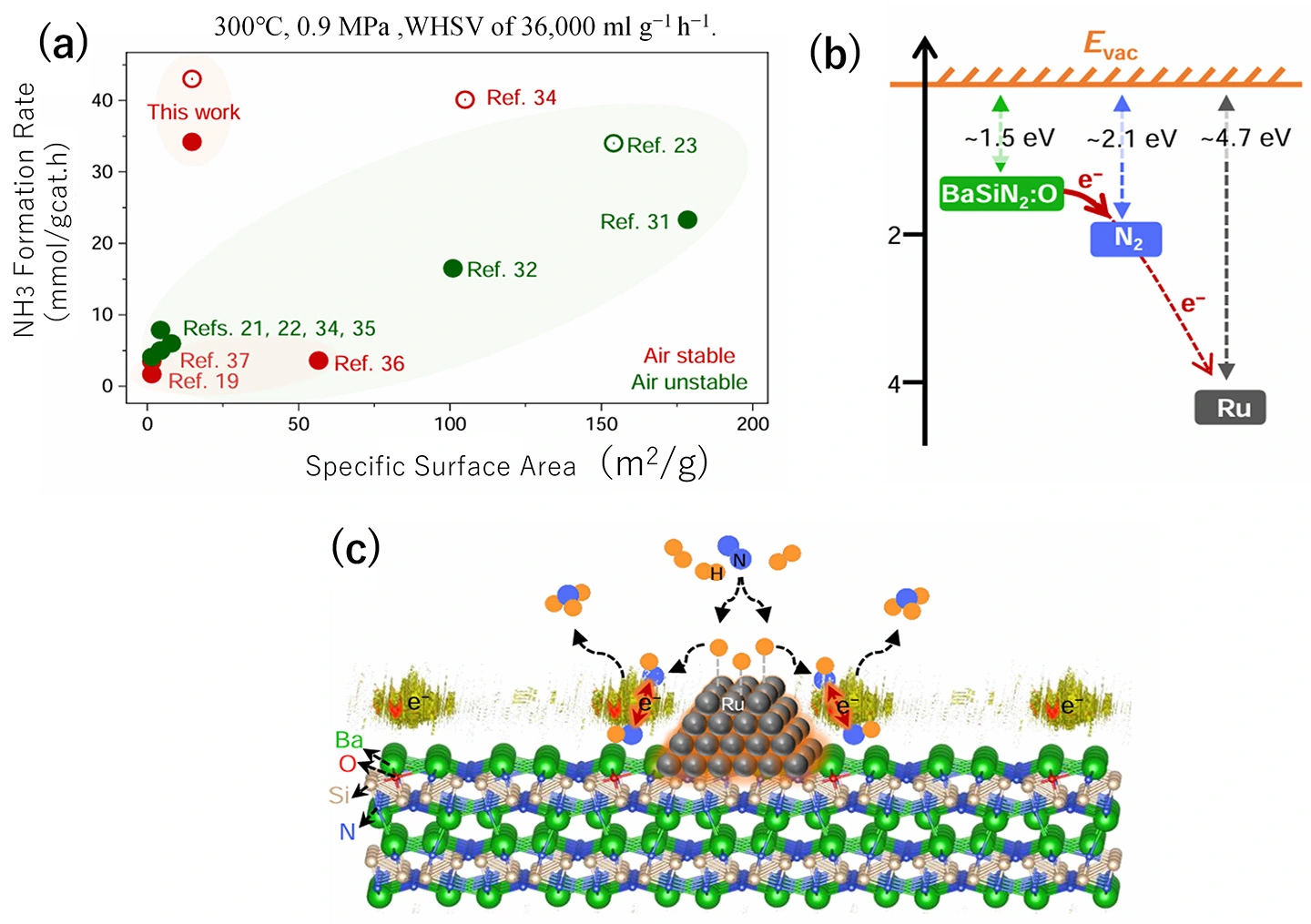
Source: Institute of Science Tokyo press release
There is a cost sitting in that paragraph, and it is spelled ruthenium. The metal has also been running hot: Umicore quoted it near $1,700 a troy ounce in July 2026, over $50,000 per kilogram and more than triple its price at the start of 2024, pushed up by hard-drive demand from data centers. Techno-economic modeling of earlier ruthenium ammonia catalysts found that the metal, and how long it lasts before it degrades, dominates everything else in the economics. A gentler catalyst that needs a platinum-group metal has not escaped the problem. It has moved it.
Three different bets on the same problem
Nobody in this field thinks Haber-Bosch falls over next year. The interesting question is which of several routes gets to a green, small, flexible ammonia plant first, and the world's labs have split into camps.
The most aggressive bet is electrochemical. Skip heat and pressure entirely: put nitrogen and water in a cell, apply a voltage, get ammonia at room temperature. The version that works uses lithium as an intermediary, an idea European groups have ground away at for a decade. In February 2026, a team at Shanghai Jiao Tong University published in Science a redesigned interface layer that pushed this route to 98% Faradaic efficiency at 100 milliamps per square centimeter, which is roughly the current density an industrial cell would need. The catch is in the same abstract: energy efficiency, 21%. Almost every electron goes where you want it. Most of the energy does not.
The second bet is a gentler thermal catalyst, which is where Tokyo sits, and where it has company. The Ammonia Energy Association notes that Ammobia, a US startup backed by Shell, Air Liquide and Chevron among others, is pushing a 300°C, 20-bar process paired with a sorbent that pulls ammonia out as it forms, and was scaling from a bench rig to a 50 kg/day pilot during 2026.
The third bet is that none of this matters as much as the price of clean electricity, and the evidence for that is uncomfortable. Australia's Australian Renewable Energy Hub lost BP as a partner in 2025; the Desert Bloom project was shelved; Whyalla was cancelled after hundreds of millions of Australian dollars went out the door. No catalyst fixes a power purchase agreement.
What is distinctive about the Japanese entry is that it is a bet on materials, made by a group that keeps finding new things to do with electrons that have nowhere to live, a story that started with a cheap, cement-like oxide.
Where a catalyst like this actually wins
Read the techno-economic literature carefully and a specific niche appears. Ruthenium-on-exotic-support catalysts lose to old-fashioned iron whenever electricity is cheap and the plant is gigantic. They win when electricity is expensive and the plant is small.
That is not a consolation prize. That is exactly the shape of renewable ammonia.
Tsubame BHB has been building toward it since 2017. Its pilot plant, hosted inside an Ajinomoto factory in Kawasaki, ran from 2019; the company reported in 2024 that the catalyst had run for four years without measurable performance loss. Its first commercial unit was ordered for a site in Niigata. A second domestic order is for a plant making 500 tonnes a year, which by the standards of ammonia is almost nothing and is precisely the point. As of the company's 2024 announcements it expected its first overseas unit, in Southeast Asia, to start producing during fiscal 2026, and it has projects in Brazil and Laos aimed at making low-carbon fertilizer next to the farms that use it.
There is a defensive logic here too. Citing trade press, Tsubame BHB notes that Japan's domestic ammonia output has fallen from about 2 million tonnes in 2000 to around 1 million, as producers exited. When Russia, the world's second-largest ammonia producer, became an unreliable supplier, importers everywhere discovered how thin that chain was. Making an unglamorous commodity chemical at home, in small volumes and at higher cost, starts to look like insurance.
None of which a single paper can guarantee. What the Tokyo group has delivered is a design rule: build a surface that gives electrons away, then let the reaction's own feedstock protect it between shifts. Whether that rule survives years inside a reactor, and whether the ruthenium can eventually be swapped for something abundant, will decide whether this ends up in a fertilizer bag or a review article.
Does your country make its own nitrogen fertilizer, or does it arrive by ship?






Global Discussion
0 comments