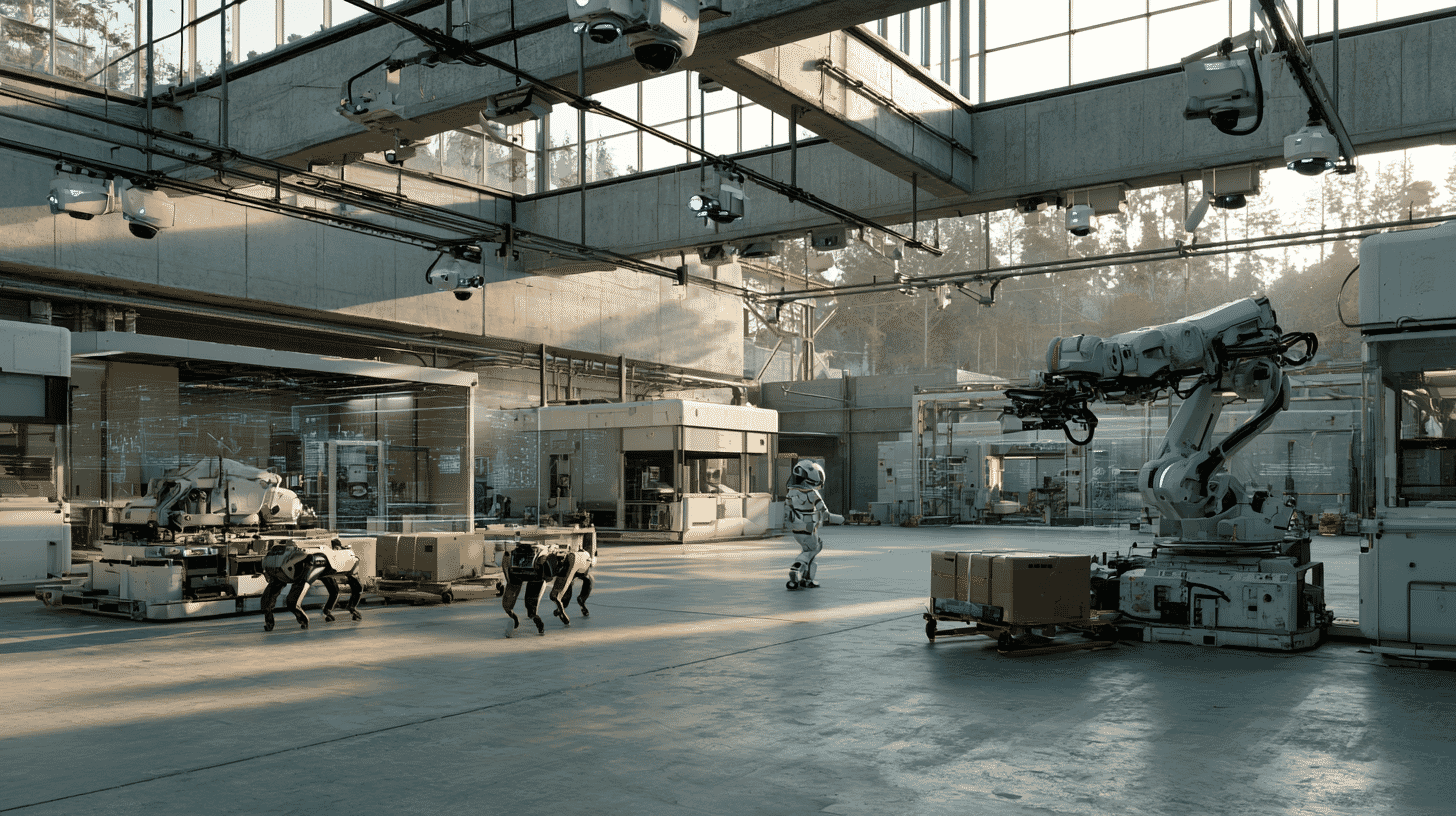
🤖 In the global race for Physical AI, almost every player is trying to build a smarter robot brain. NVIDIA's GR00T, Google DeepMind's Gemini Robotics: different stacks, same instinct. Japan's Fujitsu just walked in with a different answer. Don't make the robot smarter, make the space smarter. On April 23, 2026, at its lab in Kawasaki, Fujitsu unveiled "Kozuchi Physical OS," the culmination, in a sense, of robotics research the company has been quietly doing since 1983.
A different bet: intelligence in the space, not the robot
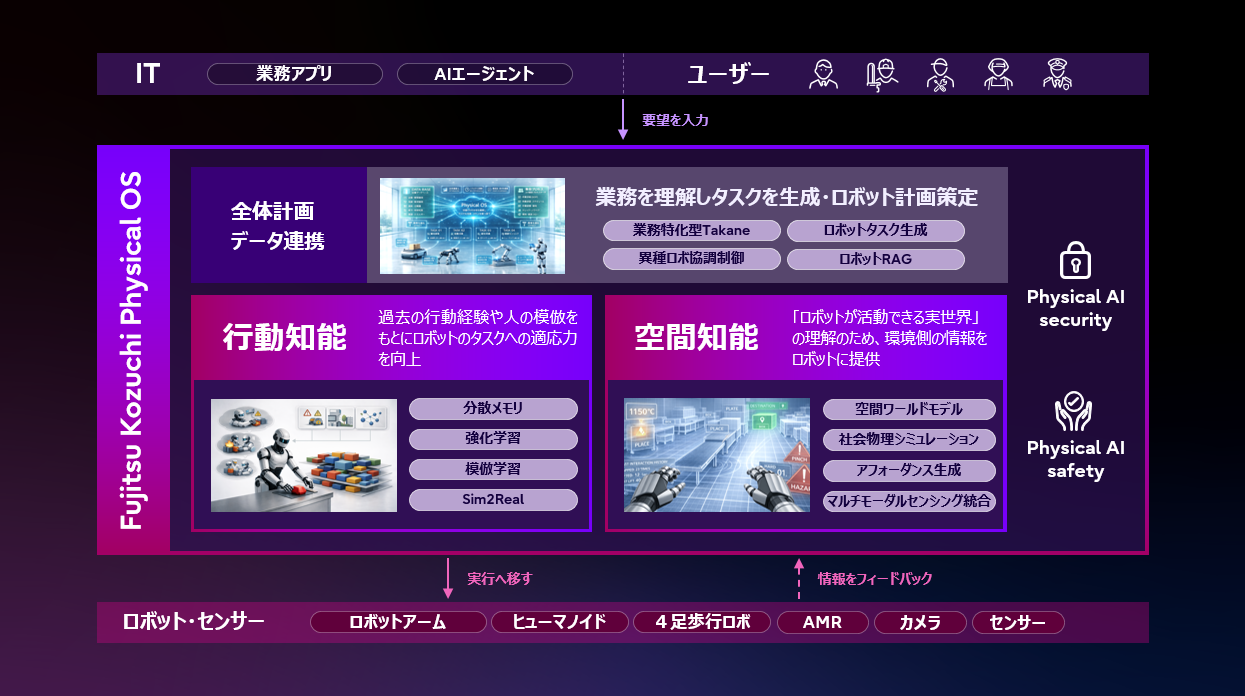
On April 23, 2026, Fujitsu held a press briefing at its Physical AI Research Lab in Kawasaki and laid out its new research strategy. At the center sits a software platform called Fujitsu Kozuchi Physical OS.
Genta Suzuki, who heads Fujitsu Research's Physical AI Lab, framed the company's positioning in unusually candid terms. The race to build the operating layer for individual robots is brutal, he said. So Fujitsu is going somewhere else, into the intelligence of the space itself. "We want to differentiate with an approach that makes the space smart."
That sentence is the whole strategy in miniature.
The current frontier of Physical AI development is dominated by a single question: how smart can you make the AI riding inside the robot? NVIDIA's Isaac GR00T and Google DeepMind's Gemini Robotics, strip away the marketing and they are, at heart, attempts to give the robot a more capable brain. Fujitsu is choosing not to fight that battle head-on. Instead, it's making the environment around the robot, the cameras on the ceiling, the sensors on the wall, the other robots in the room, the place where intelligence lives.
What Kozuchi Physical OS actually is
The name Kozuchi comes from a Japanese folk-tale object: a magical mallet that, when shaken, produces whatever you wish for. Fujitsu has already used the Kozuchi brand for its enterprise AI services. This new offering is the Kozuchi family's first move into the physical world.
The platform stands on two pillars.
Brain intelligence ("行動知能", literally "behavioral intelligence") gives a robot the ability to adapt to tasks based on prior experience and imitation of human work. This is roughly the same problem NVIDIA's GR00T and Google's Gemini Robotics are solving with vision-language-action (VLA) models.
Spatial intelligence is the part that's actually distinctive. Cameras and sensors placed in the environment, and even cameras on other robots, feed data back to the platform. Information the robot itself cannot see (behind its back, around a corner, on the other side of a shelf) gets filled in from the outside. The platform fuses all of it into a single situational picture.
The architecture splits work between two layers. Robots run autonomously on the edge, making their own local decisions. A separate sovereign cloud, a cloud environment designed to comply with each country's data-sovereignty and regulatory requirements, handles space-wide coordination using all that environmental data.
A demo on stage made the abstraction concrete. In the spatial world model demo, two quadruped robots roamed a room while a combined view from fixed cameras and onboard cameras tracked them in real time, flagging anomalies and intrusions instantly. In a separate sim-to-real demo, a quadruped robot trained in simulation to balance a load on its back walked nearly as fast as an unloaded one without dropping the cargo, a small but telling display of how training data crosses from the virtual world into physical hardware.
How this differs from NVIDIA and Google DeepMind
Lay Fujitsu's approach next to the two foreign giants and the contrast sharpens.
NVIDIA's Cosmos and GR00T are the closest thing the industry has to a de-facto stack. Cosmos provides world foundation models for synthetic data and simulation; GR00T N1.6, an open reasoning vision-language-action model, gives humanoids full-body control with reasoning support. NVIDIA's robotics ecosystem now stretches across industrial giants like ABB, FANUC, KUKA and Yaskawa, surgical robot makers like CMR Surgical and Medtronic, and humanoid pioneers like Figure, Agility, and Boston Dynamics. NVIDIA has also released OSMO, an edge-to-cloud compute framework for robot training workflows, meaning the edge-plus-cloud architecture Fujitsu emphasizes is not, by itself, unique territory.
Google DeepMind's Gemini Robotics descends from the company's foundation models. It is built on Gemini 2.0 and brings Gemini's multimodal reasoning into the physical world, including dexterous tasks like folding origami, packing lunch boxes, and preparing salads. Apptronik's humanoid Apollo is one of the showcase platforms. The lineage traces back to RT-2, the 2023 model that established the VLA paradigm by treating robot actions as language tokens.
Both companies share one core idea: make the robot itself smarter. Train enormous models on web-scale text, vision, and robot demonstration data, then put that brain inside the machine. It's the LLM playbook, ported to the physical world.
Fujitsu is making a sideways move. Rather than betting everything on a single ultra-capable robot brain, it's positioning Kozuchi Physical OS as the orchestration layer above the robots, the layer that integrates heterogeneous robots (arms, humanoids, autonomous mobile robots) with fixed sensors and ties them together into a coherent space.
A cleaner way to put it: NVIDIA and Google are building the inside of the robot. Fujitsu wants to build the outside, the OS that runs the space the robots inhabit. The two layers are not strictly in competition. It's entirely plausible that NVIDIA's foundation models will run on robots that are themselves orchestrated by Fujitsu's OS. Whether that's the actual play, or whether Fujitsu eventually builds its own VLA model to stack underneath, is one of the open questions.
Why Carnegie Mellon
On the same day as the OS announcement, Fujitsu unveiled a second major move: the Fujitsu–Carnegie Mellon Physical AI Research Center, a joint research center with the U.S. university long considered the world's top robotics program.
Thirteen CMU professors spanning robotics, machine learning, language technologies, human-computer interaction, electrical and computer engineering, and philosophy are participating. Research will take place at CMU's Robotics Innovation Center, which opened in February 2026 in the Hazelwood Green district of Pittsburgh, a roughly 14,000-square-meter facility designed to bridge fundamental research and commercial deployment.
The center's outputs feed directly into Kozuchi Physical OS starting in fiscal year 2026. Vivek Mahajan, Fujitsu's CTO and Senior Executive Vice President, framed the partnership as a way to fuse AI, computing, networks and robotics, and to accelerate the social deployment of "trustworthy Physical AI."
The philosophy angle is worth pausing on. Two of the participating CMU professors specialize in philosophy, Peter Spirtes (department head) and Kun Zhang. Their inclusion signals that Fujitsu is treating the social-acceptance and ethics dimension of Physical AI as a first-class research question, not an afterthought. Given Japan's exposure to humanoid deployment in elder care and hospitals, that may turn out to be a strategically smart bet.
Source: Fujitsu press release
The roadmap: v1 in 2026, self-evolving robots by 2028
Suzuki spelled out a release schedule that, by Japanese-corporate standards, is unusually specific:
- FY2026 (v1): Robot control at the spatial unit, the platform's foundation, due before the end of fiscal year 2026 (March 2027)
- FY2027 (v2): Easy expansion of robot skills
- FY2028 (v3): Self-evolving robot coordination spaces
- FY2029–2030 (v4): Humans and robots cooperating in the same space; knowledge accumulated in one site can be applied to another
The v4 vision, moving learned behavior from one factory to another, is essentially Fujitsu's bet on solving Japan's labor-shortage and knowledge-transfer problems by treating workplace know-how as software that can be redeployed.
Fitting into Japan's national Physical AI strategy
Fujitsu's announcement doesn't exist in isolation. The Japanese government has identified Physical AI as a strategic sector and published a public-private investment roadmap targeting a 20-trillion-yen domestic market and a 30%-plus global share by 2040, with semiconductors targeted to reach 40 trillion yen in domestic revenue the same year.
The numbers in dollars: with the yen near 159 to the dollar as of May 2026, the 20-trillion-yen target translates to roughly $126 billion, out of an estimated total global AI robotics market of around 60 trillion yen, about $377 billion, by 2040.
Japan's fiscal 2026 initial budget allocated 1.239 trillion yen (about $7.8 billion) to AI and semiconductors, 3.7 times the previous year's figure, of which 387.3 billion yen ($2.4 billion) went specifically to Physical AI and foundation-model development.
Here's the structural problem Japan is trying to solve. By the government roadmap's own accounting, Japanese makers hold roughly 70% of the global industrial robot market, worth about 0.8 trillion yen, and dominate precision reducers through Nabtesco and Harmonic Drive Systems. In service robotics, a market of about 2.8 trillion yen, their share is barely 10%. The hardware position is exceptional; the newer categories are not. The risk is that if foreign companies own the foundation-model and simulation layer, most of the new value created by Physical AI flows abroad and Japanese makers end up as commodity hardware suppliers.
Fujitsu's deliberate use of the word "OS" is a positioning move against that scenario. If Kozuchi Physical OS becomes the orchestration layer that runs Yaskawa, FANUC, and other Japanese robots in real factories, Japan keeps a piece of the high-margin software stack, not just the metal.
What to watch
A few honest tensions in the strategy.
Can the "OS" label survive contact with reality? Windows became a common substrate because third parties found it cheap to build on. For Kozuchi Physical OS to become the orchestration layer for heterogeneous robots, Fujitsu will need an ecosystem of robot makers, integrators, and tool developers willing to commit. The company can't pull this off alone, and the partner list, beyond CMU on the research side, is still thin.
The competition isn't waiting. NVIDIA used GTC 2026 to preview Cosmos 3, the first world foundation model the company describes as unifying synthetic world generation, physical AI reasoning, and action simulation, and to announce GR00T N1.7 as commercially viable for real-world deployment. Google DeepMind keeps shipping Gemini Robotics updates. Fujitsu's v1 lands sometime before March 2027, and the foreign incumbents will be on their next major release by then.
Social acceptance is a real variable. Physical AI lives in the same physical space as humans. Liability for failures, surveillance concerns, employment effects, none of these are software-only problems anymore. CMU's philosophy faculty are on the team for a reason.
International expansion will test the "sovereign" framing. Europe and parts of Southeast Asia, both wary of dependence on U.S. cloud incumbents, are natural candidates for a Japanese sovereign-cloud-plus-OS stack. Whether Fujitsu can translate the "Made in Japan AI server" narrative it has been building separately into the Physical AI conversation is one of the more interesting unknowns.
A smarter robot, or a smarter space? Fujitsu picked the second answer. Japanese manufacturing has spent decades winning through genba-ryoku, the "power of the shop floor," the collective intelligence of a workplace and its people. Treating the physical space itself as the unit of intelligence is, in a way, a translation of that idea into the AI era. How is your country thinking about the next generation of human-robot workplaces, through the robot, or through the room?
Update: developments since June 2026
On June 24, the government formally designated Physical AI as one of the flagship product-and-technology areas within its 17 priority investment sectors, with a projected 10.5 trillion yen of combined public and private investment through fiscal 2040 and 1.5 trillion yen of budget measures by fiscal 2030. Counting related semiconductors and vertical AI, the projected figure rises to 101.6 trillion yen.
Competitors moved too. NVIDIA announced Cosmos 3, its next Physical AI foundation model, at GTC Taipei on June 1. Fujitsu's v1 is due within fiscal 2026, meaning by March 2027; that gap is the distance between them.
References
- https://global.fujitsu/en-global/pr/news/2026/04/23-01
- https://eetimes.itmedia.co.jp/ee/articles/2605/20/news058.html
- https://www.nikkei.com/article/DGXZQOUC236YY0T20C26A4000000/
- https://nvidianews.nvidia.com/news/nvidia-releases-new-physical-ai-models-as-global-partners-unveil-next-generation-robots
- https://nvidianews.nvidia.com/news/nvidia-expands-open-model-families-to-power-the-next-wave-of-agentic-physical-and-healthcare-ai
- https://deepmind.google/models/gemini-robotics/
- https://www.nikkei.com/article/DGXZQOUA1823M0Y6A310C2000000/









Global Discussion
5 comments