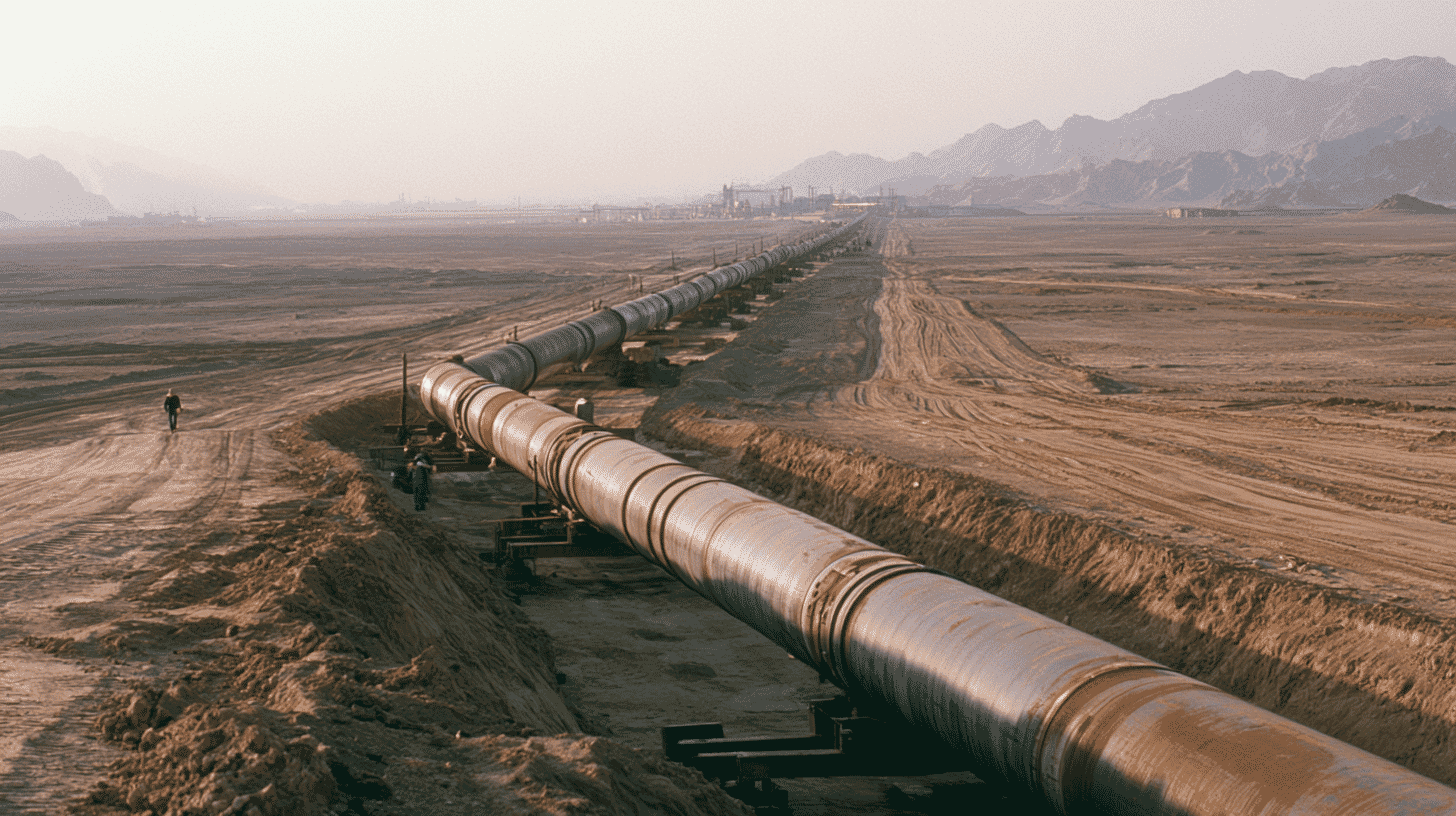
⛽ Six months ago the Strait of Hormuz went quiet, and it has never fully come back. What has changed is everything around it. Gulf producers are digging trenches for seven new pipelines, Iraq is trying to reach the Mediterranean, and a Dubai port operator is scouting a coastline outside the chokepoint. Japan, which used to move more than nine of every ten barrels it burns through that strait, is unusually exposed to whether it works.
Where the strait stands after six months
The crisis dates from February 28, 2026, when US and Israeli strikes on Iran killed Supreme Leader Ali Khamenei. Iran's Revolutionary Guard warned shipping away, and traffic collapsed within days.
The International Energy Agency puts 2025 traffic at roughly 20 million barrels a day of crude and refined products, about a quarter of the world's seaborne oil trade. The US Energy Information Administration's August 11 outlook put transits at 4.9 million barrels a day in the second quarter of 2026, against 21.6 million in the last quarter of 2025 before the conflict. That is a fall of nearly 80 percent. Vortexa put the seven-day figure at 6 to 7 million barrels a day on August 23. On one day in late August, Reuters counted two commodity vessels through the strait against a ten-day average of 14. Before the war, more than 130 crossed daily.
A memorandum signed in June by Presidents Trump and Pezeshkian was supposed to fix this. It didn't. Kpler's accounting of the 60-day window found about 374 million barrels cleared the Gulf, roughly 6.1 million a day against 2.3 million during the blockade, but the strait never reopened properly and attacks resumed in July. Iran and Oman outlined a phased shipping corridor on August 26, including joint mine clearing. Tehran was quick to add that it does not mean an immediate reopening.
Brent crossed $100 in early March for the first time in four years, then eased, closing at $89.31 on August 28, still about a quarter above pre-war levels. Goldman Sachs estimates Gulf exports have recovered to 15 to 16 million barrels a day, against 22 to 24 million before the conflict and a March floor of 5 to 6 million. That figure counts total exports, bypass loadings included, not transits through the strait; it does not mean the strait has reopened. The EIA's August outlook forecasts Brent averaging $85 a barrel in the third quarter and $87 across 2026, and does not expect regional production and trade patterns to return to pre-conflict form until early 2027.
How many bypass routes exist, and how much can they carry
Two pipelines did the heavy lifting. Saudi Arabia's East-West line, Petroline, runs about 1,200 kilometres from the Abqaiq fields to Yanbu on the Red Sea. Riyadh converted a parallel gas line to crude service in March, taking capacity to 7 million barrels a day. About 2 million of that feeds refineries on the kingdom's west coast, leaving roughly 5 million for export, and Yanbu is now loading close to that ceiling. The UAE's ADCOP line covers 360 kilometres from Habshan to Fujairah on the Gulf of Oman and moves 1.5 to 1.8 million barrels a day, though loadings there have been interrupted by drone attacks. The IEA's estimate of combined spare bypass capacity, 3.5 to 5.5 million barrels a day, was always about a quarter of what Hormuz carried. That spare capacity is now spoken for.
EIA figures show transits through Bab el-Mandeb on the Red Sea side rising from 5.4 million barrels a day in the last quarter of 2025 to 8.1 million in the second quarter of 2026. The agency attributes the increase to Saudi Arabia rerouting crude through the East-West pipeline to Yanbu.
So the region started building. Goldman Sachs counted seven pipeline and export-infrastructure projects in a July note, some under construction, some merely plausible. The bank's base case adds 3.8 million barrels a day of bypass capacity by the end of 2027 and 7.3 million cumulatively by the end of 2028, lifting total bypass capacity above 14 million barrels a day. That is more than 60 percent of the seven Gulf producers' 23 million barrels of pre-war exports; an accelerated case reaches 75 percent. Median construction time in the region, Goldman notes, runs about two and a half years. Two projects are already in the ground: a new West-East line in the UAE, roughly half complete and due in 2027, and Iraq's Basra-Haditha pipeline. Iraq is also pursuing a Mediterranean outlet from Basra to Ceyhan in Turkey, with a branch to Baniyas in Syria, in which American companies are involved.
US Treasury Secretary Scott Bessent told NPR in August that within two years the strait would become irrelevant, "just another body of water."
Energy analysts on the same programme were less enthusiastic. David Goldwyn, a former State Department energy envoy, said the export constraints will be a semi-permanent feature for the next several years and prices will stay higher. Robert McNally, an energy adviser in the George W. Bush administration, made the blunter point: the pipelines will not be finished in time to help, and even if they were, Iran can hit a pipeline as easily as a tanker. The IEA's own view is that with everything built, Hormuz would still be needed for roughly half of pre-war export volumes.
There is also cargo that pipelines cannot touch. Liquefied natural gas has to be shipped. By CSIS's account, around 93 percent of Qatar's LNG normally goes through Hormuz. A missile strike on the Ras Laffan complex in March removed about 17 percent of Qatar's annual export capacity, with repairs estimated to take as long as five years.
The invisible cost is insurance
Before the war, war-risk cover for a Hormuz transit ran about 0.25 percent of a ship's hull value. By July, The National reported quotes of 3 to 10 percent, and Marsh's global head of marine told S&P Global's Platts that additional war-risk premiums had jumped to between 7.5 and 10 percent. For a $100 million tanker that is a bill of $3 million to $10 million per voyage, against roughly $250,000 before.
A route can exist and go unused, because the shipowner, the crew and the underwriter all have to agree it is worth it. Around 6,000 seafarers were still stuck in the region in July, and IMO Secretary-General Arsenio Dominguez has called the sustained cost of marine insurance there a matter of great concern. Bypassing Hormuz does not escape the problem: Yanbu cargoes leave through the Red Sea and Bab el-Mandeb, where Yemen's Houthis declared an embargo on vessels serving Saudi ports in late July.
Four different rewrites: the US, EU, China and India
The United States had the easiest job. It is a net energy exporter, and it filled the gap with strategic reserve releases and commercial stock draws rather than new production. Nomura's economists flag the catch: if the strait normalises and the reserve draw stops, sustaining American barrels into Asia will require actual output growth.
Europe lost its Qatari LNG, which was 6 percent of first-quarter imports and far more for some members. Italy took 33 percent of its 2025 LNG from Qatar, Poland 25 percent and Belgium 16 percent. The US share of European LNG went from 28 percent in 2021 to 58 percent in 2025, and 63 percent in the first quarter of 2026. With an EU ban on Russian gas due before the end of 2027, Chatham House argues that dependence now looks structural rather than temporary. European gas at the Dutch TTF hub traded around €66.6 per megawatt-hour in late August, climbing for a third straight week on worries about winter storage.
China went to Russia and had the buying power to win. Kpler put China's seaborne Russian crude imports at about 1.25 million barrels a day in August, with a rising share loaded from European ports.
India went to Russia too, and got squeezed. Its Russian imports hit 2.6 million barrels a day in June, a record in Kpler's data, more than half of roughly 5 million barrels of total crude imports, up from about 1.1 million in February. It topped up with Venezuelan heavy grades. But as Chinese buying rose, trade publications report that Indian refiners found Russian cargoes harder to secure, and India's strategic reserve covers only about 9.5 days of net imports.
Japan had no pipeline option and no discounted seller courting it. It bought what was left and paid the freight.
Japan's procurement: from 25 percent in April to 100 percent
Japan's industry ministry publishes the numbers monthly. In 2025 the country imported about 2.36 million barrels a day of crude, 94 percent of it from the Middle East and 93 percent through Hormuz, with the UAE at 43.3 percent and Saudi Arabia at 39.4 percent.
Procurement from routes that avoid the strait ran at about 25 percent of that baseline in April, 62 percent in May, 82 percent in June, and roughly 100 percent in both July and August. American crude is now arriving at about ten times the pre-crisis monthly average. Cargoes have also come from Mexico, Canada, Ecuador, Azerbaijan, South Sudan, Australia, Brunei, Malaysia and Russia's Sakhalin project.
The bridge across the gap was stockpile. Japan pushed for an IEA coordinated release of 400 million barrels, the largest in the agency's history, and drew on its own reserves twice, from late March and again from May 1. It has not needed a third release, and roughly 200 days of cover remain. A per-litre subsidy has held pump prices near ¥170 (about $1.06) since late March, down from a record ¥190.8 on March 16. It is funded from the national budget and is labelled an emergency stopgap, not a standing programme. METI's own estimate is that even if procurement from September onward falls to 75 percent of the pre-crisis monthly average, reserves can cover the gap through the end of March 2028.
Middle Eastern crude arriving in Japan fell 32.8 percent from a year earlier in July. Total crude imports rose 5.5 percent. The volume came back; where it comes from did not.
The circuit that links oil to the yen
Finance ministry data put July's trade deficit at ¥634.5 billion, about $4.0 billion at ¥160 to the dollar, the third monthly shortfall in a row. Crude import value jumped 87.8 percent to ¥1.41 trillion, roughly $8.8 billion, on a yen-denominated unit price of about ¥116,000 per kilolitre, up 78 percent. Exports and imports both set single-month records.
The recovery made this worse in the short run. While cargoes were blocked Japan could not buy much, so the deficit stayed contained even as prices rose. Now that volumes are back, the bill has landed. A wider deficit means more importers selling yen to pay in dollars, which weakens the yen, which raises the yen price of the next cargo.
On July 31, Japanese and US authorities intervened jointly to buy yen: the first coordinated intervention since 2011, and the first on the yen-buying side since 1998. Finance Minister Satsuki Katayama confirmed it three days later. The effect faded. The yen closed at ¥159.90 to ¥160.00 in New York on August 28, a one-month low, after Federal Reserve Chair Warsh signalled concern about sticky inflation.
What changed, and what didn't
The map changed. Seven pipeline projects, new port plans, a Japanese import list running to more than a dozen countries instead of four.
The arithmetic didn't. Even Goldman's 2028 case leaves 40 percent of Gulf exports tied to the strait, and the IEA puts the residual nearer half. Pipelines can be attacked. Insurance had not repriced downward as of July. LNG cannot be piped anywhere.
Prime Minister Sanae Takaichi asked her industry minister, Ryosei Akazawa, on June 26 to produce a package for restructuring Japan's energy supply and demand by the end of August. It is reported to rest on three pillars: diversifying crude sources, using nuclear power, and expanding domestic renewables. The deadline falls at the end of August; as of August 30, 2026 the contents had not been made public. Japan has known since 1973 that it depends on a single strait, and over those five decades the dependence rose rather than fell. Whether six months of buying from fifteen countries changes that, or whether the long-term Gulf contracts return the moment the strait does, is still open.
If your country's main energy route closed tomorrow, how long could it hold out, and who would it call first?
References
- https://www.meti.go.jp/shingikai/sankoshin/sokai/pdf/035_02_00.pdf
- https://ene-fro.com/article/ef508_a1/
- https://www.npr.org/2026/08/23/nx-s1-5942201/gulf-countries-race-to-build-new-oil-pipelines-as-alternatives-to-the-strait-of-hormuz
- https://www.cnbc.com/2026/07/16/oil-pipeline-iran-strait-hormuz-red-sea-iraq-uae-saudi.html
- https://www.iea.org/about/oil-security-and-emergency-response/strait-of-hormuz
- https://www.eia.gov/outlooks/steo/report/global_oil.php
- https://www.iea.org/news/iea-member-countries-to-carry-out-largest-ever-oil-stock-release-amid-market-disruptions-from-middle-east-conflict
- https://www.thenationalnews.com/business/2026/07/17/war-risk-shipping-premium-surges-again-as-tensions-escalate-at-strait-of-hormuz/
- https://www.kpler.com/blog/60-days-of-a-broken-us-iran-mou-the-market-stopped-waiting-for-hormuz
- https://www.marinelink.com/news/strait-hormuz-commodity-vessel-transits-542400
- https://ieefa.org/european-lng-tracker
- https://www.chathamhouse.org/2026/06/even-hormuz-reopening-will-not-resolve-europes-key-energy-vulnerability
- https://www.nikkei.com/article/DGXZQOUA188HM0Y6A810C2000000/
- https://news.web.nhk/newsweb/na/nd-20260828de47041
- https://www.csis.org/analysis/beyond-russian-gas-trade-offs-eu-liquefied-natural-gas-diversification
- https://www.spglobal.com/energy/en/news-research/latest-news/shipping/072226-middle-east-shipping-insurance-costs-rise-on-hormuz-risks-marsh
- https://www.nomura.co.jp/wealthstyle/article/0794/
- https://www.hydrocarbonprocessing.com/news/2026/08/china-boosts-imports-of-russian-crude-stymieing-indias-refiners/
- https://oilprice.com/Energy/Crude-Oil/Indias-Russian-Oil-Boom-Outlives-the-Hormuz-Shock.amp.html
- https://tradingeconomics.com/commodity/brent-crude-oil
- https://tradingeconomics.com/commodity/eu-natural-gas
- https://www.nri.com/jp/media/column/kiuchi/20260803_2.html
- https://www.jiji.com/jc/article?k=2026062601202&g=eco









Global Discussion
4 comments