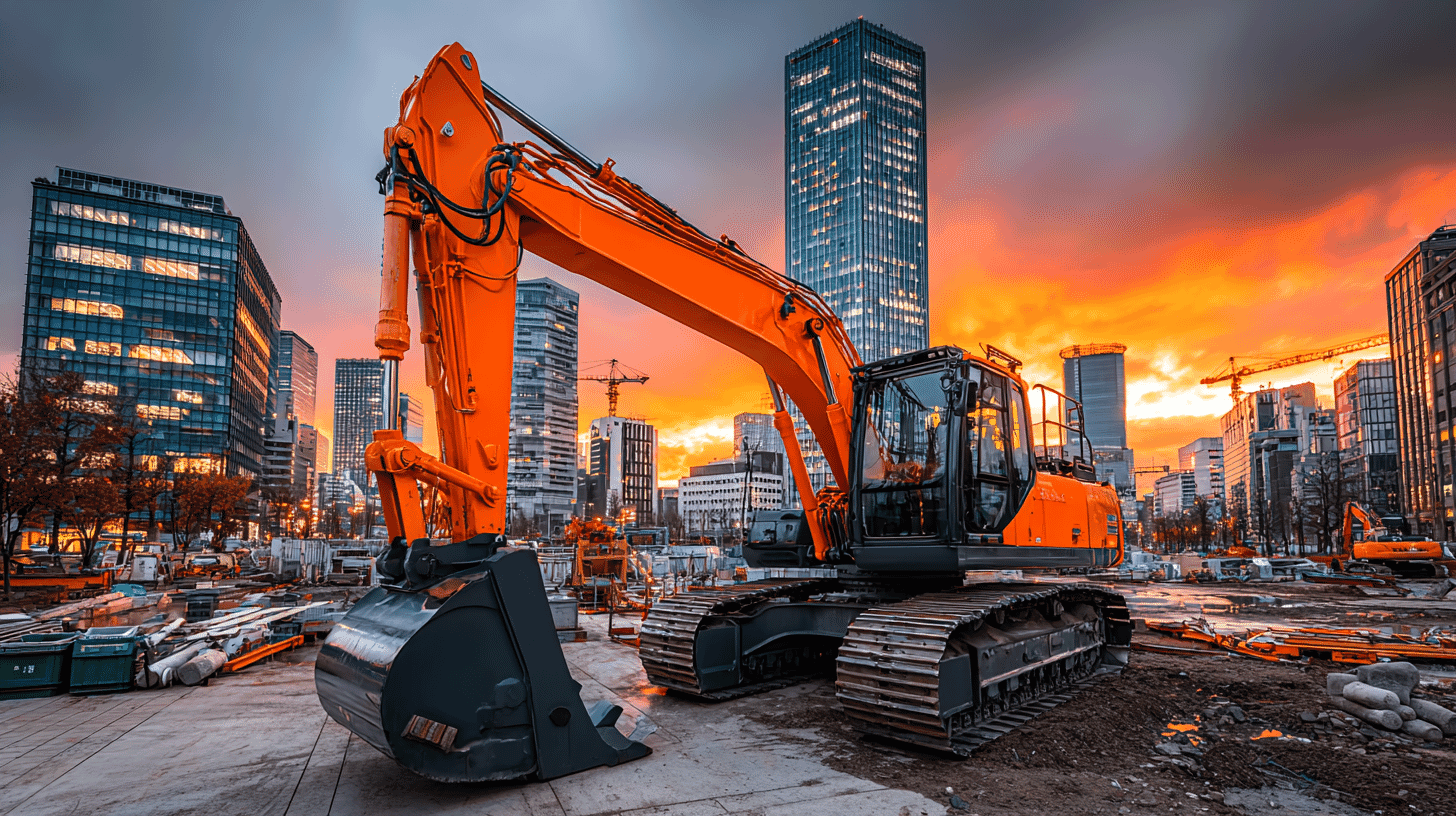
A single company invested in everything from convenience stores to construction equipment, from textiles to energy. Japan's Sogo Shosha, the general trading companies, do exactly that. One of them has now spent $900 million to gain veto power over a major construction machinery maker. Here is the model Warren Buffett put $23.5 billion into.
ITOCHU Raises Stake in Hitachi Construction Machinery to 33.4%
On February 19, 2026, ITOCHU Corporation, one of Japan's Big Five general trading companies, announced it would raise its voting rights in Hitachi Construction Machinery (Hitachi-CM) to 33.4%. The additional investment came to roughly ¥134 billion ($900 million), one of ITOCHU's largest strategic moves in recent years.
The number "33.4%" carries special significance. Under Japanese corporate law, a shareholder holding more than one-third of voting rights can block "special resolutions" at shareholder meetings, decisions covering mergers, charter amendments, and other fundamental corporate changes. In practical terms, ITOCHU has secured veto power over Hitachi-CM's most consequential decisions.
Background: Hitachi-CM's Journey to Independence
Hitachi Construction Machinery was once a subsidiary of Hitachi, Ltd., Japan's industrial conglomerate known for everything from nuclear power plants to elevators. In recent years, Hitachi has been aggressively divesting non-core businesses to focus on IT and digital solutions.
In August 2022, Hitachi sold a 26% stake in Hitachi-CM (worth roughly $1.2 billion) to HCJI Holdings, a special purpose vehicle jointly established by ITOCHU and Japan Industrial Partners (JIP), a Japanese private equity fund. Hitachi continued to reduce its holdings, selling an additional 7% to institutional investors in November 2025, bringing its stake down to approximately 18%.
In the current transaction, the JIP side exits HCJI Holdings and HCJI buys back that stake as treasury stock, leaving ITOCHU in sole control of the vehicle. Counting direct and indirect holdings, ITOCHU's voting rights reach 33.4%, making it Hitachi-CM's dominant shareholder in practice.
"LANDCROS": A New Brand for Global Ambitions
Hitachi-CM will rename itself LANDCROS Corporation on April 1, 2027, shedding the Hitachi name it has carried throughout its history. The board approved the change on October 28, 2025, and it becomes final once shareholders approve the charter amendment at the June 2026 annual meeting.
Industry observers see ITOCHU's hand in the transformation. Unlike passive financial investors, Japanese trading companies embed themselves in the businesses they back, building sales networks, arranging financing, optimizing logistics and reworking governance. The rebrand is the clearest sign that Hitachi-CM is now setting its own course.
The "Overpaying" Debate
Not everyone is applauding the deal. When Hitachi sold shares to institutional investors in November 2025, Hitachi-CM's stock was trading around ¥4,500. Today, it hovers near ¥6,500. Critics ask: why didn't ITOCHU buy at the lower price?
The numbers also raise eyebrows. Hitachi-CM trades at a P/E ratio of roughly 18x, which is actually higher than ITOCHU's own P/E of about 17x. The estimated annual equity earnings from the investment are around ¥10 billion ($67 million), and on pure financial-return grounds, some analysts consider the price steep.
ITOCHU has pushed back sharply against the "overpaying" narrative. The company emphasizes that the acquisition was a voluntary strategic decision, not an obligation under its agreement with JIP. Securities analysts supporting ITOCHU's position argue that the real objective was never short-term returns, but rather securing the governance leverage needed to drive long-term transformation. ITOCHU operates under four strict investment disciplines, born from costly missteps during past resource ventures, including never overpaying and never investing in unfamiliar sectors.
The Global Construction Equipment Landscape
The construction equipment industry is a global oligopoly. According to the "Yellow Table 2025" published by the UK's KHL Group, the competitive landscape looks like this:
- #1 Caterpillar (USA), $37.8 billion in revenue, ~15.9% global share
- #2 Komatsu (Japan), $26.6 billion, ~11.2% share
- #3 John Deere (USA), $13.0 billion
- #4 XCMG (China), Rapidly growing
- #7 Hitachi-CM (Japan), ~$9.1 billion in revenue
The top 10 companies account for roughly 61% of the entire market. While Chinese manufacturers have been gaining ground rapidly, they have not yet cracked the high-end mining equipment segment, where advanced technology creates significant barriers to entry.
Hitachi-CM's competitive strengths include its hydraulic excavators and ultra-large mining machinery. Its "ConSite" service, which uses IoT technology to remotely monitor equipment 24/7 and predict mechanical failures before they happen, exemplifies the company's pivot toward being a "solutions provider" rather than simply a hardware manufacturer.
Hitachi-CM's mid-term plan, "BUILDING THE FUTURE 2025," rests on four pillars: innovative solutions, a broader value chain, expansion in the Americas, and organizational strength. ITOCHU's involvement bears directly on the third. Sales financing through their joint venture Zaxis Finance, logistics support and dealership expansion are how the gap with Caterpillar and Komatsu is meant to close.
What Is a "Sogo Shosha"?
Why is a trading company investing in, and steering, a construction equipment manufacturer? That is the part hardest to read from outside Japan.
Japan's Sogo Shosha (総合商社, literally "general trading companies") are a corporate form with few parallels elsewhere. The Big Five, Mitsubishi Corporation, Mitsui & Co., ITOCHU, Sumitomo Corporation, and Marubeni, operate across an extraordinarily diverse range of industries: energy, metals, food and agriculture, textiles, machinery, chemicals, real estate, finance, IT, and more.
These companies began as import/export intermediaries over a century ago, but have evolved into something far more complex. Today, they function as strategic investment holding companies that take equity stakes in businesses across entire value chains, embedding their personnel in management, connecting portfolio companies to each other, and leveraging their global intelligence networks to create synergies that no single manufacturer could achieve alone.
Think of them as a hybrid of Berkshire Hathaway, a private equity fund, and an investment bank, but with deep operational involvement in their portfolio companies and a multi-generational time horizon.
ITOCHU, in particular, has built its reputation in "downstream" consumer-facing businesses. It fully acquired FamilyMart (Japan's second-largest convenience store chain) and conducted an aggressive takeover of sports apparel maker DESCENTE. The Hitachi-CM investment marks an ambitious expansion into "heavy industry" territory.
Why Buffett Fell in Love with the Sogo Shosha
Warren Buffett's Berkshire Hathaway began buying shares in all five major Sogo Shosha in the summer of 2019. By the end of 2024, its holdings had grown to $23.5 billion from a cost basis of $13.8 billion, and filings in March 2025 showed stakes ranging from 8.5% to 9.8% across the five.
What attracted the world's greatest investor?
Diversification through a single investment. Each Sogo Shosha is effectively a portfolio spanning dozens of industries and geographic regions. Buffett himself has noted their operations are "somewhat similar to Berkshire itself."
Improving shareholder returns. Japanese corporate governance reforms, including Tokyo Stock Exchange pressure on companies trading below book value, have pushed the Sogo Shosha to increase dividends and share buybacks significantly. Dividend yields now range from 2.9% to 3.1%, a dramatic improvement from historically conservative payout policies.
Deep undervaluation. Despite their transformation, the Sogo Shosha still trade at price-to-book ratios below 1.0, compared to over 2.0 for comparable Western conglomerates. Morningstar analysts have estimated over 20% undervaluation.
Brilliant financing. Buffett financed much of his investment by issuing low-cost yen-denominated bonds (around 1% interest), while collecting roughly 4% in dividends, pocketing the spread while naturally hedging currency risk.
Buffett has said he expects to hold these investments "for 50 years or possibly forever," and has indicated his successor Greg Abel will keep the positions. In a period of tariff uncertainty and geopolitical fragmentation, the globally diversified portfolios of the Sogo Shosha have held up well.
How Trading Companies Are Reshaping Japanese Corporate Governance
ITOCHU's stake increase is more than a financial transaction; it reflects a shift in how Japanese corporations are governed.
Japanese companies traditionally operated inside stable networks of cross-shareholdings, taking strategic direction from parent companies and main banks. Change was slow and management rarely faced external pressure.
That world is rapidly changing. The Tokyo Stock Exchange's 2023 initiative pressuring companies with price-to-book ratios below 1.0 to disclose improvement plans has been a catalyst. Activist investors, both foreign and domestic, are gaining influence. And trading companies, with their combination of capital and operational expertise, have emerged as a new category of "constructive activist."
ITOCHU doesn't just demand higher returns; it provides the tools to achieve them. For Hitachi-CM, this has meant establishing Zaxis Finance in the U.S. for customer leasing, co-developing sales and service operations in Indonesia, and bringing governance frameworks, ESG capabilities, and logistics know-how that a standalone manufacturer would struggle to build on its own.
The securing of 33.4% and veto power takes this "partnership model" to a new level, and is being closely watched across Japanese industry as a template for how trading companies can drive corporate transformation.
Does Your Country Have a Sogo Shosha?
Japan's general trading companies occupy a unique space in global business, part conglomerate, part private equity firm, part investment bank, part logistics company, and part strategic consultant, all rolled into one. South Korea's chaebols (Samsung, Hyundai) and India's diversified conglomerates (Tata, Reliance) share some similarities, but the Sogo Shosha are distinctive in that they generally don't manufacture products themselves. Their value comes from connecting, financing, and optimizing entire industry ecosystems.
When the world's greatest investor says he wants to own them "forever," it raises a fascinating question: Is there anything like a Sogo Shosha in your country? And if not, could there be? We'd love to hear your perspective.
Update: On April 15, 2026, ITOCHU announced that the additional acquisition of Hitachi-CM shares had closed after clearing regulatory approvals. The deal was structured as HCJI Holdings buying back, as treasury stock, the entire HCJI stake held by HCJ Holdings on the JIP side, at a price of ¥134.08 billion. Hitachi-CM guided to revenue of ¥1.37 trillion for the year ended March 2026, down 0.1%, and net income of ¥78 billion, down 4.2%. At Berkshire Hathaway, Greg Abel became CEO in January 2026, and the annual report published on February 28 disclosed end-2025 stakes of 10.8% in Mitsubishi Corporation, 10.4% in Mitsui, 10.1% in ITOCHU, 9.8% in Marubeni and 9.7% in Sumitomo Corporation, with the holdings worth $35.4 billion, up 50% from a year earlier. Abel described the five as investments comparable in importance to Berkshire's major U.S. holdings, and between May and July 2026 the remaining three stakes were also lifted above 10%. (As of August 2026)
References
- https://www.itochu.co.jp/ja/news/press/2026/260219.html
- https://www.nikkei.com/article/DGXZQOUC194E70Z10C26A2000000/
- https://diamond.jp/articles/-/384483
- https://kikai-news.net/2025/06/05/世界の建設機械はトップ50発表、堅調維持も市場縮/
- https://fortune.com/2026/02/10/warren-buffett-japan-bet-makes-24-billion/
- https://www.morningstar.com/stocks/why-buffetts-japanese-trading-house-picks-have-room-rise-20-or-more






Global Discussion
14 comments