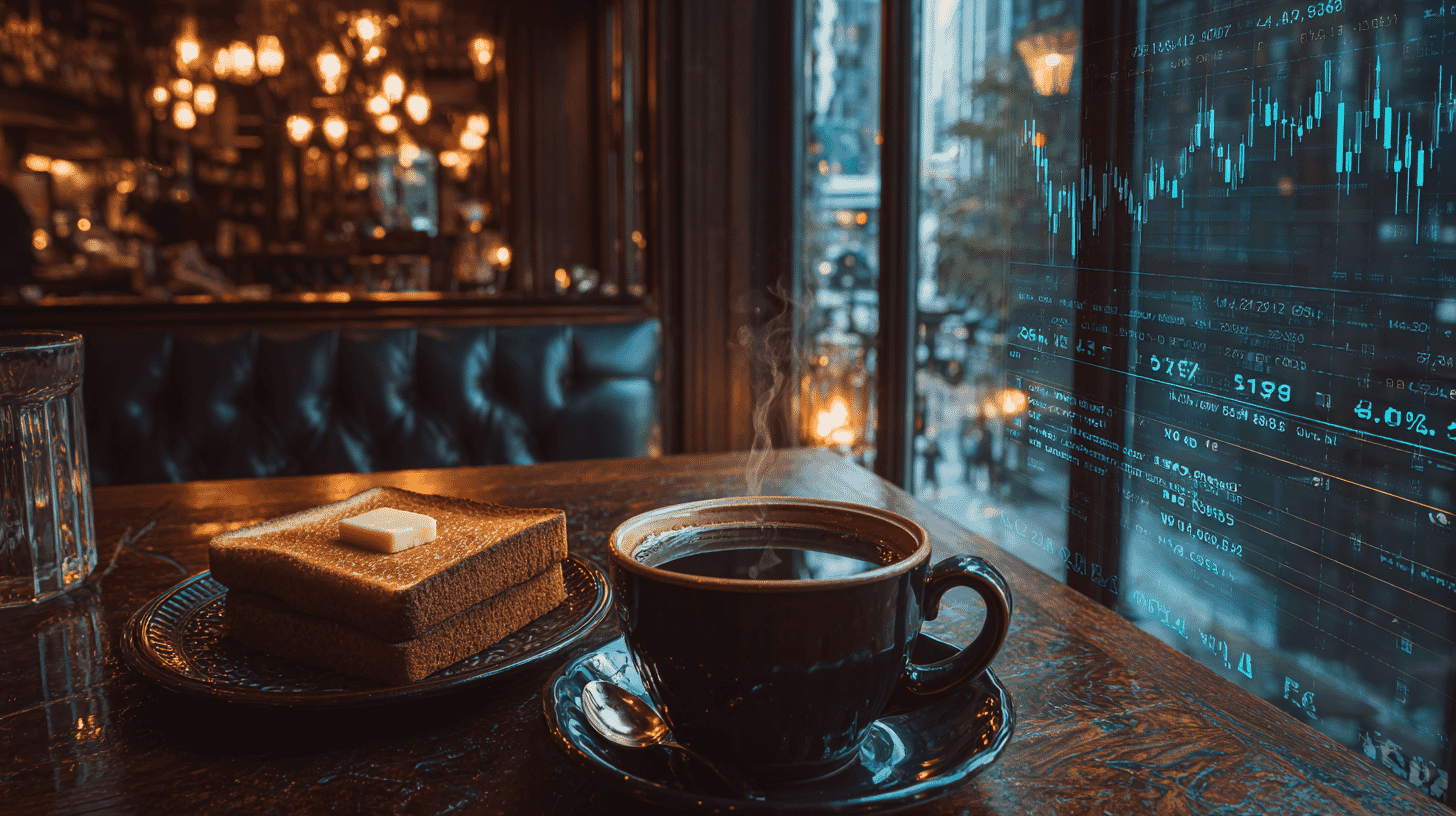
BlackRock manages $14 trillion in assets, more than the GDP of China. In April 2026, this giant of Wall Street took a 5.28% stake in a Nagoya-born Japanese coffee chain called Komeda Holdings. Why would the world's largest asset manager bet on a café when Tokyo's stock market is dominated by semiconductors, AI, and data centers? The answer lies in a conviction BlackRock holds about the AI era: there are some things machines will never replace.
April 3, 2026: The Three Characters "Pure Investment"
On April 3, 2026, BlackRock filed a large shareholding report with Japan's Ministry of Finance. The contents: 2.44 million shares of Komeda Holdings (listed on Tokyo Stock Exchange Prime Market, ticker 3543), or 5.28% of all outstanding shares. The reporting obligation date was March 31.
What caught the attention of Japanese financial markets was a specific line on the form, "purpose of holding." BlackRock had written three characters: "pure investment" (純投資).
In Japan's large shareholding reports, "pure investment" has a specific meaning. Unlike activist investors who demand changes from management, "pure investment" means the holder expects returns from the company's existing business model, no restructuring demands, no boardroom battles. In other words, BlackRock looked at how Komeda operates today and decided, "this is a buy."
Komeda's total market capitalization is about ¥143 billion (around $900 million). For BlackRock, with $14 trillion under management, this is a tiny slice. But behind this "small bet" lies a much bigger investment thesis about what will matter in the AI-dominated decade ahead.
"Nobody Stops Drinking Coffee Because of AI"
BlackRock's 2026 Global Investment Outlook, published in December 2025, carries the theme "Micro is Macro." In context, this refers to how AI infrastructure spending has grown so massive at the individual-company level that it now moves the whole macroeconomy.
But while BlackRock is bullish on AI, it isn't putting everything on that single card. The asset manager also emphasizes active selection and companies that benefit from the mundane forces of inflation and wage growth, the kind of "real world" businesses that don't care whether a chatbot writes code.
Generative AI can write essays, generate software, and design images. But AI cannot drink coffee for you. This sounds like a joke until you realize it's a serious investment thesis.
Food, clothing, shelter, the physical needs of human life, cannot be replaced by digital intelligence. No matter how smart AI becomes, humans still wake up, get dressed, eat breakfast, and go home to sleep. This simple fact translates, in the language of institutional investors, into "an AI-proof defensive line."
The urgency of this thesis was amplified in early 2025 by what Japanese market observers call the "Anthropic Shock." When U.S. AI company Anthropic unveiled advanced AI agents capable of handling legal and accounting workflows, SaaS stocks, the "safe bet" of the 2020s, dropped sharply overnight. The lesson: today's tech darling can become tomorrow's obsolete code. That volatility is pushing institutional capital toward industries AI can't upend.
Komeda Isn't a Coffee Chain: It's a Food Supply Platform
Here's the twist: what BlackRock bought isn't really a café business. Komeda's actual structure is unusual even by Japan's restaurant industry standards, it operates more like a food manufacturing and wholesale platform than a chain of coffee shops.
About 70% of Komeda's revenue comes from wholesale food sales to its franchise (FC) stores. This is backwards from how most global chains work. McDonald's or Starbucks earn most of their franchise revenue from royalty fees that scale with store sales, typically a percentage, like 5% of every dollar the franchisee takes in.
Komeda's royalty is radically different. Instead of a percentage, franchise stores pay a flat monthly fee: ¥1,500 per seat (about $9.50). Whether a franchise store doubles its sales or stagnates, Komeda's royalty income from that store doesn't change.
Instead, Komeda makes money by running its own factories that roast coffee beans and bake the bread used in its signature "Shiro Noir" dessert (a Danish-style pastry topped with soft-serve ice cream, wildly popular with Japanese customers). These ingredients are then wholesaled to over 1,100 franchise stores. The more those stores sell, the more ingredients they order, and Komeda's wholesale revenue grows automatically.
This franchise-friendly model reduces closure rates dramatically, which is why around 99% of Komeda's stores are franchise-operated, an astonishingly high ratio. Stable franchises mean stable wholesale demand, which means predictable cash flow for headquarters.
On the outside, Komeda looks like a cozy coffee shop chain. Underneath, it's a food supply-chain platform with 1,100+ downstream customers. That structure is almost certainly what BlackRock saw.
The Singapore Acquisition and Japan's Food Export Play
Another reason BlackRock entered now, in April 2026, likely ties to Komeda's overseas expansion.
In March 2025, Komeda acquired 70% of Poon Resources, a Singapore-based chain that operates roughly 30 cafés and Thai restaurants under brands like "Kaffe & Toast" and "Saap Saap Thai." Komeda already has locations in Taiwan, Shanghai, Hong Kong, and Indonesia, and its medium-term business plan sets a target of 80 overseas stores.
The Poon acquisition is not a simple headcount addition. Singapore serves as a gateway to Southeast Asia, and acquiring Poon brought Komeda local operational expertise, manufacturing capability, and ready supply chains all in one move. From there, expansion into Malaysia, Thailand, and Vietnam becomes a viable roadmap rather than a distant ambition.
BlackRock's large shareholding report came in April 2026, about a year after the Poon acquisition closed, just as integration progress became visible.
And here, a broader investment thesis comes into focus: Japanese food chains expanding overseas are now treated as legitimate investment opportunities by global institutional money.
Sushi, Ramen, Yakiniku: "Japan Quality" as a Global Brand
Japanese food going global is no longer a novelty. Hakata-born Ippudo ramen operates over 400 stores in 15 countries. Kura Sushi went public on the NASDAQ. Yoshinoya beef bowls reach the Middle East. Uniqlo-style rollouts now happen for ramen, sushi, udon, curry, izakaya, and even convenience-store bento concepts.
What underpins all of this is a brand called "Japan Quality", an uncodified but widely recognized value around ingredient sourcing, food safety standards, service consistency, and store-design precision. Global consumers have learned to treat Japanese restaurant brands as "safe premium choices."
In 2025, Japan's food and agricultural exports hit a record ¥1.7 trillion (approximately $10.7 billion). Roughly 181,000 Japanese restaurants now operate outside Japan, and demand for Japanese ingredients keeps climbing.
From a financial perspective, this is a rare combination: high entry barriers (authentic Japan Quality is hard to replicate), meaningful global growth runway, and, critically, AI-proof demand. BlackRock's Komeda position can be read as one chip placed on this broader structural bet.
Record Profits Back the Thesis
The fundamentals support BlackRock's read. On April 8, 2026, Komeda reported full-year results for the fiscal year ended February 2026:
- Revenue: ¥57.2 billion (approximately $360 million), up 21.6% year-on-year
- Operating profit: ¥9.4 billion (approximately $59 million), up 6.8%
- Net profit: ¥6.5 billion (approximately $41 million), up 11.1%
Net profit hit an all-time high for the second consecutive year, and revenue is on track for its sixth consecutive year of growth. The Poon contribution boosted top-line numbers, and domestic price adjustments supported margins.
The business isn't without risks. The flat-rate royalty model is generous to franchisees but limits headquarters' upside when store sales explode. Komeda's R&D budget is smaller than global giants like Starbucks, which could limit product innovation over time.
Still, the fact that the world's largest asset manager filed as a 5%+ shareholder with "pure investment" intent is meaningful. This is more than mechanical ETF rebalancing, it's deliberate capital allocation.
What Are Your Country's "AI-Proof" Industries?
Nobody stops drinking coffee. Nobody stops eating ramen. No sushi master is being replaced by ChatGPT. BlackRock's Komeda investment turns that plain fact into an investment philosophy, and Japan's food industry is being re-evaluated as a rare asset class that pairs AI-proof demand with a globally recognized premium brand.
What industries in your country are considered "AI-proof"? Is your food culture being treated as a global investment asset? We'd love to hear your perspective.







Global Discussion
15 comments