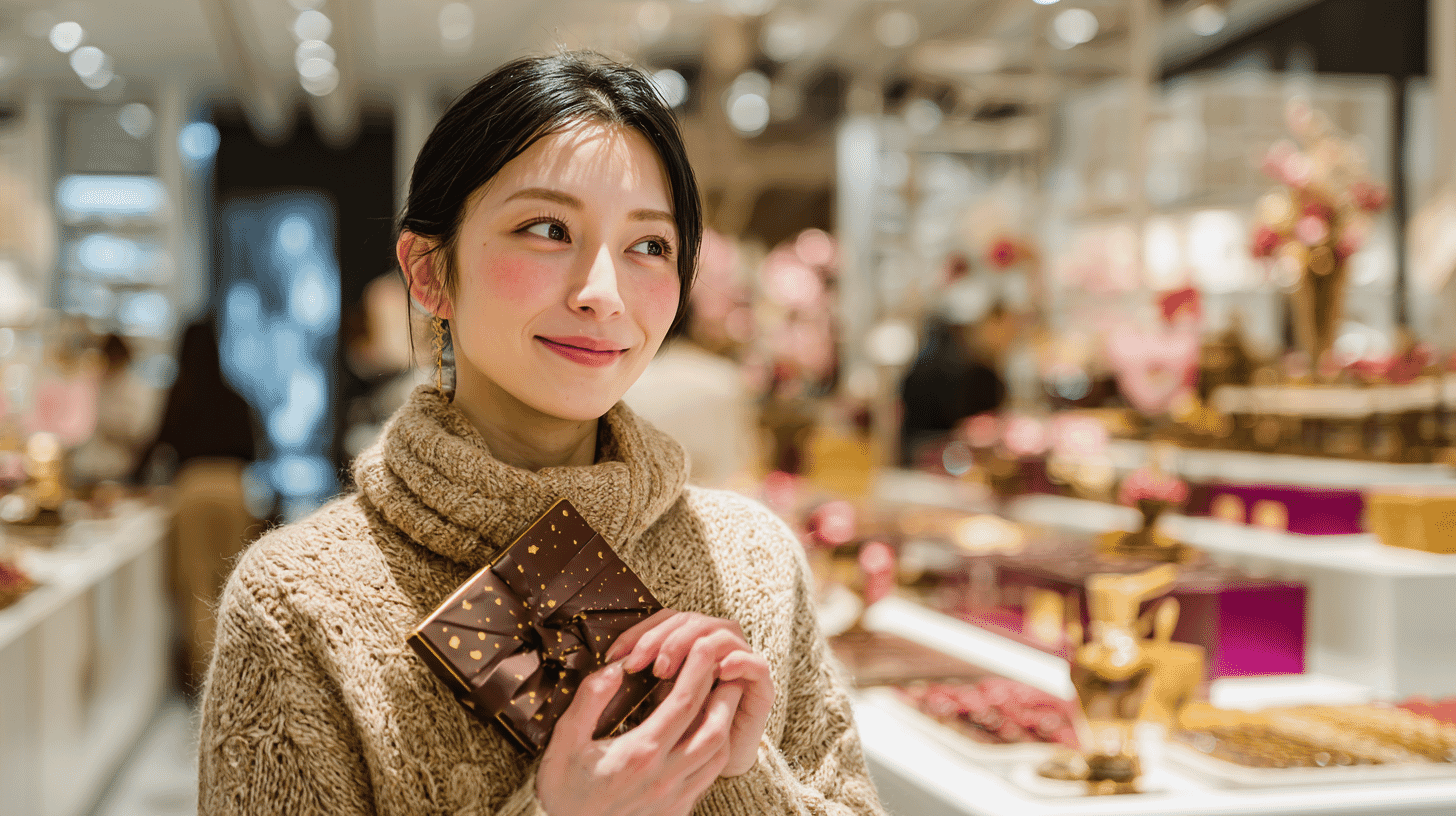
For decades, Japanese women dreaded the annual ritual of buying "obligation chocolate" for every male colleague in the office. In 2026, 70% of Japanese people say that culture is dead, and 85% of working women don't want to participate at all. Instead, they're spending record amounts on premium chocolate for themselves. Japan's Valentine's Day is quietly transforming.
What Was Giri-Choco? Understanding Japan's Unique Valentine's Tradition
Valentine's Day in Japan looks nothing like it does in the West. While couples in Europe and North America exchange gifts mutually, Japan has followed a distinctive tradition since the 1950s: women give chocolate to men. What started as a marketing campaign by confectionery companies became deeply embedded in Japanese social life.
The most uniquely Japanese aspect of this tradition was "giri-choco," literally "obligation chocolate." In Japanese culture, "giri" refers to a sense of social duty or indebtedness. Giri-choco had nothing to do with romance. It was chocolate that women gave to male bosses, coworkers, and business associates as a token of appreciation for their everyday support. From the 1980s through the 1990s, the practice became so widespread that department store chocolate counters were mobbed before February 14, and office women would arrive at work carrying bags of individually wrapped chocolates for distribution.
But the tradition came with a heavy burden on both sides. Women faced significant financial and time costs buying dozens of chocolates, while men were obligated by an unwritten social rule to give return gifts on "White Day" (March 14), and those gifts were expected to be more expensive than the chocolate they received. A tradition meant to express gratitude gradually became recognized as one of the workplace's most tedious annual obligations.
70% Say Giri-Choco Is Fading: What 2026 Surveys Reveal
A 2026 Valentine's Day survey by the Kufu Consumer Research Institute, covering 5,967 respondents, paints a clear picture of transformation. Approximately 70% of respondents felt that giri-choco culture has declined or disappeared entirely. A separate survey by research firm Intage, polling 5,000 people aged 15 to 79, found that 85.4% of working women said they don't want to participate in workplace giri-choco, the highest figure since the survey began five years ago.
Only about half (48.4%) of respondents plan to give any Valentine's gift at all. Among those who do, 72.6% intend to give to romantic partners or spouses, so-called "honmei-choco" (true-feelings chocolate). Children and grandchildren (37.6%) and parents or grandparents (16.9%) followed, while workplace-related gifting dropped sharply. A Japan Life Insurance survey also found that 72.1% of respondents believe giving Valentine's presents to coworkers is "unnecessary."
Perhaps most strikingly, the percentage of women who say they won't give any chocolate at all rose by 4 points to 42.8%. Family chocolate, friendship chocolate, and obligation chocolate all declined across the board, revealing what analysts describe as a "quiet retreat" across the entire Valentine's market.
Three Forces Killing Giri-Choco
The COVID-19 Pandemic and Remote Work
The shift to remote work from 2020 onward delivered a fatal blow to giri-choco. With fewer days in the office, the physical act of handing out chocolate disappeared. Many people discovered that nothing bad happened when they stopped, and chose not to resume the practice even after returning to the office.
However, an intriguing generational gap emerged. A survey by Telerimo Research found that among people who previously gave workplace Valentine's chocolate, 67.3% of those in their 20s continued the practice, and 21.2% said they now do it more than before, compared to extremely low continuation rates among those in their 50s. Younger workers appear to be selectively using workplace Valentine's as a communication tool rather than an obligation.
Rising Harassment Awareness and Compliance
Japan's growing sensitivity to workplace harassment also contributed. More companies have adopted policies discouraging personal gift exchanges in the office. The social pressure once felt by women who feared being seen as uncooperative for not participating has reversed; now there's growing concern that giving chocolate could itself be perceived as inappropriate.
The Cacao Shock: Chocolate Becomes a Luxury
A major economic factor is the global surge in cocoa bean prices, known in Japan as the "cacao shock." International cocoa prices, which held steady at around $2,000 per ton through 2022, skyrocketed to $10,709 per ton by January 2025, nearly four times the previous level, due to severe crop failures in West Africa caused by extreme weather and disease. This directly impacted retail prices. During the 2026 Valentine's season, the average price per piece of premium chocolate hit ¥436 (about $2.90), a new record, with 62% of brands raising prices from the previous year. Japanese chocolate prices have doubled in just five years according to government statistics.
Since giri-choco requires buying for many recipients, the total cost adds up quickly. Rising prices have accelerated a clear trend: consumers would rather spend their limited budgets on meaningful gifts for loved ones or premium treats for themselves rather than on social obligations.
The Rise of "Jibun-Choco": Valentine's as Self-Care
Replacing giri-choco in the spotlight is "jibun-choco," or self-reward chocolate. As the name suggests, this is the practice of buying premium chocolate for yourself as a personal indulgence. In the Kufu survey, 42.9% of respondents said they purchase chocolate for themselves, with 72.2% citing "self-reward" or "small luxury" as their reason.
A Matsuya Ginza department store survey revealed an eye-opening inversion: average spending on jibun-choco reached ¥10,662 (about $71), surpassing ¥10,000 for the first time and nearly doubling the ¥5,573 ($37) average spent on romantic chocolate. Valentine's Day is redefining itself, from "a day to give" to "a day to treat yourself."
Survey comments overwhelmingly embrace this shift. "I'm glad giri-choco is gone, and now I can focus on people I actually want to give to and on treating myself," said a woman in her 60s. "More people are buying for themselves, so it's become normal to buy self-chocolate too," noted a 20-something woman. A minority expressed nostalgia: "Giri-choco was stressful, but it was also kind of fun. I feel a bit lonely that it's disappearing," reflected another woman in her 60s.
Tweens Are Valentine's "Peak Season"
A KidZania Tokyo survey of 1,253 people found that the percentage who plan to give handmade sweets was approximately 75% among upper elementary school students (ages 10–12) and 77% among junior high schoolers (ages 13 to 15), the only demographics where homemade gifting exceeded 70%. Trading "tomo-choco" (friendship chocolate) and spending afternoons baking together, this early-teen demographic represents the true "golden age" of Japanese Valentine's culture today.
By contrast, adults have largely moved away from homemade efforts. A Navit survey of 1,000 people found just 7.3% of adults plan to make chocolate from scratch. Adult Valentine's has transformed from a labor-intensive crafting project into an event centered on curating and enjoying high-quality treats.
Department Store Chocolate Fairs Still Thrive
While giri-choco fades, department store Valentine's chocolate events remain wildly popular. Nagoya's JR Takashimaya "Amour du Chocolat" features over 100 domestic and international brands and draws enormous crowds. Observers note that shoppers are spending well beyond the $33 average budget: bags worth $65 to $130 are commonplace.
The faces of shoppers who finally get their hands on sought-after chocolates radiate the joy of personal indulgence rather than the stress of obligation. The Valentine's market may be shrinking in volume, but it's growing in value per transaction, a textbook case of consumption polarization.
Is Valentine's Day Dying in Japan? The Future of "Love Day"
The decline of giri-choco isn't the end of Valentine's Day. It's a redefinition. The old one-way framework of "women give to men" is collapsing. New categories are emerging: "gyaku-choco" (reverse chocolate, where men give to women), "oshi-choco" (chocolate bought for a favorite celebrity or fictional character), and the ever-growing jibun-choco.
Valentine's Day has shifted from an event where people strained to meet social expectations to one where individuals choose how they want to celebrate. The decline of giri-choco is ultimately a symbol of Japan's broader shift toward prioritizing personal choice over social obligation.
Valentine's Day in Japan hasn't died. People have simply gained the freedom to decide for themselves how they want to spend it.
How do you celebrate Valentine's Day in your country? Is there a tradition of giving obligatory gifts to coworkers? Do you treat yourself to something special, like Japan's "jibun-choco" trend?
References
- https://news.yahoo.co.jp/expert/articles/e47395c02de2e4c36fdcb7b3af2bba9e3a5d2cb2
- https://prtimes.jp/main/html/rd/p/000000504.000046400.html
- https://hicbc.com/magazine/article/?id=news-ronsetsu-post-3640
- https://www.lassic.co.jp/teleremo/valentine-workstyle-2025/
- https://www.commercepick.com/archives/85113
- https://news.mynavi.jp/article/20260203-4069480/
- https://newswitch.jp/p/40477
- https://www.sompo-ri.co.jp/topics_plus/20260108-21491/
- https://prtimes.jp/main/html/rd/p/000001255.000043465.html
- https://kadence.com/knowledge/why-valentines-day-no-longer-drives-consumer-behavior-in-japan






Global Discussion
15 comments