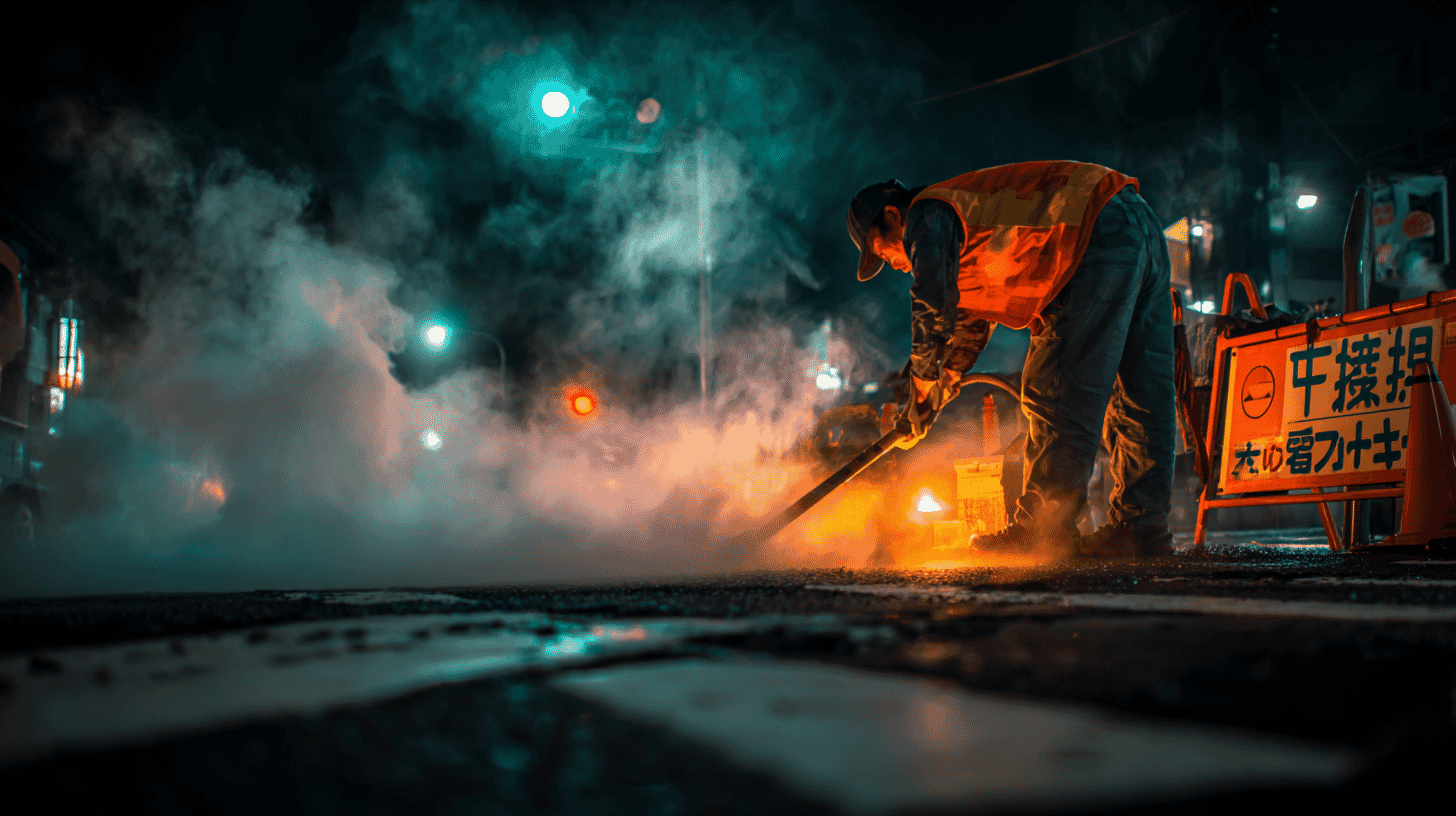
🚗 Did you know Japan's road markings aren't painted with regular paint?

Those "STOP" signs and white lines are actually made with special resin melted at nearly 200°C (392°F). In winter, they harden in just 3 minutes— fast enough to finish work during a single traffic light cycle. The secret to their nighttime glow? A "candy stick" structure hiding inside. Discover the hidden craftsmanship behind Japan's road infrastructure.


Japan's "STOP" Signs Aren't Paint—They're Thermoplastic

When you see "止まれ" (STOP) written on Japanese roads or the white lines marking crosswalks, you might assume they're painted on. In reality, they're made from a specialized material called "thermoplastic road marking" (溶融式路面標示材).

This material exists as a powder at room temperature. When heated to 180-200°C (356-392°F) in specialized kettles, it transforms into a thick liquid with a consistency similar to honey or melted cheese. Once it cools, it hardens into a plastic-like solid.

Under Japan's JIS standards (JIS K 5665), this is classified as "Type 3" marking material. Today, approximately 80% of all road markings in Japan use this thermoplastic method.

Why Not Use Regular Paint?

The primary reason Japan uses thermoplastic is speed.

Traditional paint takes time to dry, requiring extended road closures that cause major traffic disruptions in urban areas. With thermoplastic, the job is done when it cools:

  • Winter: Hardens in approximately 3 minutes
  • Summer: About 10 minutes (with water cooling)

This rapid curing makes it possible to complete marking work during a single traffic light cycle. The thermoplastic method also creates a thicker layer (typically 1.5mm), offering superior durability compared to regular paint, which may need reapplication every 6-12 months.

The "Human Printers" Behind the Lines

Road marking crews use a machine called a "hand-push liner" to draw white lines. Despite its mechanical appearance, the operation is surprisingly manual.

Workers walk alongside the machine, releasing the nearly 200°C material through a component called the "shoe" while adjusting a lever to control the slit opening. This determines line thickness and straightness—walking speed directly affects quality. It's essentially a "human printer" operation requiring years of expertise.

Even more impressive is how they create letters like "止まれ" (STOP). Depending on the situation, this is done entirely by hand:

  1. Create letter outlines using adhesive tape
  2. Pour the hot material using a ladle
  3. Smooth it flat using a trowel (like a plasterer would use)

Handling 200°C molten material while creating precise characters demands exceptional skill developed over many years.

The "Candy Stick" Secret to Night Visibility

Road markings shine when car headlights hit them at night thanks to tiny glass beads embedded in the material. These transparent spheres (0.1-1.4mm diameter) create "retroreflection"—bouncing light back toward the driver.

Fresh beads are also sprinkled on top immediately after application. However, this alone would mean the marking stops reflecting once the surface wears down.

The solution? Manufacturers pre-mix 20-23% glass beads (per JIS standards) directly into the powder material. As the surface wears away, new beads continuously emerge—like a Japanese "Kintaro-ame" candy that shows the same face no matter where you slice it.

History of Thermoplastic Markings in Japan

Japan began widely adopting thermoplastic road markings in the 1960s, coinciding with the establishment of the Road Traffic Act and national standardization of road markings.

Before this, enamel-type traffic paint was standard but suffered from long drying times and durability issues. The introduction of thermoplastics marked a significant advancement in Japan's road safety infrastructure.

Today, the technology has evolved to include spray-application methods compatible with porous drainage pavement and all-weather formulations that maintain visibility even in rain.

Thermoplastic vs. Paint: A Global Perspective

Thermoplastic road marking isn't unique to Japan—it's used worldwide. In the US and Europe, thermoplastic markings typically last 3-5 years compared to 6-12 months for regular paint. The material can withstand heavy traffic, UV exposure, and harsh weather far better than traditional alternatives.

Some countries also use MMA (Methyl Methacrylate) paint, which lasts even longer (up to 10 years) but costs more and requires specialized application equipment.

Conclusion: Technology Beneath Your Tires

The next time you drive over a road marking in Japan—or anywhere in the world—remember the technology and craftsmanship beneath your tires. Those simple white lines and STOP signs represent engineering solutions refined over decades.


How are road markings created in your country? Do they use thermoplastic, traditional paint, or something different? We'd love to hear about road marking methods from around the world in the comments!

References

Reactions in Japan

I always thought it was paint... 200°C is hotter than deep-frying! So that's why there's steam rising at those work sites. This might be the biggest 'wow' moment of my life.

I agree 0
I disagree 0

My dad used to do this job. Scorching heat in summer, freezing early mornings in winter. Just remembered him bragging 'I drew that white line.'

I agree 0
I disagree 0

Industry insider here. Young worker shortage is serious these days. Handling 200°C materials isn't a skill you learn overnight. Glad this article might get more people interested.

I agree 0
I disagree 0

Knew about glass beads making it reflective, but didn't know they're mixed inside too. The 'Kintaro-ame candy structure' description is genius lol

I agree 0
I disagree 0

Studying urban planning but we barely covered road markings in class. We should shine more light on 'infrastructure so commonplace it gets overlooked.'

I agree 0
I disagree 0

Can't count how many times that reflection has helped me during night drives... Really hard to see on rainy days, so hoping for more tech advances.

I agree 0
I disagree 0

Shocked it hardens in 3 minutes. Finishing work during a traffic light wait? That's pro level. Major respect for Japan's infrastructure workers.

I agree 0
I disagree 0

Felt a connection hearing they use trowels. But working with 200°C material is beyond me. We only dealt with mortar at most...

I agree 0
I disagree 0

The steam rising at work sites is actually pretty photogenic. Might go shoot some pics next time 🚧📸

I agree 0
I disagree 0

The 'STOP' marking in my neighborhood is fading. Budget issues I'm sure, but it's a safety matter—wish they'd maintain it properly.

I agree 0
I disagree 0

White lines are slippery in rain—honestly scary. Heard there's less slippery materials now, but not widespread yet? Hope they standardize it soon.

I agree 0
I disagree 0

The 'human printer' expression got me. It really is like printing at human walking speed when you think about it.

I agree 0
I disagree 0

Tech keeps evolving—spray methods for drainage pavement and such. But it still comes down to human hands. One job AI can't replace, I think.

I agree 0
I disagree 0

Used to find late-night roadwork annoying, but traffic-wise they can't do it any other time... Gotta be grateful.

I agree 0
I disagree 0

Living in the US but road markings here are really sloppy. Every time I return to Japan I'm moved by how clean the lines are. So it's craftsman skill...

I agree 0
I disagree 0

Loved watching roadwork as a kid. Always wondered what that white liquid was—finally feel like I have the answer.

I agree 0
I disagree 0

Voices from Around the World

Mike Reynolds

Been in road construction for 15 years—same method here. Thermoplastic is standard in the US too. But you can tell from photos how precise Japanese work is. Wish my crew would take notes.

Sophie Laurent

We use thermoplastic in France too. But I'd never heard the explanation about reflective beads mixed in like 'Kintaro-ame candy.' Japanese people are really good at explaining technology.

Klaus Weber

Germany's Autobahn uses thermoplastic too. What's interesting is Japan's emphasis on manual craftsmanship. We've mechanized more, but for complex characters, handwork definitely wins on quality.

Chen Wei

China uses similar tech, but rapid urban development means inconsistent quality. Japan's 80% thermoplastic standardization is admirable. Regulatory standardization is key.

Park Ji-hoon

Korea uses the same method—probably because the technology was transferred from Japan historically. But Korean manufacturers are developing their own high-brightness materials now. The tech competition is getting interesting.

James Thompson

Rain is frequent in the UK, so road marking visibility really matters. All-weather material development is a global challenge. Keeping an eye on Japanese tech development.

Maria Santos

Unfortunately in Brazil, many road markings are fading due to budget shortages. Japan's thorough infrastructure maintenance is enviable. Want to show this article to our politicians.

David Miller

Australian road worker here. We call it 'hot applied thermoplastic.' Interesting how names differ by country. Same technology though.

Raj Patel

In India, heavy traffic wears out markings quickly. We're researching how to adapt Japan's durable materials and techniques to Indian conditions.

Anna Kowalski

Poland's winters are harsh—snowplows scrape off markings. Japan has cold regions too. Would like to know how they handle this.

Tom van der Berg

Netherlands is a cycling country, so bike lane marking quality is crucial. Japan's precise application is informative. Though rain-time slipperiness is a universal challenge.

Carlos Rodriguez

Mexico City's road markings are honestly terrible. Reading this shows proper tech and investment can make a difference. Problem is political will...

Lisa Anderson

Canada has regions that hit -40°C, so material selection is tricky. Would be interesting to exchange info with Japanese engineers. Cold-region expertise is valuable.

Ahmed Hassan

In UAE, extreme heat is the issue. Wondering if thermoplastic softens above 50°C. We face the opposite challenge from Japan.

Emma Wilson

Work for a NZ road construction company. Love the 'human printer' expression! We're aiming for full mechanization here, but this made me appreciate manual work again.