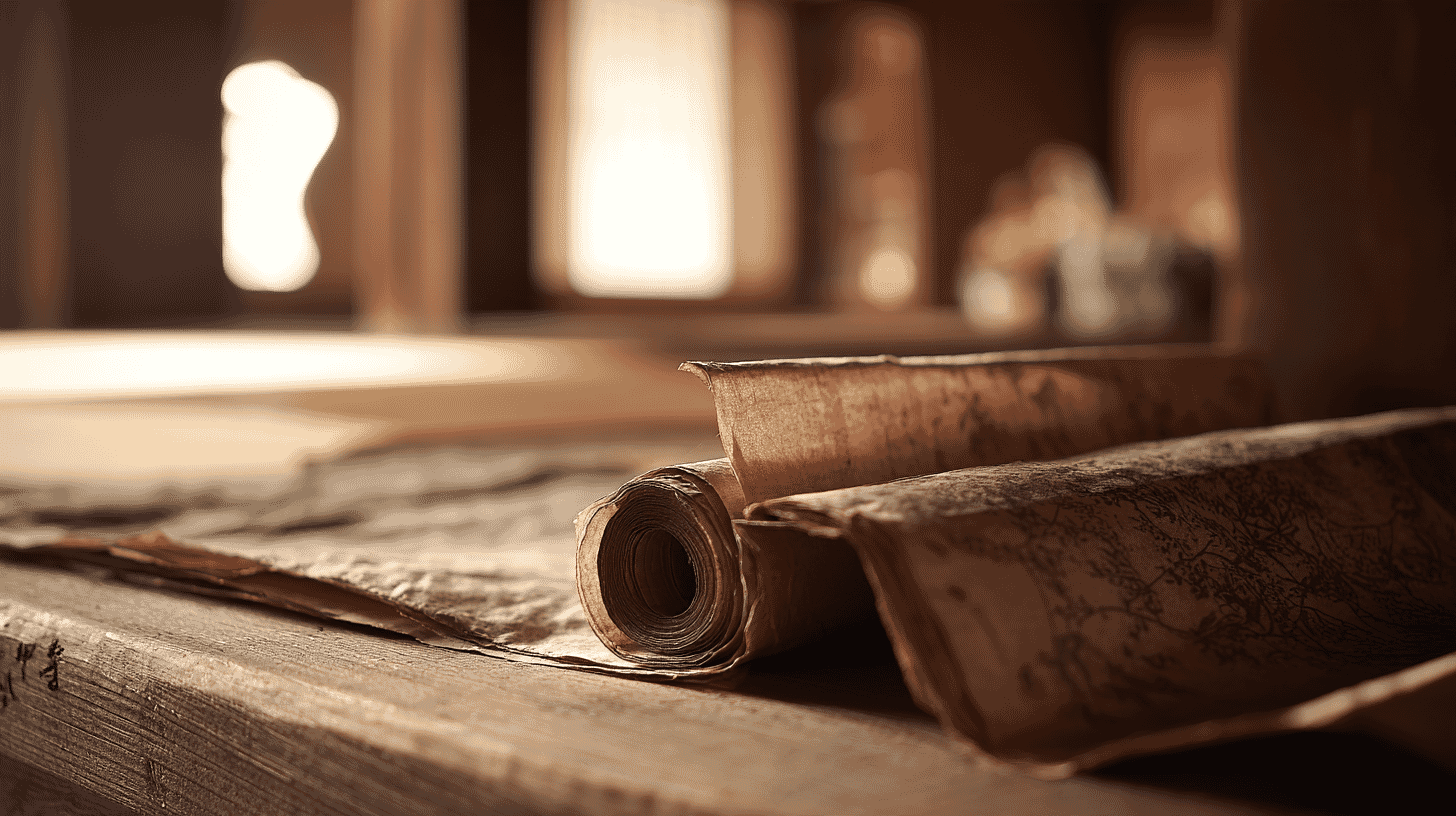
📜 A wooden Kannon statue in the hills south of Kyoto went out for restoration this year. In August, the Buddhist sculptor working on it told the temple there was a scroll inside: 95 sheets of paper, rolled together and sealed in a statue thought to be about 700 years old. Its contents have yet to be studied.
A secret Buddha sent out for repair
Shojuin is a small temple of the Koyasan Shingon school in Ujitawara, a tea-growing town in southern Kyoto Prefecture. Temple tradition says it was founded in 1200. Its principal image is an Eleven-Headed Kannon, the bodhisattva of compassion shown with a ring of smaller heads on its crown. The statue is carved from wood, stands about 60 cm tall, and is estimated to date from the late Kamakura period, which ended in 1333. It is a designated cultural property of Ujitawara town.
It is also a hibutsu, a "secret Buddha" kept behind closed doors and shown roughly once every 50 years. Ahead of the restoration, the temple opened those doors from April 1 to November 30, 2025. The statue had not been repaired in a long time, and the regional tourism board billed the opening as the first and last chance to see it in that state.
The statue went to the restorer in January 2026, and the temple announced the find on its official X account on October 9, 2026.
According to the temple and to ABC TV in Osaka, the bundle is about 30 cm tall and 5 cm across. Ninety-four sheets carry images of Kannon, and wrapped inside them is one sheet of ink writing. The temple's deputy head priest told ABC that even the head priest had no idea it existed. As of October 2026, the temple plans to request a formal study of the contents and the date.
The statue was also a container
In Japan, a Buddhist statue was often something to fill as well as to look at. Art historians call these objects nōnyūhin, roughly "deposited items": things sealed inside the hollow of a statue, out of sight.
JAANUS, the dictionary of Japanese art terms hosted by Columbia University, lists donors' written prayers, lists of names of people who wanted a bond with the image, copied sutras, printed Buddhist images, wooden tags giving the sculptor's name and the date, tiny stupas, miniature statues and relics. Coins, mirrors, grain and medicine turn up too.
The same dictionary describes a belief that sutras and relics gave a statue its soul, bringing it closer to a living presence. There was also a practical side. From the Heian period, sculptors hollowed out wooden figures and assembled them from joined blocks, which left space in the body. Deposits reached their greatest number and variety in the Kamakura period, so a late-Kamakura statue with something inside is typical of its time.
If temples and shrines are new to you, our earlier piece on what shrines mean to Japanese people, and how they differ from temples covers the basics.
What one sheet of ink can settle
Writing sealed inside a statue often answers questions the statue itself cannot. In Nara, the two guardian figures in the Great South Gate of Todaiji, each about 8.4 m tall, were carved in 1203 by a team led by Unkei and Kaikei. After centuries with little repair, they went through a five-year restoration starting in 1988. Inside, workers found sutras, documents and many ink inscriptions, among them a copy of the Hokyoin Darani sutra bearing the names of Chogen, the monk who rebuilt the temple, and the sculptors.
According to Todaiji, those papers show that work began on the 24th day of the 7th month of 1203, by the old lunar calendar. One figure was standing in the gate by the 7th day of the 8th month. The next day, a sutra copied at the east end of the gate was fixed inside the chest of the other. The two were made side by side in 69 days, with Jokaku and Unkei's son Tankei also among the lead sculptors.
Shojuin's sheet may hold nothing like that. It could be a prayer or a list of donors. Until it is read, nobody can say whether the scroll went in when the statue was carved or during a later repair.
The temple's announcement says each of the 94 picture sheets bears an in (印), a word that can mean a mark or a stamp, showing Kannon's form. Printed images are one of the standard deposits listed by JAANUS, and there is a precedent nearby. At Hoshakuji, also called Takaradera, in Oyamazaki in Kyoto Prefecture, the principal Eleven-Headed Kannon held documents from 1233 about its rebuilding and 4,840 printed images of the same Kannon; the prints are now an Important Cultural Property. Shojuin has not used that term for its own sheets, though, and nobody has examined them yet.
Not a custom unique to Japan
A famous statue with deposits in Japan was made in China. The standing Shaka at Seiryoji in Kyoto, 160 cm tall, was carved in 985 in Taizhou, under the Song dynasty, for the Japanese monk Chonen. Objects found inside it showed how it was commissioned and who gave money for it. It also held a set of internal organs sewn from silk, which caught the attention of historians of medicine.
Korea has its own tradition, called bokjang. A gilt-bronze Amitabha from Munsusa Temple, dated 1346 and 69 cm tall, was found in 1973 to contain a wooden container, silk "treasure bottles," texts and a written inventory of everything placed inside, according to a 2020 paper in the Journal of Korean Art & Archaeology.
The temple of the heart-shaped window
Many people know Shojuin for a window. In the guest hall, a frame shaped like a heart looks out on the garden. Its name, inome, means "boar's eye." The temple describes it as a traditional pattern that has decorated temples and shrines for about 1,400 years, meant to ward off misfortune and invite good fortune. These days it also draws visitors who come to pray for a good match.
The view through it changes with the seasons: cherry pink in spring, green in early summer, red in autumn, white in winter. From about August 20 to mid-September, before 4 p.m., the sun casts a heart-shaped shadow on the floor. The guest hall ceiling holds 160 painted panels, and from early June to mid-September about 2,000 wind chimes hang in the grounds.
The Kannon and the scroll are not on view. As of October 2026, the temple has not announced any plan to show the scroll, and the statue remains a secret Buddha.
Practical notes, checked in October 2026: the temple is open 9:00 to 16:30, or 10:00 to 16:00 from December 1 to March 31 (last entry 15:45). On weekends and holidays until December 6, 2026, the Uji-cha Bus runs from Keihan and JR Uji stations to the Shojuin-guchi stop. MK Taxi runs a reserved direct service from Kyoto Station. Otherwise, the Kyoto tourism association suggests a regular Keihan bus from Uji to the stop named 維中前, then a taxi of about 10 minutes.
Shojuin's scroll sat inside a statue that was itself hidden most of the time. Other places have their own versions: relics under altars, papers in cornerstones, letters in time capsules. Is there a custom like that where you live?
References
- https://x.com/shoujuin28/status/2108406565942526186
- https://news.yahoo.co.jp/articles/820c32f296e79a7f540435eb4f829980764eeca3
- https://news.yahoo.co.jp/articles/0b5ae979d4be04c2fd8b0d43c32d5ebaec660fef
- https://shoujuin.boo.jp/?page_id=498
- https://shoujuin.boo.jp/?page_id=466
- https://shoujuin.boo.jp/?page_id=141
- https://shoujuin.boo.jp/
- https://ochanokyoto.jp/event/detail.php?eid=1001
- https://ochanokyoto.jp/spot/detail.php?sid=254
- https://projects.mcah.columbia.edu/jaanus/node/56
- https://www.todaiji.or.jp/en/information/nandaimon/
- https://kotobank.jp/word/%E6%B8%85%E5%87%89%E5%AF%BA%E5%BC%8F%E9%87%88%E8%BF%A6-846462
- https://ijkaa.org/v.14/0/59/28
- https://www.kyoto-kankou.or.jp/info_search/9687
- https://kotobank.jp/word/%E9%8E%8C%E5%80%89%E6%99%82%E4%BB%A3-46541
- https://kotobank.jp/word/%E5%AE%9D%E7%A9%8D%E5%AF%BA-132049





Global Discussion
4 comments