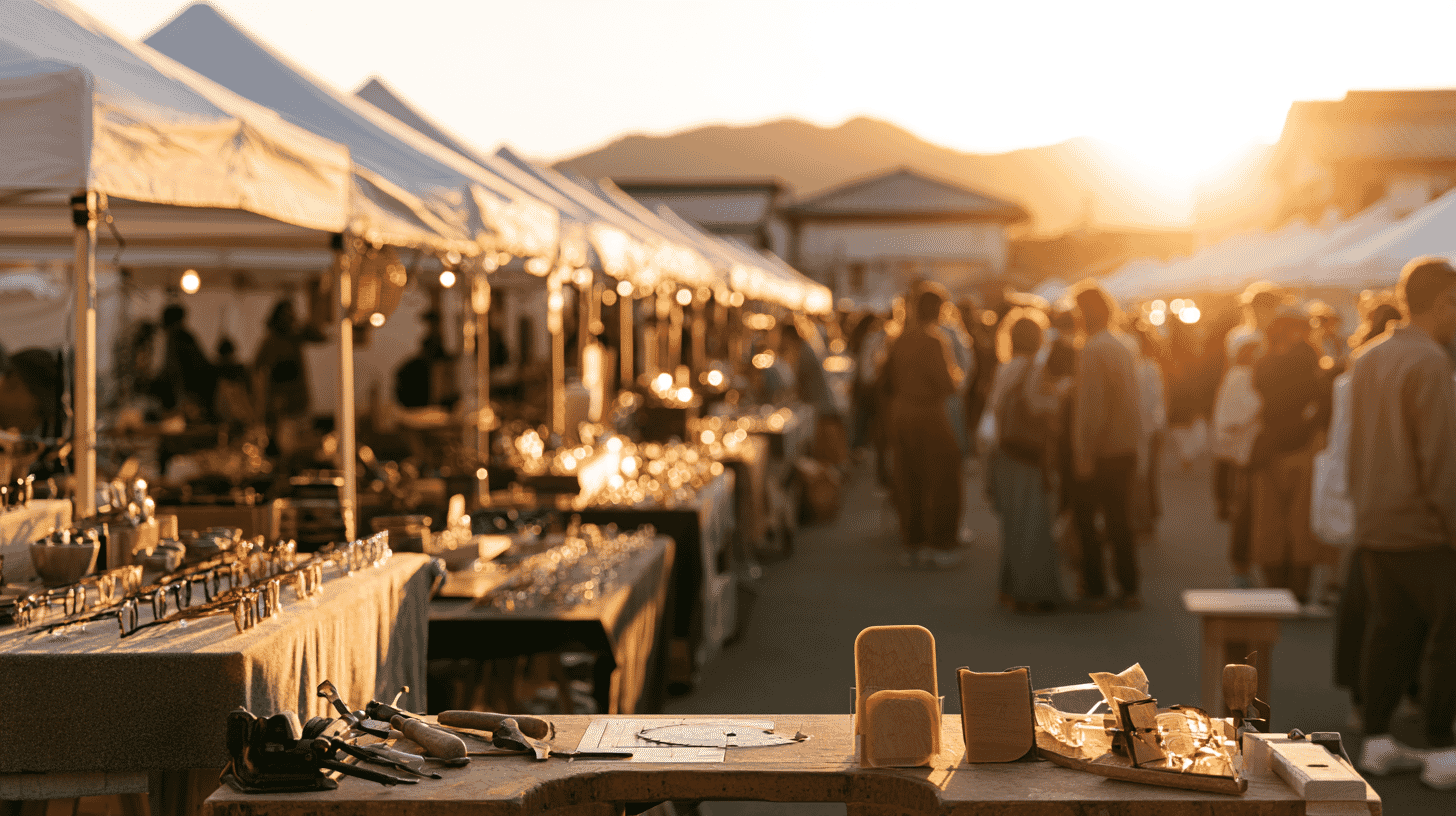
👓 Good news for anyone who has ever spent forty minutes in front of a mirror trying on frames: there is a town in Japan that has been making glasses since 1905, and once a year it opens the whole place up. Megane Fes 2026 runs Saturday, September 19 and Sunday, September 20, 2026, admission is free, and one of the exhibitors is a high schooler who designed a pair meant to make you look like you are about to cry.
There are only a handful of eyewear towns left
Most industries spread out. Eyewear did the opposite. If you own a pair of glasses, there is a good chance some part of it passed through one of a handful of places.
Sabae, in Fukui Prefecture on Japan's snowy northwest coast, makes 93.5% of Japan's eyeglass frames, according to a survey the Hokuriku Local Finance Bureau published in January 2025. Belluno, in northern Italy, counted 360 businesses and 120 satellite units at the end of 2021, with a payroll above 14,200, and sold close to 3 billion euros abroad that year, roughly 40% of Italy's eyewear exports; the Italian government's trade portal puts the Belluno and Cadore district at about 70% of national production. The Jura mountains in France have been at this the longest: the first wire frame was made there in 1796, and by 1882 the valley around Morez was turning out 11 million pairs a year. Danyang, in China's Jiangsu Province, took the lens half of the business and never gave it back: People's Daily Online reports more than 1,600 companies there turning out over 400 million pairs of lenses a year, about half of the world's lenses and roughly 70% of China's.
Four towns, four different answers. Belluno stayed big, with global groups and component specialists sitting in the same valley. Danyang went for volume. The Jura shrank: a 2016 trade-press report put employment in the Morez valley at about 1,600, down from 10,000 in the 1970s, and 2,500 across all of France. Sabae bet on technique and never chased scale. Four is a convenient number rather than a strict count, and Daegu in South Korea is described by local media as its own country's largest eyewear cluster, with a council launched in March 2026 to revive it. Still, a festival that opens the whole district for two days is very much a Sabae habit.
From a farmer's winter job to the titanium frame
Sabae's origin story is almost too neat. Winters in Fukui bury the rice fields, farmers had months with nothing to do, and in 1905 a local named Gozaemon Masunaga brought eyewear craftsmen in from Osaka and taught frame-making as an off-season job. He split the work into steps so beginners could learn one piece at a time, which is why locals still describe the place as one giant factory with the walls taken out. A single frame can pass through a string of small workshops before it is finished.
Titanium, the material that made Sabae famous, is light and strong and a nuisance to work with. In a Japan Science and Technology Agency write-up of a project with Osaka University and the Sabae manufacturer Charmant, pressing, cutting, joining and surface finishing are all described as harder on titanium than on steel or copper, and the brazing alloys melt so hot that the heat spreads and warps the frame. The Fukui Optical Association says the town solved it in 1983, producing the world's first light, durable titanium eyeglasses. The near-weightless frames that feel like nothing today start there.
The district more than halved
Sabae nearly lost all of this once. A 2022 report by the Development Bank of Japan and Fukui Bank tracks the fall in painful detail. Eyewear shipments from Sabae peaked at 64 billion yen, about $410 million, in 2001, then collapsed to 28 billion yen, about $179 million, by 2010. Cheap imports arrived from China, three-price chain stores rewrote what a customer expected to pay, and the average retail price of a pair in Japan slid from 27,666 yen in 2006 to 21,400 yen in 2019. Workplaces shrank too: eyewear businesses in Fukui with four or more employees went from 387 in 2003 to 237 in 2013 and 195 in 2021, according to the Hokuriku Local Finance Bureau.
Then it stopped falling. Shipments were back to 36.1 billion yen, about $231 million, in 2019. Not the old peak, but a recovery built on a different model: fewer anonymous subcontracts for foreign brands, more workshops putting their own name on the temple arm and selling straight to people who care about this stuff. Megane Fes, which started in 2014 under the slogan "thank you, glasses," is that strategy in festival form.
Two days when the town becomes one long optician's counter
The 2026 edition is themed "Global Vision, Local Fun" and fills the Megane Museum and the streets around it with about 90 booths, more than 40 of them eyewear-related companies.
Some of it is straightforward shopping. "Meet! Meet! Megane!" gathers 13 companies from the district so you can try the frames on with the people who made them standing right there. Some of it is the good weird stuff. "Mega-Ten" puts 12 manufacturers on display who never get a storefront, the ones doing hinges, lens work, surface treatment and repair. There is a memorial service for worn-out glasses, a job-experience corner where kids get paid in vouchers they can spend at the festival, live music, a fashion show, and something called the MEGANE Macho Grand Prix, which is exactly as advertised.
And then there are the students. Second-year design students from Sabae High School are exhibiting frames they built in class, under the booth name "Chiiki no Design: Tange Lecture 2026." One of them, Marin Takeuchi, made what she calls a crying-face pair. She told Fukui Keizai Shimbun she worked on making the wearer's eyes look droopy and timid, and that the frame takes a teardrop crystal so it suits the moments when "you want to cry but can't." That is a stranger design brief than most commercial eyewear will ever attempt.

Source: Fukui Optical Association via PR TIMES
How to actually cut your own frame
The Megane Museum runs a frame-making class year round. You pick from roughly 70 frame designs and 500 materials, then cut and file the front yourself with a jigsaw and hand files before a craftsman takes about two months to finish it and ships it to you. The standard course is 28,000 yen, about $179, and the shortened version is 31,300 yen, about $200, both including a case, engraving and shipping. Book at least six days ahead, bring a friend since the minimum is two participants, and note that it is closed Wednesdays.
If you want to see the actual factories, a bus tour of eyewear plants is scheduled for September 18, the day before the festival. And if your trip lands slightly later, RENEW runs October 9 to 11, 2026, opening workshops across Sabae, Echizen City and Echizen Town, the same event that drew about 55,000 visits over three days in 2025.
Getting there stopped being an excuse in 2024. The Hokuriku Shinkansen extension opened on March 16, 2024, putting Fukui Station as little as 2 hours 51 minutes from Tokyo. From there it is a local hop to Sabae Station on the Hapi-Line Fukui, then about a 10-minute walk, or three minutes by car from the Sabae interchange. Shuttle buses and temporary parking are planned, and the festival goes ahead rain or shine.
Does your country have a town like this?
Sabae is the sort of place that should not exist in a globalized economy: one small city, one product, more than a century of it, and a two-day festival where the supply chain sells you snacks and pays your kids in vouchers. It is betting on letting people in the door.
Is there a town in your country that has made one thing for a hundred years? And is it still making it, or is there a museum where the factory used to be?
References
- https://meganefes.com/
- https://news.yahoo.co.jp/articles/ca5d978af0d5eaab32ea606ef88e9b794b878792
- https://prtimes.jp/main/html/rd/p/000000032.000014696.html
- https://www.megane.gr.jp/museum/about/fukuisabae
- https://www.megane.gr.jp/museum/school/
- https://www.dbj.jp/upload/investigate/docs/1da1fd3e33a45c337d2236334e42c666.pdf
- https://renew-fukui.com/
- https://prtimes.jp/main/html/rd/p/000000011.000106005.html
- https://www.trevisobellunosystem.com/en/news/the-eyewear-district-in-the-belluno-area/
- https://www.lunetiers-du-jura.com/en/glasses/history-of-the-sector/
- https://en.people.cn/n3/2024/1003/c90000-20225982.html
- https://travel.rakuten.co.jp/mytrip/howto/hokurikushinkansen-tsuruga-kanazawa-guide
- https://lfb.mof.go.jp/hokuriku/content/025/2025013002.pdf
- https://opportunitaly.gov.it/news-and-media/italian-eyewear-geographic-excellence
- https://www.jst.go.jp/seika/bt129-130.html
- https://us.fashionnetwork.com/news/French-eyewear-industry-struggles-despite-appeal-of-made-in-france-,749911.html
- https://en.sedaily.com/society/2026/03/09/k-eyewear-policy-council-launches-to-revive-daegus-glasses






Global Discussion
4 comments