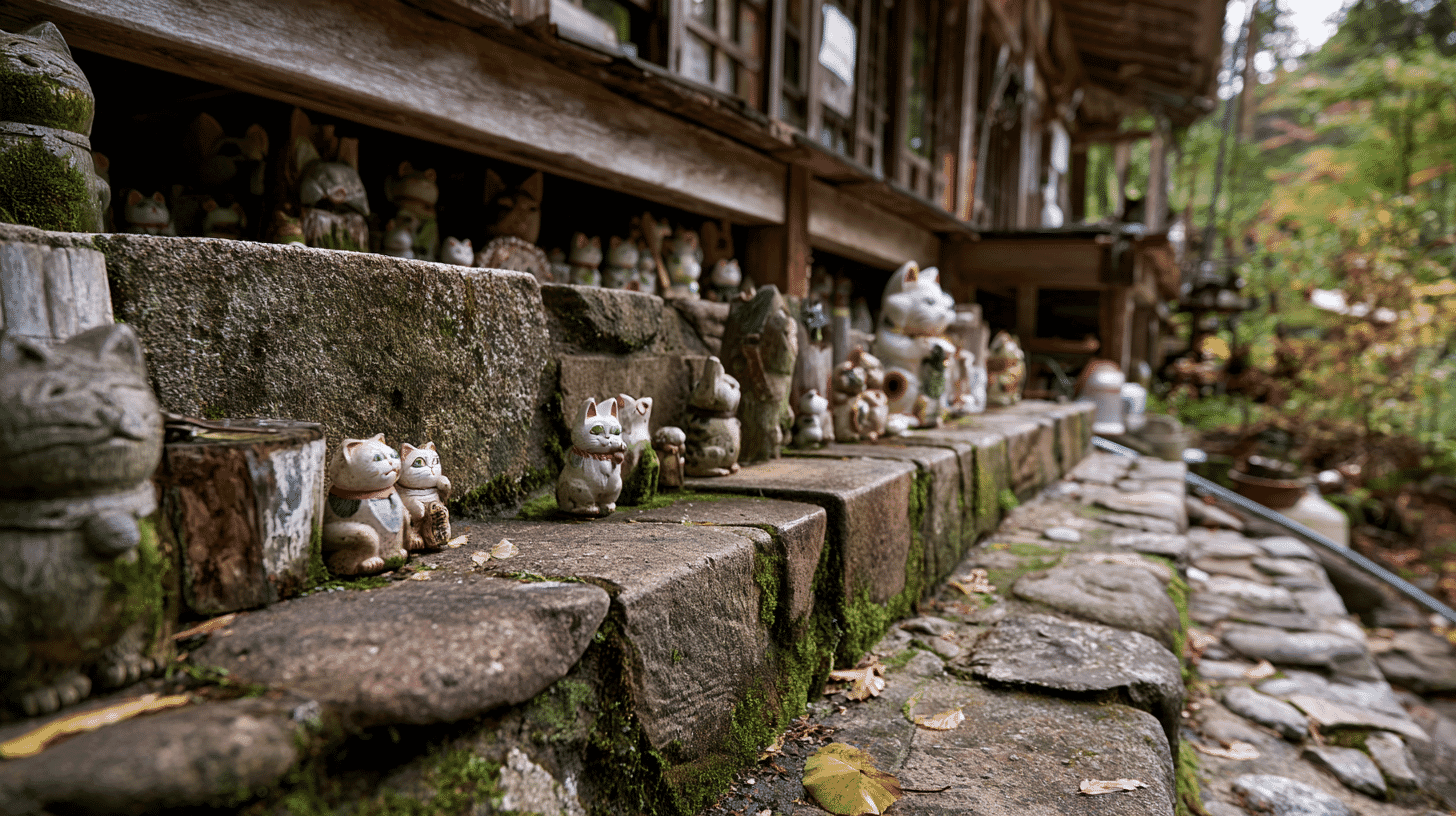
🐕 Up a mountain road in Hagi, in western Japan, there is a Buddhist temple so full of cats that people simply call it Neko-dera, the Cat Temple. This year it started offering a paper charm against harassment. The animal on it is a dog. The reason is hiding inside the English word "harass," and, the way the priest tells it, the charm is meant to calm whoever is about to lose their temper.
A mountain temple full of cats
Unrinji is a Rinzai Zen temple in Hagi, Yamaguchi Prefecture, with more than 400 years of history. It sits about 30 minutes by car from the old town, in farming country. The stone steps, the veranda and the main hall are crowded with beckoning maneki-neko, figurines, and wooden cats carved with a chainsaw by Takao Hayashi, a Yamaguchi-based artist. Anime and manga illustrators have donated cat artwork too. The Mainichi Shimbun counts more than 1,000 cat figurines and other pieces. The temple also keeps more than 800 Jizo statues found in a nearby village.
There is a legend behind the nickname. In 1625, when Mori Terumoto, lord of the Hagi domain, died, his retainer Nagai Motofusa followed him in death. Motofusa's cat, the story goes, stayed by its master's grave for 49 days and then died there. Its cries were heard every night until a monk at Tenjuin, Terumoto's temple, held a memorial service for it. Tenjuin closed around the Meiji Restoration. Unrinji was one of its branch temples.
The Japan Tourism Agency's visitor guide is honest about this: the temple's historical link to Motofusa's cat is tenuous. The cats came much later. Jisei Sumida became head priest in 1996, and according to a 2026 report by a Yamaguchi University researcher, the temple's life as a cat temple began around 2008, when he put a gifted collection of beckoning cats on display. The prefecture's tourism federation says that first batch was 20 to 30 figures. Visitors kept bringing more.
Why a dog
The charm's name is written 波羅洲免吐調御符, read harasumento chōgo-fu. The first five characters are picked for sound, spelling out "harassment" the way Japanese sometimes writes foreign words with kanji. The last three mark it as a charm.
Local broadcaster tys Television Yamaguchi described the art as the Buddha resting a hand on a dog and waiting for it to settle down. It is the temple's first charm with a dog as its motif, and if you look closely, a cat is hiding in it too, according to the Mainichi Shimbun. The priest's explanation is that "harass" is said to come from a French word for the cry that urges hunting dogs on once they have found their prey.
Dictionaries mostly back him up. Merriam-Webster traces "harass," first recorded in English in 1612, to French harasser, and from there to Middle French harer, "to set a dog on," built on hare, an Old French cry used to urge dogs forward. Etymonline is more careful and calls the origin uncertain, with harer as one possible source. Either way, trace the word back far enough and harassment begins with someone shouting a pack of dogs into a chase.
So the dog on the charm is not the victim. It is the one being stirred up, and the Buddha is calming it. Next to it runs one line: "Let those harsh voices stop here."
Less a shield than a brake
The idea came from his regulars, who told him about bosses who leaned on them hard and remarks that stung, and asked whether the temple had a charm for that. Yet the priest mostly talks about the other side. Once people get worked up, he told tys, they can chase someone into a corner, and the charm is there to say: calm down, take a breath. yab Yamaguchi Asahi Broadcasting, which covered it in April, put it more plainly: it is for not harassing, more than for not being harassed. People who harass are not always acting out of malice, the priest said. Sometimes it is a sense of justice, or of duty, that runs out of control.
Going from that first request to a finished design took several years; reports put it at three to five. The charm costs 1,000 yen (about $6) and has been offered since spring 2026. Besides selling it at the temple, Unrinji was also taking orders by phone and through its social media accounts as of April 2026, yab reported.
Speaking to the Mainichi Shimbun, the priest described Japan as being in a transition, from an era when strong words were tolerated toward one where people forgive and try to understand each other. He hopes people will put the charm up at home or at work, as a cue to pause.
Why it is in the news again
From October 1, 2026, every employer in Japan, even one with a single worker, must take measures to protect staff from customer harassment, known as kasuhara. The amendment to the Comprehensive Labor Policy Promotion Act passed in June 2025. As the rule took effect, local TV and newspapers picked up the spring charm again. We covered the law and the "customer is god" culture behind it in an earlier article.
Japan has more than one cat temple
Gotokuji, a Soto Zen temple in Tokyo's Setagaya ward, says it is the birthplace of the maneki-neko. Its legend has a cat beckoning Ii Naotaka, lord of the Hikone domain, through the gate just before a thunderstorm broke. Shonenji in Kyoto, a Jodo temple founded in 1606, also goes by Neko-dera. In its story, the third head priest's cat helped bring the struggling temple back to life, and the temple now holds memorial services for animals every spring and autumn. If you would rather meet live cats, Japan has an island for that, too.
Other countries have their own animal temples. At the Karni Mata temple in Deshnoke, in India's Rajasthan state, about 20,000 rats are treated as sacred, and spotting a rare white one is said to bring luck. Is there a temple, church or shrine near you that seems to belong to an animal? And if you could hang one line on your office wall, would you pick "Let those harsh voices stop here"?
References
- https://news.infoseek.co.jp/article/mainichi_20261015k0000m310131000c/
- https://newsdig.tbs.co.jp/articles/-/2996795
- https://www.youtube.com/watch?v=fDKCSoPCUig
- https://www.mlit.go.jp/tagengo-db/R2-00355.html
- https://www.mlit.go.jp/tagengo-db/common/001556462.pdf
- https://yamaguchi-tourism.jp/blog/detail_144.html
- https://www.yamaguchi-u.ac.jp/rits/wp-content/uploads/2026/08/20260811yamaguchimutsumi.pdf
- https://x.com/nekoma40
- https://www.merriam-webster.com/dictionary/harass
- https://www.etymonline.com/word/harass
- https://www.businesslawyers.jp/articles/1457
- https://gotokuji.jp/en/manekineko/
- https://nekodera.net/w/eng
- https://www.worldatlas.com/articles/where-is-the-karni-mata-rat-temple.html







Global Discussion
4 comments