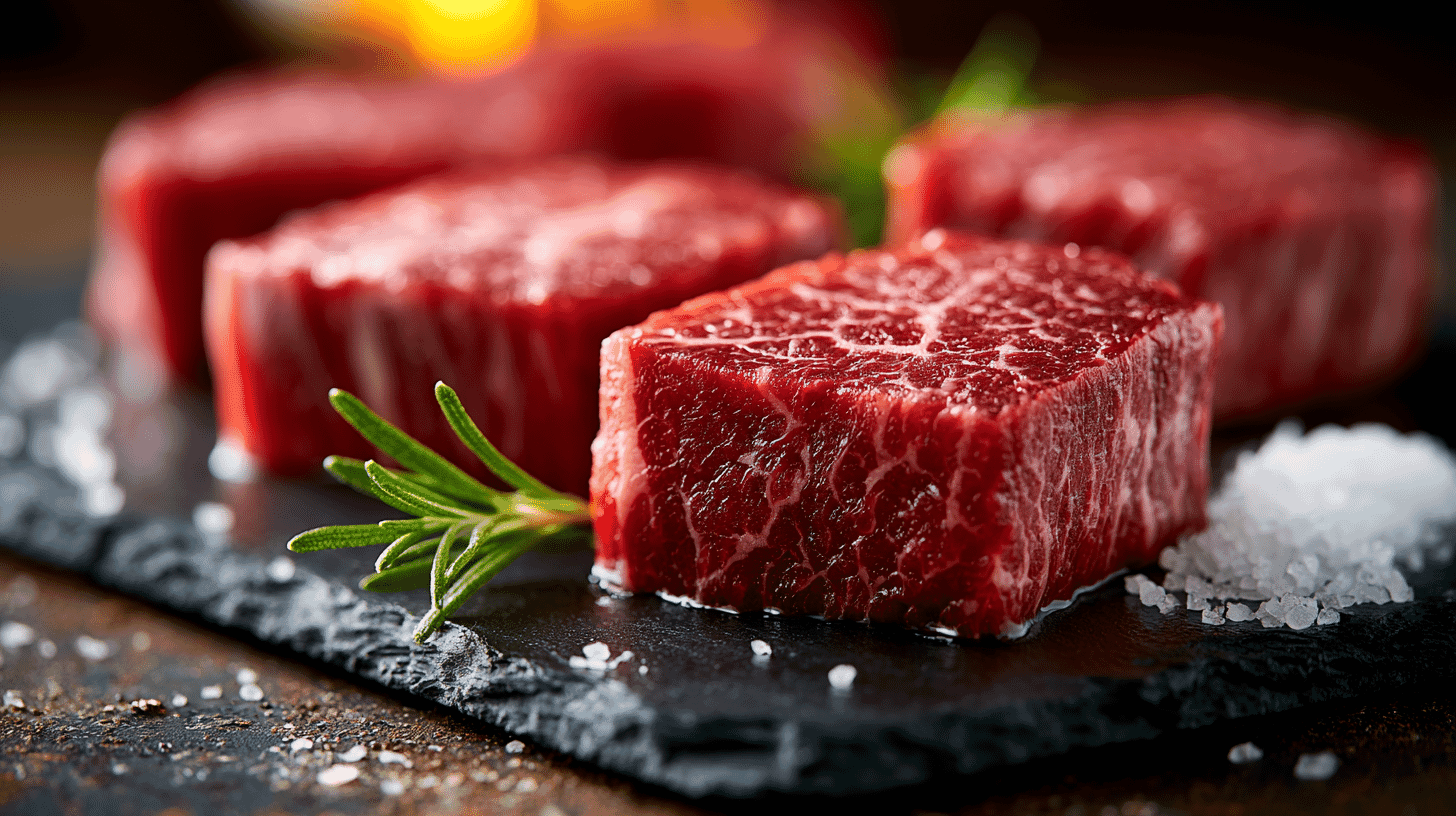
🥩 You can order "Kobe Beef" in New York, Singapore, or Dubai. But there are Japanese wagyu brands so rare that they barely leave the prefecture where they're raised, let alone the country. Japan's beef exports just hit another record high, and yet the cattle most prized by Japanese food obsessives are exactly the ones you'll never find on a menu abroad. Here's why the wagyu world splits in two.
First, "wagyu" isn't quite what most people think
Outside Japan, "wagyu" has come to mean "very marbled, very expensive beef," and increasingly it's raised in Australia, the United States, or anywhere with a herd descended from Japanese bloodlines exported in the 1990s. Those cattle are usually crossbreds, and to keep them separate, people often spell them "WAGYU" in capital letters.
In Japan, the word is narrower and legally defined. Real wagyu (和牛) means one of just four native breeds, or a cross between them, born and raised in Japan, with the pedigree traceable through a national registration system. By far the dominant one is the Japanese Black (kuroge washu), which accounts for well over 90% of the wagyu raised in the country. The other three, Japanese Brown, Japanese Shorthorn and Japanese Polled, are niche. The Japanese Polled, for instance, has dwindled to roughly 200 head nationwide.
On top of the breed sits the brand. A brand beef (銘柄牛) is cattle that meets a specific region or group's rules on bloodline, feed, raising method, and grade. There are more than 300 of them across Japan: Matsusaka, Yonezawa, Hida, Saga, Maezawa, and on and on. Most trace back to a single foundational bloodline: the Tajima cattle of Hyogo Prefecture, which is also the source of Kobe Beef and, by some estimates, the genetic ancestor of the great majority of branded wagyu nationwide.
So when someone abroad eats "wagyu," and someone in Japan debates which brand of wagyu is best, they're often not talking about the same thing at all.
The brands that crossed the ocean
A handful of brands have become genuinely global. Kobe Beef is the obvious one. Strictly speaking, the official name is "Kobe Beef" or "Kobe meat," and it refers only to Tajima cattle that clear demanding grade requirements. It's protected as a geographical indication in Japan and trademarked in many overseas markets, which is part of why it became the worldwide shorthand for luxury beef.
But Kobe is far from alone. Miyazaki beef quietly built a dominant position in the United States more than a decade ago through a single big processor, Miyachiku, and aggressive promotion. Saga beef went the other direction geographically, becoming a favorite in Hong Kong, Macau, and Singapore after the prefecture started exporting in 2007 and, more recently, opened its own high-spec slaughter facility, KAKEHASHI, to ship directly from the source. Hida beef built its own export-certified plant in Gifu. Omi and Kagoshima beef move through a specialized facility in Himeji that processes brands from across the country.
The latecomer to all this is Matsusaka, one of the "big three" wagyu names domestically. It only began a serious export push around 2023, planning to multiply its overseas shipments more than tenfold and running promotional events as far afield as Dubai. For a brand that famous, that's surprisingly recent, and it points to the real reason some wagyu travels and some doesn't.
Why most wagyu never leaves the country
The bottleneck isn't fame. It's the slaughterhouse.
To export beef, the animal has to be processed at a facility certified for the destination country, and those standards are strict, especially for the United States and the EU, which scrutinize everything from hygiene to animal welfare. Building or upgrading a plant to clear them takes years and serious money. As a result, only somewhere in the range of a dozen-plus facilities in all of Japan are certified to handle export beef.
That single fact reshapes the whole map. A brand can be world-class, but if its cattle can't reach a certified plant for the country you live in, its beef legally cannot be exported there. Kobe's producers spent years getting a nearby facility approved for the US and EU precisely so they didn't have to truck cattle hundreds of kilometers to the few plants that qualified. Saga and Hida built their own. Most regional brands have done neither, and for many of them, with modest production and a loyal domestic market, there's little reason to.
There's also a matter of philosophy. As one Kobe Beef executive put it years ago, the old attitude was simple: if you want Kobe Beef, come to Japan and eat it. It was Japan's shrinking population, not foreign demand, that eventually pushed producers to look overseas to keep their operations viable.
The phantom beef you can only eat in Japan
Then there are the brands Japanese food lovers chase precisely because they're almost impossible to get: the ones nicknamed maboroshi, "phantom" beef.
Mishima beef comes from a tiny island in Yamaguchi Prefecture and is a purebred native strain so rare and historically important that the cattle are treated as a protected natural monument. Production is minuscule; even in Japan, eating it is a once-in-a-lifetime event for most people. Iga beef, raised in a cold mountain basin in Mie Prefecture, has lived for generations in the shadow of its famous neighbor Matsusaka, beloved by insiders but consumed almost entirely close to home. Brands like these aren't holding back from the world out of strategy. There simply isn't enough of them to go around, and what exists rarely makes it past the local region, never mind across an ocean.
The exception that proves the rule is Ozaki beef, named not after a place but after the farmer who raises it, Muneharu Ozaki, in Miyazaki. He ships only around 30 head a month, finishing them far longer than usual. By every measure it's a phantom brand, and yet it turns up on the tasting menus of three-star restaurants in Paris. It's a reminder that for these ultra-limited names, "available abroad" is less about export pipelines than about a chef somewhere being willing to fight for a few kilograms.
China, and the climb to 2030
The biggest missing piece on the export map is China. Japan's beef was banned there in 2001 after a case of BSE ("mad cow disease"), and it has stayed out ever since. In July 2025 the two countries' quarantine agreement finally took effect, bringing a reopening after 24 years within reach. Then, by late November 2025, the talks reportedly stalled amid worsening Japan–China relations: proof that for all the food-world romance, wagyu exports ride on diplomacy as much as on flavor. (Note: a year after the agreement took effect, as of July 2026 there had been no visible progress in the talks and shipments had still not resumed.)
The trajectory everywhere else, though, keeps climbing. Japan's beef exports reached a record 64.8 billion yen (about $405 million) in 2024, up 12.1% on the year and more than double the 2019 figure, and the first months of 2025 were running 15% ahead of the year before. The government's official goal is to push beef exports to 113.2 billion yen (roughly $708 million) by 2030, with the United States, Taiwan, and Hong Kong leading the way. A weak yen in the 160-to-the-dollar range has only sharpened the appeal of Japanese beef abroad.
So the wagyu you can buy in your city and the wagyu a Japanese gourmet quietly worships may never be the same animal. The famous brands chase the world; the rarest ones never leave. In your country, is the prized local food the one that gets exported, or the one you have to travel there to taste?






Global Discussion
4 comments