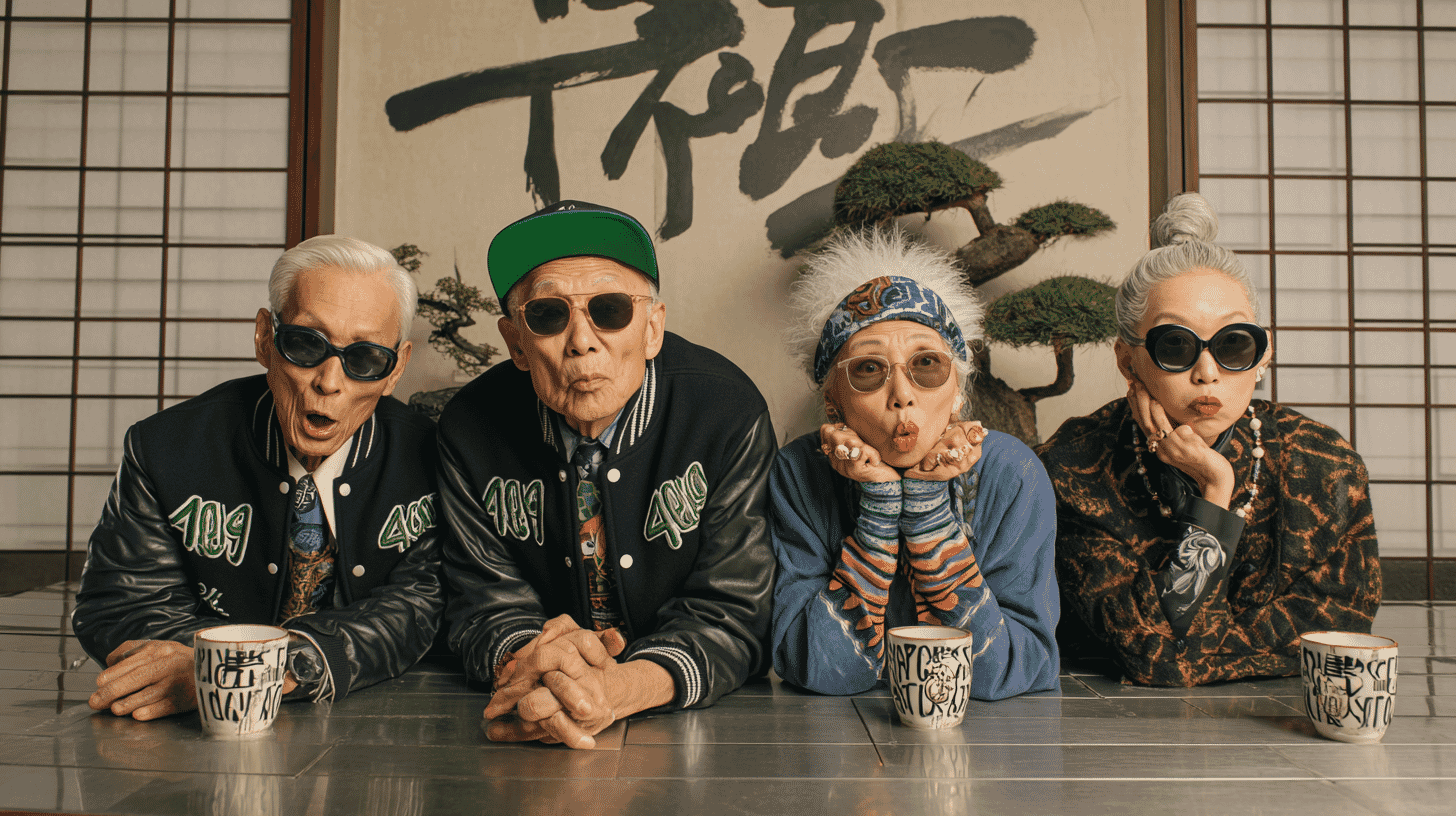
Two minutes from Shibuya Station, in the heart of Tokyo's trendiest youth district, a group of grandpas and grandmas (average age 73, oldest member 80) are serving tea at a new takeout cafe. Welcome to "G-CHA & Ba-CHA," where the motto is simple: youth isn't about age, it's a state of mind.
A Cafe Like No Other in Tokyo's Trendiest Neighborhood
On March 20, 2026, a unique takeout tea cafe called "G-CHA & Ba-CHA" (pronounced "Jii-cha Ba-cha") quietly opened near Miyamasuzaka in Shibuya, one of Tokyo's most famous and fashion-forward neighborhoods. What makes it special isn't just the matcha. It's the people behind the counter.
The staff serving your tea aren't college students or aspiring baristas. They're a group of regular grandpas and grandmas, recruited through open job postings, ranging from their mid-60s to 80 years old. The average age is 73. Three senior staffers are on duty at any given time, greeting customers with warmth and energy, while seated comfortably, by design.
The cafe's name is a clever Japanese wordplay. "Ji-chan" and "ba-chan" are affectionate terms for grandpa and grandma, while "cha" means tea in Japanese. The abbreviation "G&B" gives it a streetwear-cool ring that fits perfectly into the Shibuya landscape.
The Creative Minds Behind the Project
G-CHA & Ba-CHA was born from a collaboration between ENTAKU produce, an experience-design company, and Tokyu Corporation, the railway and real estate giant behind much of Shibuya's urban redevelopment.
The mastermind is Suguru Myoen, a creative director known for concept-driven pop-up experiences across Japan. His past projects include "Tomodachi ga Yatteru Cafe" (a cafe where staff talk to you like old friends) and "Ii Hito Sugiru Yo Ten" (an exhibition about people who are "too nice"). When Tokyu asked him to create something that would energize Shibuya, Myoen proposed the idea of seniors working stylishly in the heart of a young neighborhood.
A self-described "grandpa's boy" growing up, Myoen had long wanted to create a project centered on the senior generation. Seeing his own parents' generation, now in their 60s and 70s, still full of energy, he was convinced that older adults deserved a cool, creative space to be active and visible.
The cafe occupies a building that will eventually be demolished for redevelopment, so it's planned to operate for about 18 months to two years while the space is available.
The "3 G&B Rules," Designed for Senior Wellbeing
What truly sets this cafe apart is how seriously its creators thought about making work sustainable and enjoyable for elderly staff. They consulted occupational health doctors and specialists in senior employment to develop a custom set of workplace rules.
The 3 G&B Rules:
- Rest whenever you want to rest
- Speak up immediately if you're tired
- We work because it's fun
Staff serve customers while seated to reduce strain on joints, knees, and backs. If any staff member feels tired during operating hours, they can freely take a break, even if it means temporarily pausing service. The cafe's official Instagram proudly notes: "If our staff get tired, we will freely take a break!"
Orders are placed by customers filling out paper order slips using pink pens (the shop's signature color, chosen for high visibility). Payment is cashless only, eliminating the need for staff to handle money or operate a cash register.
One of the most charming innovations is the "Grandchild System" (mago seido). During busy periods, customers can volunteer to help as honorary "grandchildren", donning the cafe's uniform to assist with line management or order support. Volunteers receive a free drink as thanks.
While the senior staff handle customer-facing service, a younger employee works behind the scenes making the drinks.
The Menu: Japanese Tea with a Modern Twist
The drink menu was created under the supervision of Junki Yoshida, known for his work at the Ebisu-based "JANAI COFFEE." All teas use carefully selected matcha and tea leaves from Shizuoka Prefecture, one of Japan's premier tea-producing regions.
The full lineup of seven drinks includes:
- Ji-cha (Grandpa Tea): Ginger-infused hojicha / roasted green tea (¥780, about $4.90)
- Ba-cha (Grandma Tea): Jasmine green tea (¥800, about $5.00)
- Matcha Latte (¥930, about $5.80)
- Matcha Latte + Salty Caramel Sauce
- Matcha Latte + Chocolate
- Matcha Latte + Coffee
- Matcha Ice Cream
Customers choose from three cup designs, and when your order is ready, a staff member hand-writes your name on a sticker and places it on the cup, a personal touch that has become one of the cafe's signature moments.
Merchandise is also available, including shopping bags (¥300), stickers (from ¥200), caps (¥4,000), and T-shirts (¥6,300). Dollar figures in this article use ¥160 to the dollar, the rate as of July 2026.
Inside the Space: Street Culture Meets Japanese Tradition
The interior was built from a stripped-down shell. Mortar benches, wall-mounted graphics, wire mesh, and neon signs reading "健康" (Health) and "FOREVER YOUNG FOREVER GENKI" create a space that blends Japanese aesthetics with street culture. A private section features a silver counter and shoji sliding doors, a mix of tradition and modernity.
As a takeout-only shop, there's no seating for customers, but the stylish packaging, bags printed with the kanji for "元気" (energy/vitality) and "健康" (health), ensures you carry the shop's spirit with you.
Japan's Aging Society and the Concept of "Ikigai"
To understand why a cafe like this resonates so deeply in Japan, you need to understand the country's demographic reality. Japan's Statistics Bureau put the population aged 65 and over at 36.19 million as of September 15, 2025, or 29.4% of the total, the highest share among the 38 countries with populations above 40 million. In 2024, 9.3 million people aged 65+ were employed, a record high and the 21st consecutive annual increase since 2004, accounting for 13.7% of all workers. Roughly one in seven workers in Japan is now 65 or older.
But it's not just about economics. Japan has a deeply rooted cultural concept called "ikigai" (生きがい), roughly translated as "a reason for being", the thing that gives you purpose and makes you want to get up in the morning. For many Japanese seniors, staying connected to society and feeling useful is as important as physical health for maintaining quality of life.
G-CHA & Ba-CHA embodies this philosophy. Its slogan, "Youth isn't about age, it's a state of mind!", captures a growing sentiment in Japan that the elderly shouldn't be sidelined but celebrated and empowered.
Similar concepts have appeared elsewhere in Japan, such as the "Grandma Maid Cafe" in Takadanobaba (where all maids must be 65 or older) and "Orders May Be Wrong" restaurant (staffed by people with dementia). But G-CHA & Ba-CHA stands out for positioning seniors not as a novelty but as genuinely cool, blending the warmth of grandparents with the slick visual language of Shibuya's youth scene.
Cafe Information
G-CHA & Ba-CHA
- Address: 707, 1-12-24 Shibuya, Shibuya-ku, Tokyo
- Access: 2-minute walk from Shibuya Station (Miyamasuzaka exit)
- Hours: 11:00 AM – 7:00 PM
- Style: Takeout only
- Payment: Cashless only
- Instagram: @g_and_b_shibuya
Note: The cafe is expected to operate for approximately 18 months to 2 years, until the building is scheduled for redevelopment.
In your country, do seniors have opportunities to stay active and engaged in the community? Could a concept like "working because it's fun" catch on where you live? We'd love to hear how your country approaches aging and senior participation, share your thoughts!






Global Discussion
15 comments