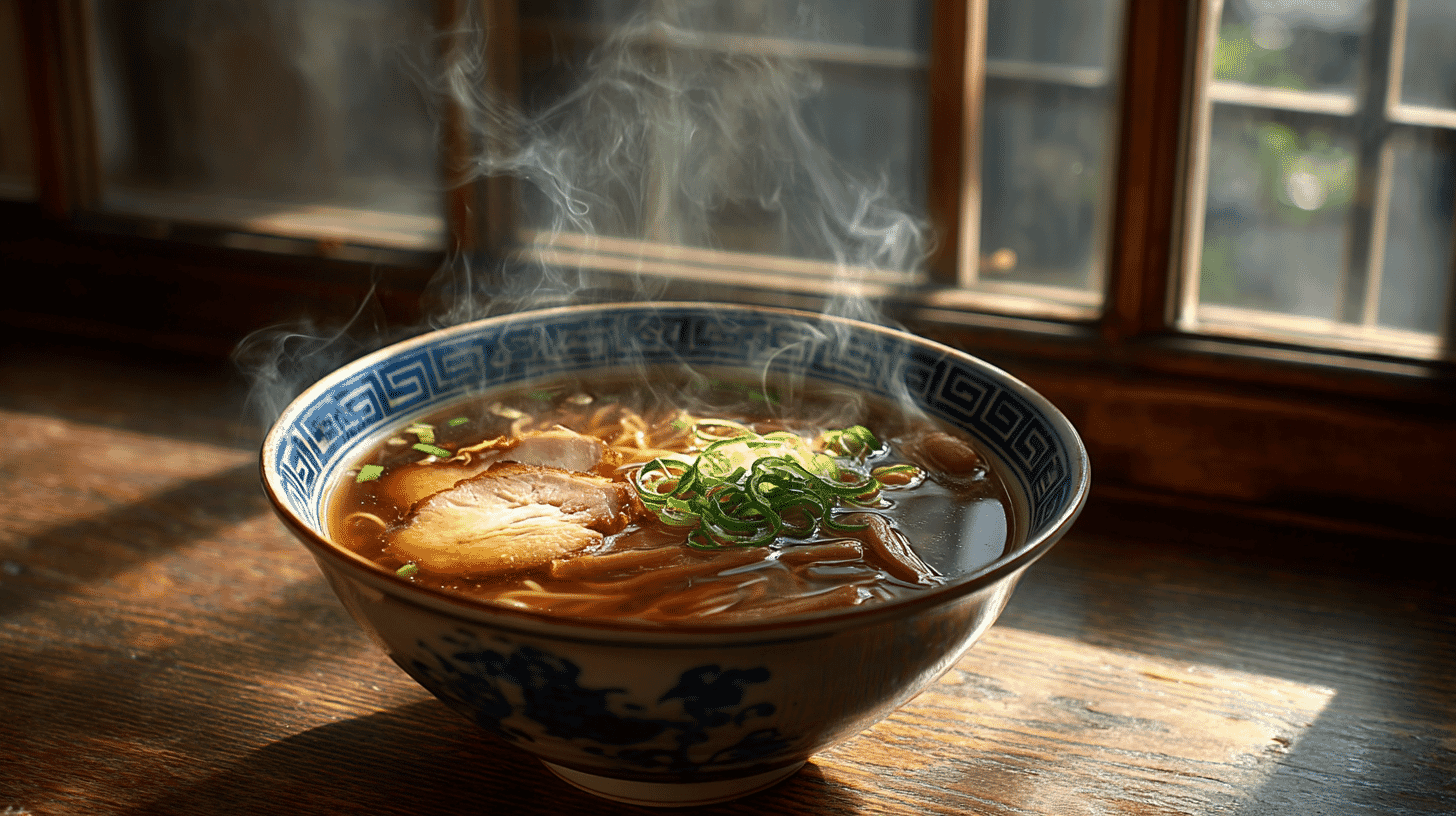
🍜 The bowl that arguably started it all is back, and the timing could hardly be better. Just as ramen overtook sushi as the food foreign visitors most love eating in Japan, the Asakusa shop credited with turning a Chinese noodle soup into "shoyu ramen" has reopened on the very street where it began in 1910. Its reviver isn't a celebrity chef. He's a TV producer, and the great-great-grandson of the man who started it all.
A customs officer, twelve cooks, and the shop that lit the fuse
In 1910, a former Yokohama customs officer named Ozaki Kan'ichi opened a modest eatery in Asakusa's Shinhata-cho and called it Rairaiken. To run the kitchen, he brought in twelve Chinese cooks from Yokohama's Chinatown.
The Chinese noodle soup circulating in Japan back then (known as "Nankin soba") was heavy, oily, and a bit too pungent for local palates. Ozaki's shop retuned it: a clear broth, seasoned with soy sauce, ladled over wheat noodles and sold cheaply to ordinary people. He called it "raumen." That bowl is widely described as the prototype of Tokyo-style shoyu (soy-sauce) ramen, the ancestor of the clear, brown, comforting bowl now served from Sapporo to São Paulo.
It caught on fast. During busy stretches like New Year, Rairaiken reportedly served 2,500 to 3,000 customers in a single day. The same shop is often named as the birthplace of two other Japanese-Chinese staples, chuka-don (a rice bowl topped with stir-fry) and tenshin-don (a crab-omelet rice bowl said to have been invented so customers could eat something fast).
One honest caveat, because the history gets embellished a lot: whether Rairaiken was literally Japan's first ramen shop is contested. The Shin-Yokohama Ramen Museum, which spent roughly three decades digging through the record, deliberately calls it "the shop that ignited Japan's first ramen boom" rather than the outright first. That is the safer, more accurate framing, and it's arguably a bigger claim anyway.
Why so many old Japanese eateries are named "-ken"
Here's the part that food-history nerds love. Rairaiken didn't just sell noodles; it minted a template.
As the shop packed out night after night in Asakusa (then Tokyo's great entertainment district, pulling visitors from across the country), copycats sprang up in its image. Cheap, casual, Chinese-inflected, serving ramen, wonton, and shumai. The format spread from the capital to the whole country, and with it spread a naming convention: shop after shop signed off with the suffix "-ken" (軒). If you have ever wondered why so many humble Chinese-Japanese diners in Japan are called something-something-ken, this Asakusa shop is a big part of the answer.
Rairaiken helped popularize the visual language too. The white bowl ringed with a blue "raimon" lightning pattern, the design foreigners now instantly read as "Chinese restaurant," spread alongside it. The shop became such a fixture of the national imagination that it turns up by name in beloved pop culture, from the Sazae-san comic strip to the Otoko wa Tsurai yo (Tora-san) films. This is the origin story of what Japan calls "machi-chuka": the neighborhood Chinese joint, unpretentious and everywhere, a genre unto itself.
Disappearance, and a great-great-grandson's gamble
Rairaiken's Asakusa location shut during World War II when the family's sons were drafted. The name resurfaced afterward near Tokyo Station and later in Uchi-Kanda, but with no successor to carry it, the shop finally lowered its curtain for good in 1976. For roughly half a century, one of the most important names in Japanese food history existed mostly in books and nostalgia.
The revival started as a museum exhibit. In 2020 the Shin-Yokohama Ramen Museum, drawing on its long research and the cooperation of the founder's descendants, reconstructed the Meiji-era bowl with supervision from Shina Sobaya, the revered shop of the late master Sano Minoru. It was a hit, but it was a five-year project, and in September 2025 the museum run ended.
That left Takahashi Yusaku with a decision. He is Ozaki Kan'ichi's great-great-grandson (through the founder's third son, who married into the Takahashi family), and by trade he runs a TV production company, not a noodle counter. At first he figured the name could live on through products or pop-up events. But everyone he talked to (companies, collaborators, fans) kept asking the same question: Isn't there an actual shop? A name alone, he realized, doesn't preserve a food culture. Without a place where people can sit down and eat, the memory quietly fades.
There was also a clock ticking at home. His grandfather, Takahashi Kunio, is 92 and is regarded as the only living relative who tasted the prewar Rairaiken bowl. Reviving the shop while his grandfather was still around to see it became the deciding motivation. On July 2, 2026, "Asakusa Rairaiken" opened its doors again in Asakusa, its birthplace, for the first time in about 80 years,, in a spot that until recently housed another old neighborhood Chinese diner.
The bowl itself: "hundred-year soy sauce"
The flagship is called the Hyakunen Shoyu Raumen, the "hundred-year soy sauce raumen." It's a reconstruction, not a guess. The noodles use "Sato no Sora," a modern wheat variety that carries genes traced back to Meiji-era grain, and the soy sauce is Yamasa, the same brand Rairaiken used from the start. The result is a clear pork-and-chicken broth, complex and faintly sweet, with wavy noodles, simple menma, green onion, and a slightly sweet slice of char siu. Showa-era comfort in a bowl.
It's priced to match its populist roots. Early diners report the raumen around ¥850 (roughly $5) and a small tenshin-don near ¥550 (about $3.40): the affordable, everyday register that Rairaiken pioneered when it first made "expensive" Chinese food cheap. The shop sits at 3-42-4 Asakusa, Taito Ward, open 11:00 to 20:00.
The origin story behind a global craze
Why does one small reopening matter beyond Tokyo? Ramen is having a global moment, and at home it just dethroned the old king. In a Japan Tourism Agency survey, ramen was the food foreign visitors named as their most satisfying meal in Japan, at 18.9%, ahead of sushi's 14.5%. Outside Japan, a 2025 agriculture ministry survey counted roughly 181,000 Japanese restaurants worldwide, double the roughly 89,000 of 2015 but about 6,000 fewer than the 187,000 recorded in 2023. Global instant-noodle demand hit a record 123.07 billion servings in 2024, per the World Instant Noodles Association. Fukuoka-born chains like Ippudo and Ichiran have turned tonkotsu into a passport stamp from New York to Paris.
All of it traces back, in part, to a customs officer in 1910 who thought a Chinese noodle soup would taste better with a splash of soy sauce. The dish now filling food courts worldwide has a birthplace, and as of this summer you can eat it there again.
Japan tends to remember exactly where its everyday foods came from, down to the street and the year. Does your country's national comfort food have an origin story like this, a single shop, a single person, that everyone can point to?
References
- https://toyokeizai.net/articles/-/950206
- https://www.tokyo-np.co.jp/article/498119
- https://www.raumen.co.jp/shop/rairaiken.html
- https://ja.wikipedia.org/wiki/来々軒
- https://japantoday.com/category/features/food/sushi-passed-up-by-ramen-in-survey-of-foreign-tourists%E2%80%99-favorite-thing-to-eat-in-japan-but-why


Global Discussion
0 comments