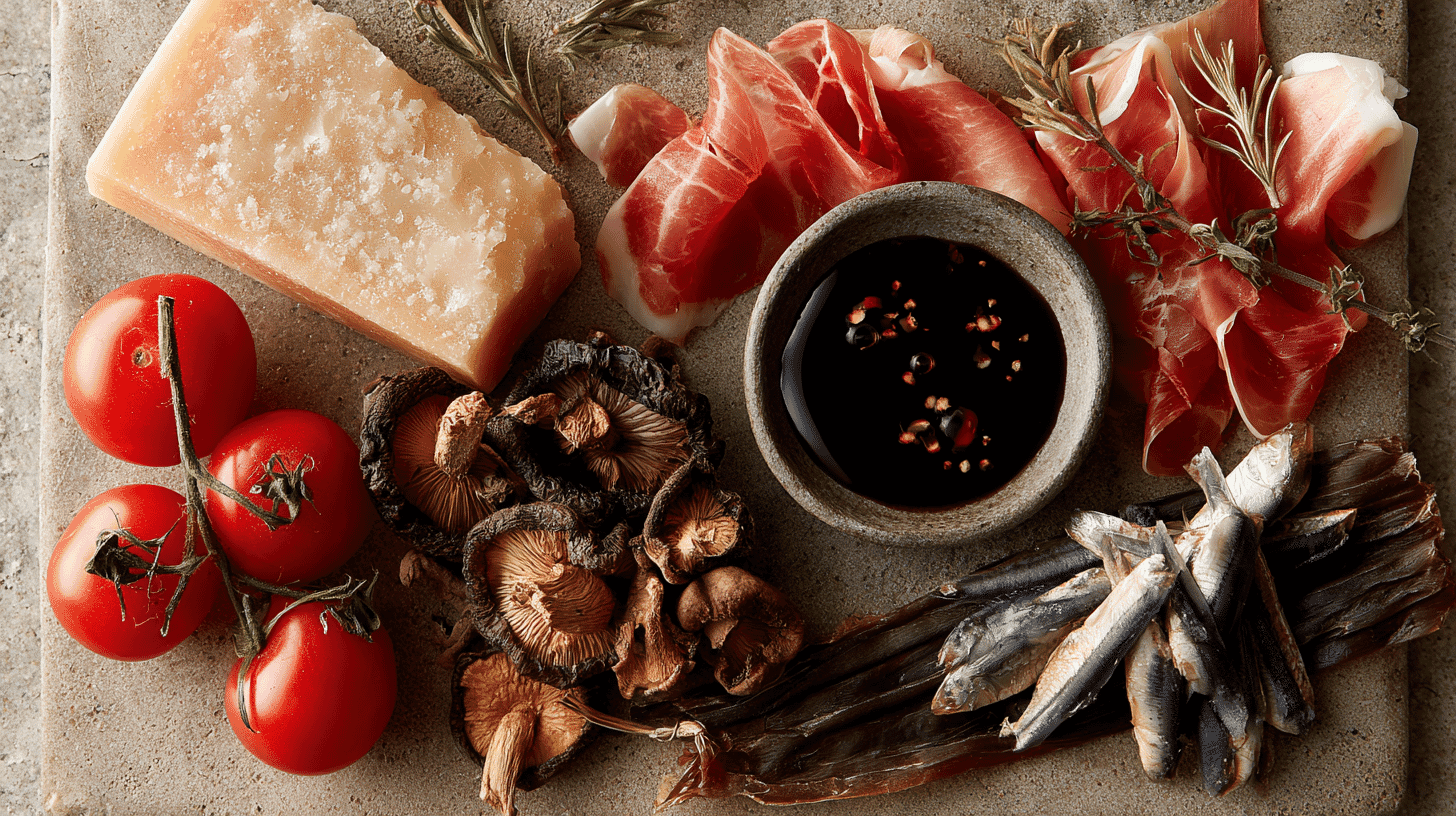
🍅 A pepperoni pizza is, biochemically speaking, a savory bomb. The cheese, the cured meat, the tomato sauce: each one is loaded with glutamate, the molecule behind the taste we now call umami. Anyone who has ever eaten that pizza and felt it land, deep and round and satisfying, has tasted umami. So here is the strange part: for most of the twentieth century, Western science insisted this taste didn't really exist. The man who proved it did was a Japanese chemist working with a pot of seaweed stock in 1908, and the world spent the next hundred years catching up to him.
The chemist and the bowl of soup
In 1907, Kikunae Ikeda was already one of Japan's leading physical chemists. He had studied in Germany under Wilhelm Ostwald, one of the founding figures of the field, and on his way home had spent a few months in London sharing a boarding house with a then-unknown novelist named Natsume Sōseki, who later became one of Japan's most celebrated writers. Ikeda was, by any measure, a serious scientist working at the frontier of theoretical chemistry.
What pulled him toward the kitchen is a story that has been told and retold, and the details are disputed. The popular version, which Ikeda himself recounted, is that he noticed the deep savoriness of a dashi, the basic Japanese soup stock made from kelp (kombu) that his wife had prepared, and wondered what was responsible for it. Some historians argue the romantic "wife's kelp" anecdote oversimplifies things, and that Ikeda, who grew up in the Kyoto region where kelp-based dashi is central to the cuisine, had been circling the question for years. Either way, in 1908 he set to work on a deceptively simple question: what, exactly, makes dashi taste so good?
His method was brute-force chemistry. He boiled down roughly 12 kilograms of dried kelp, precipitated the unknown acid as a lead salt, and was left with about 30 grams of crystals. They were glutamic acid. He then worked out how to manufacture its sodium salt, monosodium glutamate, which dissolved more readily and tasted better. He filed a patent in April 1908, and in May 1909 Suzuki Seiyakusho, the small firm run by Saburosuke Suzuki that would be renamed Suzuki Shōten in 1912 and eventually become Ajinomoto, put the world's first commercial umami seasoning on sale.
A taste that needed a name
Here is a point that trips almost everyone up, including chemists of Ikeda's own era: Ikeda did not discover glutamic acid. The molecule had already been isolated in 1866 by the German chemist Karl Heinrich Ritthausen, and it was well known in chemistry circles. One leading Japanese agricultural chemist of the time reportedly grumbled that Ikeda's work was the sort of thing he should have done himself. He had tasted glutamic acid, he said, but had never thought to taste its salt.
That distinction is the whole point. Ikeda's breakthrough wasn't the chemistry of glutamate. It was the recognition that the savory sensation was a distinct taste in its own right: not a blend of the four tastes everyone already accepted (sweet, sour, salty, bitter), but a fifth, standing on equal footing with them. He named it umami, from the Japanese word for "delicious." Giving the sensation a name was the radical act. Once a thing has a name, you can argue about whether it's real. And the world argued for a long time.
The hundred-year shrug
Ikeda published his findings in 1908, in Japanese, in the Journal of the Tokyo Chemical Society. And then, in the West, very little happened for decades.
There was no single reason for the long silence. It was a tangle of several. The paper was in Japanese, and translation lagged. The twentieth century was a brutally tense stretch between Japan and the West, with a world war in the middle of it, and scientific ideas did not flow freely across that divide. The historian Victoria Lee has noted that flavor research was flourishing in Japan partly because fermented foods like soy sauce, miso, and sake were central to both the diet and the economy: the questions that felt urgent in Tokyo simply weren't the questions being asked in Chicago.
And underneath all of that ran a quieter current: the assumption that a "fifth taste" coming out of Asia didn't need to be taken seriously. Western textbooks had four tastes, mapped neatly onto the tongue, and that was that. The idea that the four-taste model might be incomplete, and that the correction came from Japan, was not a comfortable one. Care is needed here: language barriers, geopolitics, and plain scientific caution weighed as much as bias did. But bias was part of the mix, and several food historians now say so plainly.
The result was a peculiar split. By the 1930s, MSG had quietly spread through Asian kitchens and was even slipped into American soldiers' rations during the Second World War to make bland food palatable. Pringles and Campbell's soup would later lean on glutamate without controversy. The taste was everywhere. The acceptance of the taste as a real, basic category was nowhere.
The proof on the tongue
The turning point came not from a kitchen but from a laboratory bench, and it took the better part of a century to arrive.
The first major shift came in the 1980s. An international symposium on umami, held in 1985, brought together psychophysical and electrophysiological evidence that the savory taste behaved independently of the other four: it could not be reproduced by mixing them. That was the moment umami began, formally, to be treated as the fifth basic taste rather than a curiosity.
But the clinching evidence was molecular. In 2002, a research team including Greg Nelson and Charles Zuker reported in Nature the receptor that responds to amino acids on the tongue, a pairing of two proteins called T1R1 and T1R3. The same year, a separate study in PNAS identified the human version of this receptor and showed it responds specifically to L-glutamate. There it was: a dedicated piece of biological hardware, sitting on the human tongue, whose job is to detect the very molecule Ikeda had pulled out of his kelp in 1908. Not a Japanese tongue, but the ordinary human one.
The myth that umami is something "only Japanese people can taste" collapses entirely at this point. The receptor is part of the standard human genome. What was Japanese was not the ability to taste umami, but the culture that noticed it clearly enough to name it, and the science that finally proved it.
What the cooks knew first
The most elegant part of the story is what the laboratory confirmed about the kitchen.
Japanese cooking had long combined kelp dashi with katsuobushi, dried and fermented bonito flakes. Nobody in a sixteenth-century kitchen knew why, but the combination tasted dramatically richer than either ingredient alone. Ikeda's successors explained it. In 1913, his student Shintaro Kodama identified the savory compound in bonito as inosinate; in 1960, the researcher Akira Kuninaka, working at Yamasa, identified the one in shiitake mushrooms as guanylate. Glutamate, inosinate, and guanylate are now called the three umami substances.
And here is the punchline: they amplify each other. Glutamate and inosinate together don't just add up, they multiply. Add katsuo dashi to kombu dashi and the umami intensity runs about seven to eight times that of kombu dashi alone. The kelp-and-bonito dashi that Japanese cooks had made for centuries was, it turned out, a near-perfect exploit of a biochemical synergy that wouldn't be measured in a lab until the 1960s. The cooks were running the experiment long before anyone could read the result.
This is why umami is universal, and always was. Parmesan aged for years, a long-simmered French fond, a Chinese stock, ripe tomatoes, anchovies, soy sauce, cured ham: every cuisine on earth had found its own routes to glutamate-rich ingredients and built beloved dishes around them. They simply hadn't drawn a circle around the sensation and given it a name. Japan did, and that naming is the real contribution, because a taste science refuses to name is a taste science cannot study.
What's the ingredient your own kitchen reaches for when a dish needs to taste fuller: the cheese, the fish sauce, the tomato paste, the stock cube? Odds are you've been cooking with umami your whole life. What do you call it where you're from?
References
- https://www.ndl.go.jp/kaleido/entry/17/3.html
- https://www.ncbi.nlm.nih.gov/pmc/articles/PMC4515277/
- https://www.npr.org/2022/05/02/1095988620/why-it-took-nearly-100-years-for-umami-to-be-globally-accepted-as-a-distinct-fla
- https://qz.com/978414/the-incredible-taste-of-umami-was-proven-in-1907-in-japan-but-ignored-by-the-west-for-a-century
- https://www.ajinomoto.com/umami/discovery-of-umami
- https://www.umamiinfo.jp/what/attraction/kelp/





Global Discussion
4 comments