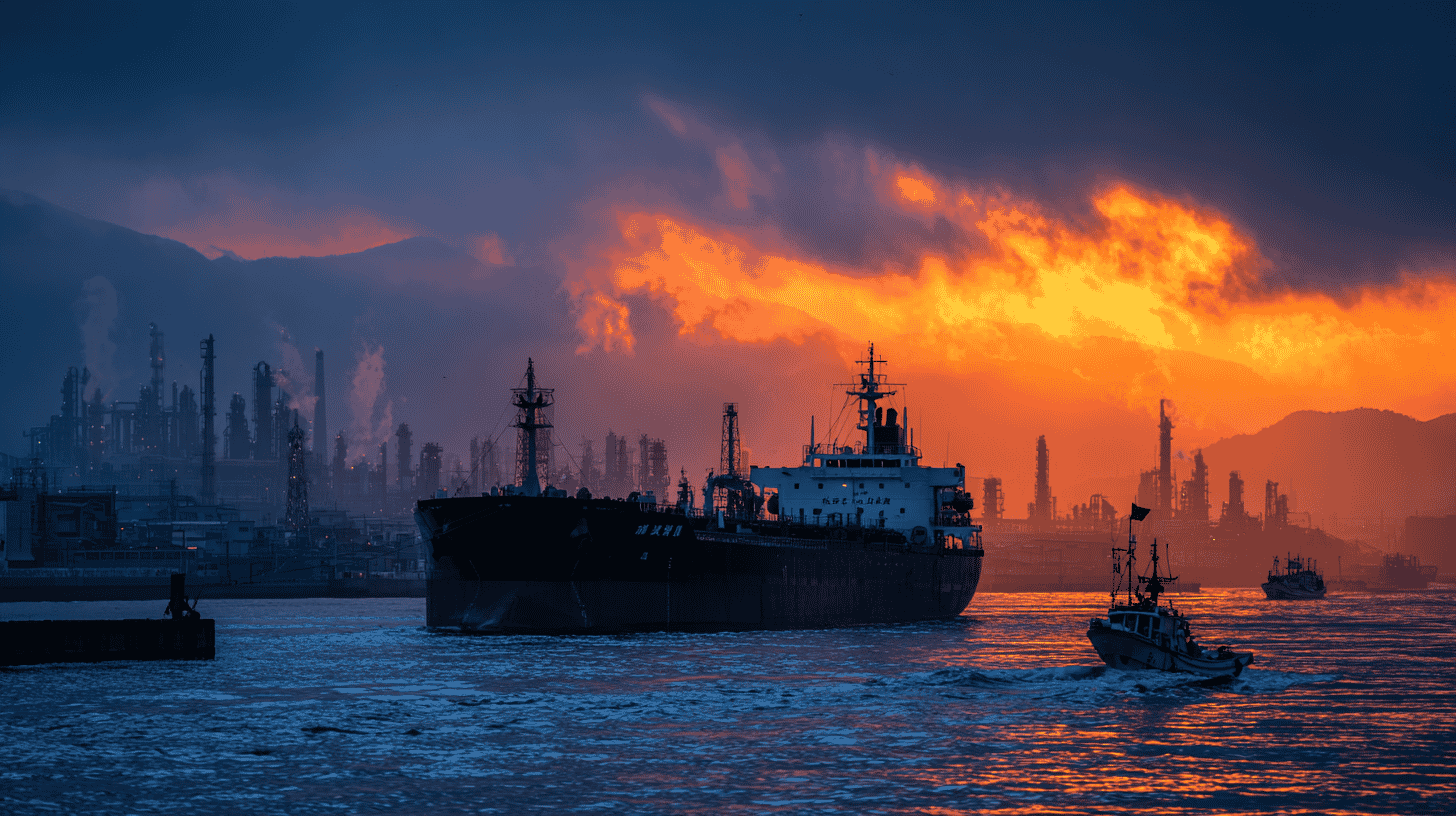
More than two months after the Strait of Hormuz was effectively shut, Japan made a move that says a great deal about the limits of its energy diplomacy: it bought Russian crude. A tanker carrying Sakhalin-2 oil headed for Taiyo Oil's facility in Imabari, Ehime Prefecture, the first Russian cargo bound for Japan since the blockade began.
Officially this is diversification. In practice it is closer to swapping one dependency for another, and it lays bare a contradiction Japan has been living with for years.
A tanker, a spot deal, and a Sakhalin pipeline back to Russia
Taiyo Oil, Japan's fourth-largest refiner, disclosed on May 1 that it had procured Russian crude. The deal was a spot purchase, a one-off contract rather than a long-term commitment: emergency improvisation in response to the Middle East crisis, not a strategic pivot. It was not a purely commercial decision either. A senior official at the Agency for Natural Resources and Energy had asked the company to secure the cargo given the deteriorating situation in the Gulf.
The tanker left Sakhalin in late April, bound for waters off the company's Shikoku works in Imabari.
Update (July 2026): the tanker Voyager reached Imabari in the early hours of May 4 and discharged on May 5. The same vessel also unloaded at Fuji Oil, an Idemitsu Kosan subsidiary, in Chiba Prefecture. According to METI's preliminary petroleum statistics released on June 30, Japan imported 761,551 barrels of Russian crude in May. It was the first Sakhalin Blend cargo in roughly a year.
The Sakhalin-2 project is led by Russian state-backed gas giant Gazprom, with Japanese trading houses Mitsui & Co. and Mitsubishi Corporation holding 12.5% and 10% respectively. Sakhalin-2 has been producing crude year-round since 2008 and exporting LNG since 2009. Japan also retains stakes in the neighboring Sakhalin-1 project.
This is the first Russian crude bound for Japan since the Strait of Hormuz fell into de facto closure.
Why now, and why Russia?
On February 28, 2026, the United States and Israel launched airstrikes on Iran, killing Supreme Leader Ali Khamenei. Iran's Revolutionary Guard Corps retaliated by banning passage through the Strait of Hormuz, laying mines and attacking commercial vessels. By early March, virtually all crude and LNG transit through the strait had stopped.
Before the closure, roughly 25% of the world's seaborne oil trade and about 20% of global LNG passed through Hormuz. Japan draws more than 90% of its crude from the Middle East, by far the most fragile position among IEA member countries.
Domestic gasoline broke through ¥190 per liter (about $1.21 per liter, or $4.59 per gallon) in March, an all-time high. Brent crude briefly topped $120 per barrel. Japan joined the IEA's largest-ever coordinated stockpile release, 400 million barrels across 32 member countries, and contributed about 80 million barrels itself: 15 days of private reserves plus a month of national reserves. That is roughly 3.5 times the 22.5 million barrels Japan released after Russia's 2022 invasion of Ukraine.
It still wasn't enough. Tokyo and Japanese refiners scrambled for non-Hormuz alternatives: Saudi crude routed via the Red Sea port of Yanbu, UAE crude via Fujairah, plus barrels from the United States, Mexico, Vietnam and Kazakhstan. The Sakhalin-2 cargo is the first time the Russian option has been used.
The "Sakhalin Exception": the loophole that won't quit
Here's the key fact: Sakhalin-2 crude is exempt from the G7/EU price cap on Russian oil.
In December 2022, the G7 and EU set a $60-per-barrel ceiling on seaborne Russian crude to choke off Moscow's war revenue. The cap was lowered to $47.60 in 2025. But Sakhalin-2 received a carve-out from the start, justified explicitly by Japan's energy security; on December 5, 2022, Japan's foreign, finance and industry ministries jointly set out the exemption on the Japanese side. In May 2025, the EU extended its own version through June 28, 2026.
So this purchase is not, in institutional terms, a sanctions violation. Nor is it a resumption of Russian crude imports generally. It sits inside the narrow carve-out built around Sakhalin-2.
Still, the image of a G7 member keeping exactly one Russian door open is a charge European researchers have made repeatedly, on the grounds that it sits awkwardly with the values-based diplomacy Japan says it practises.
Why can't Tokyo let go? Geography, sunk investment and LNG. Sakhalin-2 supplies about 9% of Japan's LNG imports, more than the volume that used to arrive via Hormuz. ExxonMobil walked away from Sakhalin-1 and Shell from Sakhalin-2, but Japan stayed put, fearing that withdrawal would simply hand the projects to China.
Germany, South Korea, India: three different bets
Other major importers facing the same shock have responded very differently.
Germany decoupled fast after Russia's 2022 invasion of Ukraine, pivoting from Russian pipeline gas to LNG from Qatar, the United States, and Norway. The catch: Qatari LNG also passes through the Strait of Hormuz. As the European Council on Foreign Relations put it, the diversification was geographic, not structural. By March 2026, German pump prices had blown past €2 per liter (about $2.13). Berlin released strategic reserves and cut fuel taxes for two months. Even a country that fully broke with Moscow could not escape the Hormuz shock.
South Korea's Middle East dependency is around 68%: heavy, but lighter than Japan's. With about 200 days of strategic petroleum reserves, its energy minister declared supply secure for over a year. President Lee Jae-myung agreed with French President Macron in April to cooperate on reopening Hormuz, while also delaying the retirement of older coal plants and rolling out a national energy-saving campaign. A pragmatic mix.
India has been the most blunt. Middle East dependency around 50%, strategic reserves of just 30 days, the most exposed of the three. Yet over the past three years New Delhi has sharply expanded Russian oil imports, and is now leaning harder still. Russian Ambassador Denis Alipov publicly confirmed that India has been buying large volumes of Russian crude recently. India and China are now in a bidding war for Russian cargoes, according to Kpler analyst Muyu Xu.
Japan's Sakhalin-2 move sits between Germany and India: keep the sanctions framework intact, but use every existing channel to the maximum.
The reserves are draining
As of March 21, Japan held a combined 240 days of oil reserves: 146 days national, 88 days private and 6 days from joint stockpiles with Gulf producers. That is OECD top-tier. But with Hormuz still shut, Japan has been drawing them down, and by April 3 the figure had fallen to 232 days.
METI announced that by May, alternative procurement should cover more than half of the previous year's volume, and supply can be secured beyond the year-end. A second tranche of 20 additional days of national reserves was authorized on April 15.
But that "secured" depends on alternative routes continuing to function. None of them, Russian, American, Mexican, Kazakh or Vietnamese, can replace the Middle East alone, and each carries its own political and logistical baggage.
The contradiction won't go away
For ordinary Japanese citizens, buying Russian crude during the Ukraine war leaves an uncomfortable taste, even if it is sanctions-compliant. Condemn Moscow's invasion publicly, then refuel from a Gazprom-led project quietly: the contradiction is hard to ignore.
Japan has an old virtue called seihin, literally "pure poverty": the idea that one should remain materially modest yet morally proud. Wandering monk-poets like Ryōkan and Saigyō embodied it, and Kōji Nakano's bestseller The Philosophy of Seihin (1992) revived the concept in postwar Japan. The West has its own versions: monastic vows of poverty, Stoicism, Thoreau's Walden, modern minimalism. All celebrate voluntary simplicity as a virtue.
History is unkind to the practice. The Franciscans were accumulating wealth within decades; Seneca preached frugality from inside an imperial fortune. Praising a principle without fully practising it is the norm for individuals, and more so for states. Japan refusing to let go of Sakhalin-2, Germany cutting fuel taxes, India openly buying Russian crude: the same pattern each time. Demanding total adherence brings a different kind of suffering, in the form of inflation and supply collapse.
The EU's Sakhalin exception expires on June 28, 2026. Without an extension, Japan's procurement options narrow further. Hormuz, meanwhile, shows no sign of fully reopening; the conditional US-Iran ceasefire holds, but transit volumes remain far below pre-crisis levels.
The structural fix, meaning renewables, nuclear restarts, hydrogen, EVs and genuine geographic diversification, is no longer a slogan. It is the country's survival math. One tanker arriving in Ehime is small news. The system it exposes is not.
What do you make of Japan buying Russian crude under these conditions? How is your country handling the Hormuz crisis? Should sanctions take priority over everyday life, or the other way around? Share your perspective in the comments.
References
- https://news.yahoo.co.jp/articles/d0553f6f522d47bce99f828e61e19aa4ed44588f
- https://news.yahoo.co.jp/articles/782f0ca9c9f917ba28205dbb4b0c51ce4de5ccfe
- https://www.nikkei.com/article/DGXZQOUC01A110R00C26A5000000/
- https://uk.finance.yahoo.com/news/japan-cuts-price-cap-russian-062438899.html
- https://enlargement.ec.europa.eu/news/eu-adopts-17th-sanctions-package-against-russia-2025-05-20_en
- https://www.iea.org/about/oil-security-and-emergency-response/strait-of-hormuz
- https://www.cnbc.com/2026/04/23/india-china-russian-oil-supply-strait-hormuz-disruption.html
- https://www.cleanenergywire.org/factsheets/how-will-2026-energy-crisis-affect-germanys-energy-transition
- https://www.cleanenergywire.org/news/germany-ready-release-oil-strategic-reserves-amid-escalating-persian-gulf-conflict
- https://ecfr.eu/article/beyond-the-strait-of-hormuz-how-europe-can-safeguard-its-energy-future/
- https://en.wikipedia.org/wiki/2026_Strait_of_Hormuz_crisis







Global Discussion
0 comments