
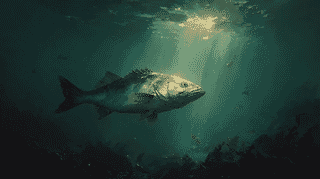
🐟 The mesh is just 1 centimeter wide. Nothing escapes, not even baby fish. After it passes through, the ocean is "empty." The weapon is called a "tiger net." Its nickname: the "Sea Vacuum Cleaner." And it's not just threatening Japan's waters. From South America to Africa, the same crisis is unfolding across the world's oceans.
The Tiger Net: What Was On the Seized Chinese Vessel
On February 12, 2026, a Japan Fisheries Agency patrol vessel spotted the Chinese tiger-net vessel Qiondongyu 11998 in Japan's Exclusive Economic Zone off Meshima in the Goto Islands, Nagasaki Prefecture. After the boat ignored a stop order for inspection and fled, its 47-year-old captain was arrested that afternoon on suspicion of violating Japan's fisheries sovereignty law (refusal of inspection). He was released the following evening, on the 13th. (For full details on the incident, see our related article.)
What made this seizure particularly alarming was what the vessel was carrying: a tiger net (tora-ami in Japanese), one of the most destructive fishing methods in use anywhere in the world today. After the arrest was announced, "Chinese fishing vessel seized" shot to the top of trending topics on X (formerly Twitter) in Japan, and many people learned the term "tiger net" for the first time, and were stunned by what it means.
After the Fisheries Agency's announcement, "Chinese fishing boat seized" trended on X (formerly Twitter), and many people said it was the first time they had heard the word "tiger net."
How Tiger Net Fishing Works, and Why It's Called the "Sea Vacuum Cleaner"
Tiger net fishing operates in three devastating steps.
Step 1: Lure fish with blinding lights Tiger net vessels are equipped with extremely powerful fish-attracting lights, far brighter than what Japanese fishing regulations allow. At night, these lights draw fish from a wide area into a single concentrated spot. Satellite imagery has captured tiger net fleets operating in the East China Sea glowing so brightly they resemble cities seen from space.
Step 2: Encircle with a massive net Once the fish are gathered, the vessel deploys an enormous bag-shaped net while circling the school. On large tiger net boats, these nets can span up to 1,200 meters (about 3,900 feet) wide. Some vessels carry small auxiliary boats on their sterns to assist with the operation. At 40 to 50 meters long, a single tiger net vessel essentially combines the functions of both a purse seine boat and a bottom trawler.
Step 3: Haul in from the stern Conventional purse seine fishing requires crews to cinch the bottom of the net shut like a drawstring bag, a labor-intensive process. Tiger nets skip this step entirely, hauling the catch directly from the stern. This simplification means a crew of roughly half the size can complete an operation in less time.
The critical problem is the mesh size. Tiger nets use mesh openings of approximately 1 centimeter (about 0.4 inches). This means they capture not just commercially valuable adult fish but also juvenile fish, small species, and virtually everything living in the water column. Compared to standard purse seining, tiger nets reportedly yield triple the catch at half the cost.
This combination of low cost, small crew, and total extraction is what earned the method its infamous Japanese nickname: "Sea Vacuum Cleaner" (umi no sōjiki).
Five Ways Tiger Nets Devastate the Ocean
The damage from tiger net fishing goes far beyond simply "catching too many fish."
1. Destroying the reproductive cycle Capturing juvenile fish with 1-centimeter mesh means wiping out the next generation before it can reproduce. Marine biologists note that mass juvenile harvesting can cause damage that takes decades to reverse, more so than catching adult fish.
2. Collapsing the food chain Tiger nets target migratory species like mackerel and horse mackerel, but they also sweep up small planktivorous fish indiscriminately. These small fish are a critical food source for larger marine predators, seabirds, and marine mammals. Removing the foundation of the food web triggers cascading effects throughout the entire ecosystem.
3. Creating "empty oceans" Local fishermen in Japan's Goto Islands report that catches have dropped to half of what they used to be, and they attribute this directly to Chinese tiger net vessels operating in the East China Sea's intermediate waters. After a tiger net fleet passes through an area, the sea is reportedly left virtually barren.
4. Undermining sustainable fishing efforts Japan imposes strict regulations on vessel size, fishing methods, and catch limits to manage resources sustainably. But when unregulated Chinese tiger net vessels harvest massively in the same waters, Japanese fishermen's conservation efforts are rendered meaningless. The system punishes those who follow the rules and rewards those who don't.
5. Degrading fish quality Fish caught in tiger nets are crushed and damaged during the hauling process, reducing their market value. Much of the catch ends up as animal feed or fertilizer rather than food-grade seafood. This quality issue is one reason Japan has never adopted tiger net technology; the Japanese fishing industry values product quality alongside sustainable yields.
Over 1,000 Tiger Net Vessels in the East China Sea
Tiger net boats first appeared in large numbers in the East China Sea around 2011. Their numbers have surged since then, with current estimates suggesting over 1,000 vessels now operate in the region.
China has an estimated 8 million fishermen (some estimates suggest over 12 million), and as the country's own coastal fisheries have been depleted through overfishing, fishermen have pushed further out to sea. Ironically, the exhaustion of China's domestic waters is one of the key drivers behind the expansion into other nations' EEZs.
Complicating matters further are so-called "sanwu" vessels, boats that lack all three documents required by Chinese law: a fishing license, vessel registration, and vessel inspection certificate. These ships are illegal even under China's own regulations. When over 200 Chinese coral-poaching boats appeared near Japan's Ogasawara Islands in 2014, many of them were sanwu vessels.
Not Just Japan's Problem: The Global IUU Fishing Crisis
China's fishing fleet isn't only a concern for Japan. Illegal, Unreported, and Unregulated (IUU) fishing has become one of the most serious environmental crises facing the world's oceans.
China operates the world's largest distant-water fishing fleet. A 2020 study by ODI identified 16,966 Chinese distant-water vessels, and a January 2026 U.S. congressional report puts the fleet at up to 16,000. Separately, an Oceana analysis of AIS data found that Chinese-flagged vessels accounted for roughly 44% of all visible global fishing activity between 2022 and 2024.
South America: The "Floating City" off Argentina Over 500 Chinese vessels have been documented massing just outside Argentina's EEZ to harvest squid on an industrial scale. These ships deliberately disable their GPS tracking systems (AIS) to avoid detection. When Peru recently restricted Chinese fishing vessels from its ports, the fleet simply shifted south to Chilean ports instead, a game of whack-a-mole.
The Galápagos: An Ecological Nightmare In 2020, approximately 260 Chinese fishing vessels appeared near Ecuador's Galápagos Islands, conducting large-scale shark fishing operations just outside one of the planet's most precious marine ecosystems. The incident drew international condemnation.
West Africa: The Most Vulnerable Victims Off the coasts of Senegal and Mauritania, large Chinese vessels are depleting fish stocks that local artisanal fishermen depend on for survival. These nations often lack the patrol ships or enforcement capacity to challenge massive foreign fleets. In the Gulf of Guinea, an estimated 40% of all catches come from IUU fishing.
The South China Sea: Where Fishing Meets Geopolitics Fishermen from the Philippines, Indonesia, and Vietnam routinely report having their equipment destroyed or being driven from their own fishing grounds by Chinese vessels. Some Chinese fishing boats are suspected of serving a dual role as part of the People's Armed Forces Maritime Militia (PAFMM), making fishing disputes inseparable from security concerns.
How the World Is Fighting Back
The international community is ramping up efforts to combat IUU fishing.
United States In December 2025, the U.S. Congress introduced legislation to impose sanctions on individuals and entities engaged in IUU fishing. In January 2026, the House Select Committee on China and a second committee published a report titled "China's Global Fishing Offensive," naming the country's distant-water fleet as the world's largest perpetrator of IUU fishing.
European Union The EU has enforced IUU fishing regulations since 2010, requiring catch certification to prove seafood was legally harvested. Non-compliant nations can be designated as "non-cooperating third countries" and face trade sanctions.
China's own steps China ratified the Port State Measures Agreement (PSMA) in 2025 and has mandated vessel monitoring systems (VMS) on its distant-water fleet with hourly position reports. However, critics argue that enforcement remains inadequate given the fleet's enormous scale.
Japan's penalty increases Following the 2014 Ogasawara coral poaching crisis, Japan tripled fines for illegal foreign fishing in its EEZ from ¥10 million to ¥30 million (approximately $65,000 to $195,000). Yet some argue that even this amount is merely a "business expense" compared to the profits a single tiger net operation can generate.
Up to $23 Billion Lost Every Year
Global economic losses from IUU fishing are estimated at $10 billion to $23 billion annually. And 93% of the world's major fish stocks are already classified as fully exploited or overexploited.
These aren't abstract numbers. They translate directly into fewer fish at your local market, higher prices on your plate, devastated fishing communities, and collapsing marine ecosystems.
In Japanese culture, the word itadakimasu is spoken before every meal, a humble expression of gratitude for receiving sustenance from nature. Embedded in it is the philosophy of taking only what you need and leaving the rest for tomorrow. This ethos, closely tied to the concept of mottainai (the spirit of not wasting), may be exactly the mindset the world needs to protect its oceans before it's too late.
How does your country deal with illegal fishing? Are destructive methods like tiger nets regulated where you live? What do you think it takes to protect ocean resources?
References
- https://www.jfa.maff.go.jp/kyusyu/press/kantoku/260213.html
- https://trafficnews.jp/post/635007
- https://imidas.jp/hotkeyword/detail/A-00-208-13-01-H020.html
- https://www.spf.org/iina/articles/furuya_03.html
- https://eleminist.com/article/640
- https://maritimescrimes.com/2025/06/05/china-iuu-fishing-global-threat/
- https://chinaselectcommittee.house.gov/sites/evo-subsites/selectcommitteeontheccp.house.gov/files/evo-media-document/final-china-s-global-fishing-offensive-compressed-1.pdf






Global Discussion
16 comments