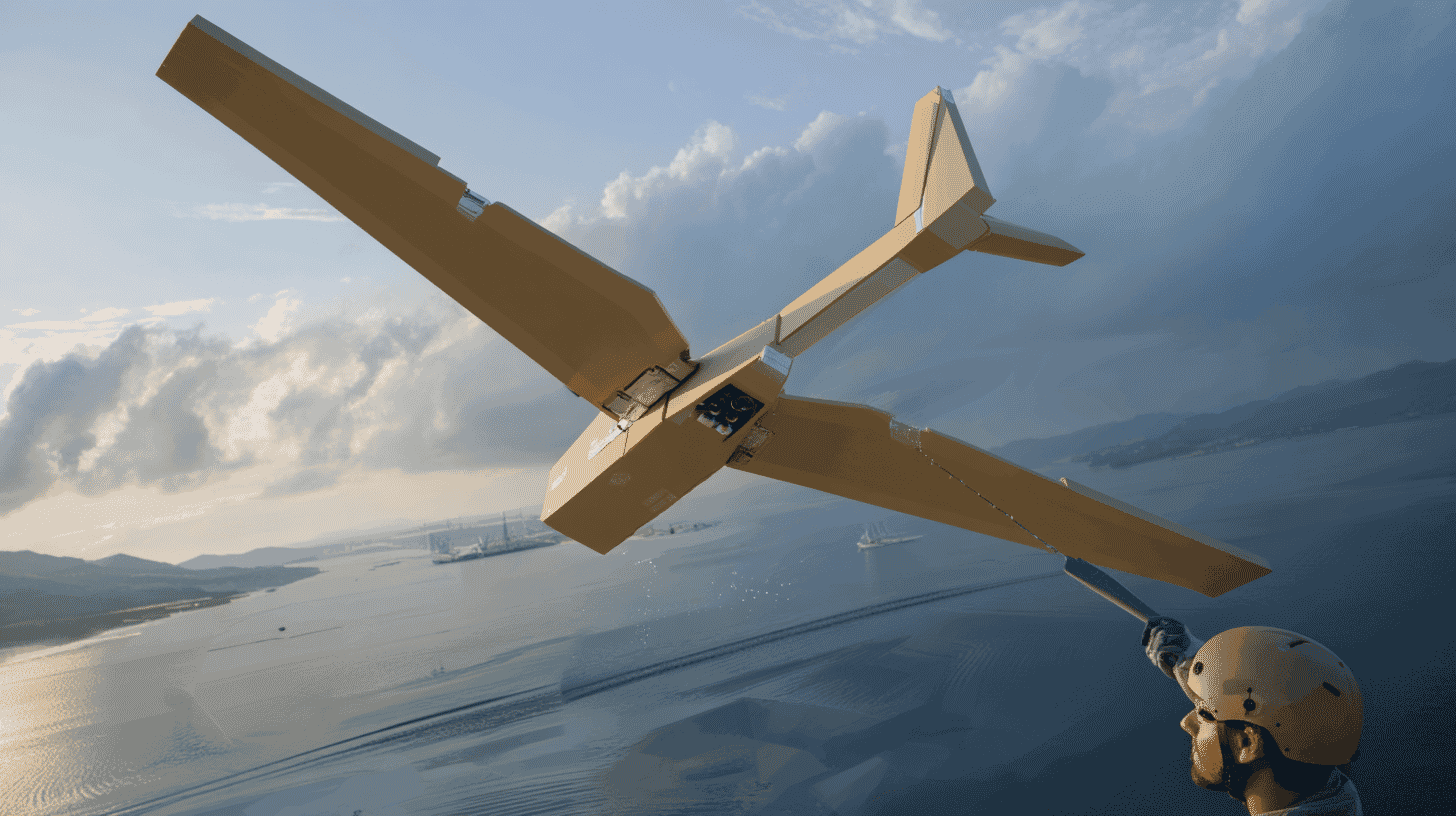
A military drone made of cardboard is poised to disrupt the defense industry. The price is just $2,000, and assembly takes five minutes. It flies at 120 km/h for two hours straight, yet costs less than one-tenth of a conventional fixed-wing drone. Why are Japan's Ministry of Defense, its Coast Guard, and even foreign militaries taking notice of this aircraft, developed by a Nagoya-based startup?
The Counterintuitive Choice: Cardboard
AirKamuy, a startup born from Nagoya University, has developed the "AirKamuy 150", a fixed-wing drone with a body made primarily of cardboard. At first glance, it might look like a child's toy, but its performance rivals that of existing military drones.
Top speed: 120 km/h. Flight time: approximately 2 hours. Range: 150 km. It can even carry payloads up to 1.5 kg. And its most striking feature? A price tag of around 300,000 yen (approximately $2,000). With mass production, that could drop below 200,000 yen.
Considering that domestic Japanese fixed-wing drones typically cost several million yen, the value proposition is staggering.
Why Cardboard?
AirKamuy CEO Takumi Yamaguchi identified the needs of modern warfare through discussions with defense officials: "cheap drones that can be mass-produced and fly for extended periods." Cardboard emerged as the material that could meet all these requirements.
Cardboard offers surprising advantages. It doesn't reflect radar waves easily, providing a degree of stealth capability. It's biodegradable, minimizing environmental impact. With water-resistant coating, it can operate in rain. And crucially, it can be mass-produced using existing supply chains.
The aircraft consists of about 10 parts that can be assembled using adhesive tape in just 5 minutes. When folded flat, approximately 500 units can fit in a single shipping container.
The Ukraine War: Proof of the "Era of Quantity"
The growing interest in cardboard drones stems from lessons learned in the Ukraine war.
The Corvo PPDS, a cardboard drone developed by Australian company Sypaq, has been used by Ukrainian forces to attack Russian airfields. In an August 2023 strike on Kursk Oblast, these drones damaged MiG-29 and Su-30 fighter jets, as well as S-300 air defense missile systems.
The effectiveness of "asymmetric warfare", using drones costing around $3,500 each to destroy military assets worth tens of millions of dollars, has been proven on the battlefield.
South Korea unveiled its cardboard "PapyDrone-800" in 2024 and has decided to adopt it for military use. North Korea has also showcased cardboard drones with rubber band-connected wings at a Pyongyang defense exhibition. The low-cost drone development race is already accelerating across Asia.
Pursuing Defense Ministry Contracts
The Japanese government is rapidly expanding investment in unmanned systems. The fiscal 2026 budget request allocates 312.8 billion yen for "unmanned asset defense capabilities", roughly triple the previous year's amount.
AirKamuy is in discussions with the Ministry of Defense to secure contracts. Potential applications span a wide range: maritime surveillance, disaster relief supply delivery, search and rescue operations, and training target drones. The low-cost nature means drones can now be deployed for purposes that were previously cost-prohibitive.
Training applications hold particular promise. Interception drills using simulated enemy drones or pilot training no longer require expensive aircraft.
International Interest
The company has exhibited at the Paris Air Show in June 2025, London's DSEI in September, and Australia's Indo Pacific in November, all through Japan's Acquisition, Technology & Logistics Agency booth. Multiple foreign militaries have already made direct inquiries.
Another strength of cardboard drones is their ease of local production. Defense equipment is often required to be manufactured domestically in each country. With AirKamuy's manufacturing know-how, production at local cardboard factories becomes feasible.
However, Japan's strict "Three Principles on Transfer of Defense Equipment" present regulatory hurdles. Building export management systems and completing procedures will take time.
The Defense Tech × Startup Challenge
Despite having an innovative product, AirKamuy has struggled with fundraising. While securing 100 million yen in April 2025, about two-thirds of approached investors declined. A common reason: internal policies restricting investment in defense-related businesses.
In Japan, an aversion to defense and military matters persists since World War II. Venture capitalists, mindful of their own investors' perceptions, tend to avoid defense tech investments.
CEO Yamaguchi describes facing a double barrier: "defense tech and hardware." Compared to software businesses, hardware industries require longer investment recovery periods. Add to that the reputational risks unique to the defense sector.
Shifting Winds
Yet the winds are changing. Prime Minister Sanae Takaichi has announced further defense budget increases. The "Japan Growth Strategy Council" has designated the defense industry as one of 17 priority sectors, with measures to strengthen growth capital for startups.
In October 2024, the Defense Innovation Science and Technology Institute was established, modeled after the U.S. DARPA. The Ministry of Defense has begun playing a role in bridging startups and venture capital.
Rapid changes in the security environment and a weakening human resource base due to aging demographics, low-cost, mass-deployable unmanned systems offer a compelling solution to both challenges. The cardboard drone stands as a symbol of this transformation.
What's Your Perspective?
In Japan, the idea of repurposing an everyday material like cardboard for defense technology has sparked both surprise and admiration. At the same time, many harbor complex feelings about involvement in weapons development.
What discussions exist in your country about developing low-cost defense technology? How do people view private startups entering the military technology space? Share your thoughts in the comments.









Global Discussion
16 comments