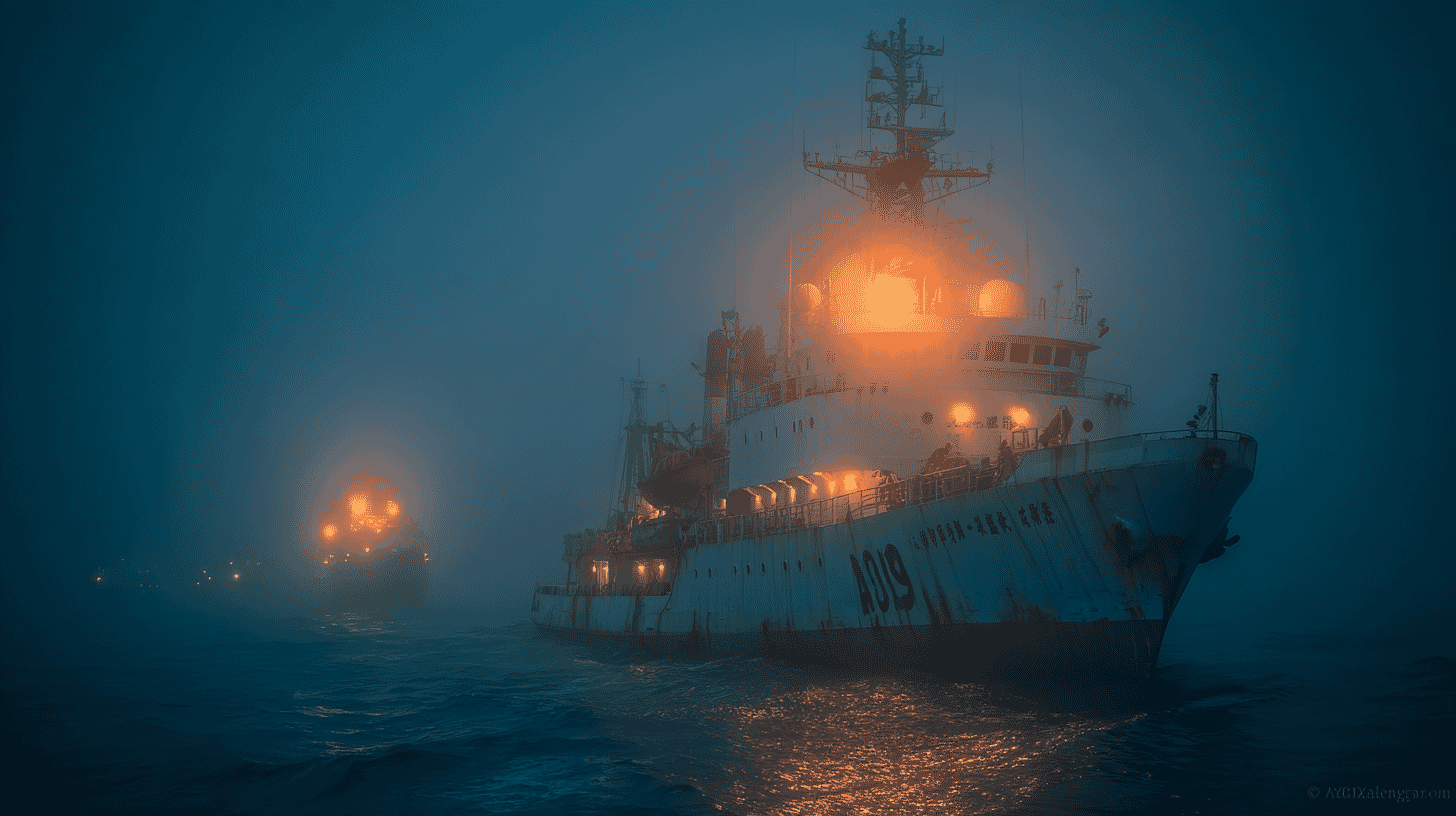
A Chinese fishing vessel has been seized in Japan's Exclusive Economic Zone, and the captain, who fled from inspection, was arrested on the spot. It is the first seizure of a Chinese vessel in nearly four years. With Sino-Japanese relations at a boiling point, what is happening out at the maritime boundary?
What Happened: A Chase Off the Goto Islands
On February 12, 2026, the 499-tonne Japanese fisheries patrol vessel Hakuo Maru spotted the Chinese fishing boat Qiongdongyu 11998 some 89.4 nautical miles (about 165 kilometers) from the Meshima lighthouse in the Goto Archipelago, Nagasaki Prefecture, on a bearing of 208 degrees.
The vessel was a "tiger net" fishing boat, a type that uses powerful lights to draw in and haul out large catches of mackerel and horse mackerel. When a fisheries inspector ordered the boat to stop for an onboard inspection, the captain refused to comply and fled.
After a pursuit, at 12:23 p.m. that day, authorities arrested the 47-year-old Chinese captain on suspicion of violating Japan's Fisheries Sovereignty Law, specifically for refusing or evading a lawful inspection. Including the captain, 11 crew members were on board. Three more patrol vessels, Nanotsu, Musashi, and Shirahagi Maru, assisted in the operation. Japan's Fisheries Agency announced the seizure the following day, February 13.
What Does "Seizure" Mean? Understanding Japan's EEZ
In Japanese maritime law, "daho" (拿捕) means the forcible capture of a foreign vessel for investigation. The incident took place inside Japan's Exclusive Economic Zone, or EEZ, a zone extending up to 200 nautical miles (about 370 km) from a country's coastline. Under the United Nations Convention on the Law of the Sea (UNCLOS), a coastal nation has exclusive rights over natural resources within its EEZ, including fish.
Fishing in Japan's EEZ without permission is illegal, and Japan has full authority to inspect and enforce the law in these waters. In this case, the captain was arrested not only on suspicion of unauthorized fishing but specifically for refusing to stop for inspection and fleeing.
Importantly, although a fisheries agreement exists between Japan and China, the two countries have not reached a new agreement since negotiations broke down in June 2017. As a result, no Chinese fishing vessels are currently licensed to operate in Japan's EEZ.
First Chinese Vessel Seized Since 2022: Why It Matters
This is the first seizure of a Chinese fishing vessel by Japan's Fisheries Agency since 2022. In 2025, only two foreign vessels were seized, one from South Korea and one from Taiwan. This incident is the first foreign vessel seizure of 2026.
However, low seizure numbers don't reflect the actual scale of the problem. According to the Fisheries Agency, in 2024, Japanese patrol ships issued warnings to 78 foreign vessels to leave Japanese waters (up from 68 in 2023). Of these, 15 were subjected to high-pressure water spraying to force them out, nearly four times the previous year's figure of 4.
The waters around the Yamato Bank in the Sea of Japan are a particular hotspot, where Chinese and North Korean fishing boats have been caught operating illegally, sometimes preventing Japanese fishermen from safely doing their work. What authorities can actually seize is just the tip of the iceberg, it's physically impossible to apprehend hundreds of foreign vessels operating as a fleet.
The Bigger Picture: Escalating Sino-Japanese Tensions
This incident doesn't exist in a vacuum. Sino-Japanese relations have been strained on multiple fronts in recent months.
In November 2025, Japanese Prime Minister Sanae Takaichi stated in parliament that if China used military force against Taiwan, it could constitute an "existential crisis situation" for Japan, a legal threshold that would allow Japan to deploy its Self-Defense Forces. Beijing reacted furiously, summoning Japan's ambassador, warning Chinese citizens against traveling to Japan, and conducting joint military drills with Russia. In December, Chinese J-15 fighter jets reportedly locked radar onto Japanese aircraft near Okinawa, and China tightened export controls on materials with potential military uses, raising fears about rare earth supply disruptions.
At sea, Chinese Coast Guard vessels have maintained an almost daily presence near the Senkaku Islands (called Diaoyu Islands in Chinese) in the East China Sea. In 2024, Chinese Coast Guard ships were spotted in the contiguous zone around the Senkakus for a record 355 days, with 39 incursions into Japanese territorial waters.
Against this backdrop, the seizure of a Chinese fishing vessel becomes more than a routine enforcement action, it's a pressure point in a much larger geopolitical contest.
A Global Problem: China's Distant-Water Fishing Fleet
China's illegal fishing problem extends far beyond Japanese waters. South Korea's coast guard reports an average of 300 Chinese vessels fishing illegally in Korean waters every day. In the South China Sea, Filipino fishermen have repeatedly been harassed by flotillas believed to be Chinese "maritime militia." China's distant-water fishing fleet, the world's largest, operates as far as the coast of West Africa and near the Galápagos Islands.
Some of these vessels are what Chinese authorities themselves call "three-no boats" (三無漁船), ships operating without proper fishing licenses, registration certificates, or inspection documents, in violation of even China's own domestic laws.
The international community increasingly views unregulated Chinese fishing as a threat to global marine biodiversity, and pressure is mounting to strengthen measures against IUU (Illegal, Unreported, and Unregulated) fishing worldwide.
Japan's Response: "Resolute Action"
Agriculture Minister Norikazu Suzuki told reporters on February 13 that Japan would "continue to crack down with a resolute stance to prevent and deter illegal fishing by foreign vessels." Chief Cabinet Secretary Minoru Kihara echoed these remarks.
The captain, however, was released the same day. China's consulate general in Fukuoka submitted a written guarantee for payment of a security bond, and Japan's Fisheries Sovereignty Law requires prompt release once a bond is paid or guaranteed. The mechanism follows the UN Convention on the Law of the Sea, under which coastal states do not hold people at length over fisheries violations in an EEZ. A seizure, in other words, is not the end of the punishment but the start of the legal process.
Japan's Fisheries Agency deploys patrol ships in key areas, including the waters around the Yamato Bank and the East China Sea, in coordination with the Japan Coast Guard. But covering Japan's vast maritime territory, the world's sixth-largest EEZ, with limited personnel and vessels remains a challenge.
Diplomatically, Japan has repeatedly pressed China through high-level maritime consultations to strengthen guidance for its fishermen, but tangible improvements have been limited.
What About Your Country?
Most Japanese people see enforcing fishing laws in their own waters as an obvious duty. The release of the captain a day later drew a different reaction, with plenty of people arguing it removes any deterrent. Calls for tougher enforcement and calls for a diplomatic fix are being made about the same event.
Does your country face problems with foreign vessels fishing illegally in its exclusive economic zone? What measures are in place?
References
- https://www.jfa.maff.go.jp/j/press/kanri/250321.html
- https://www.afpbb.com/articles/-/3622102
- https://www.spf.org/iina/articles/furuya_03.html
- https://www.mofa.go.jp/mofaj/gaiko/bluebook/2025/html/chapter2_02_02.html
- https://www.aljazeera.com/news/2026/2/13/japan-seizure-of-chinese-vessel-arrest-of-captain-could-heighten-tensions








Global Discussion
15 comments