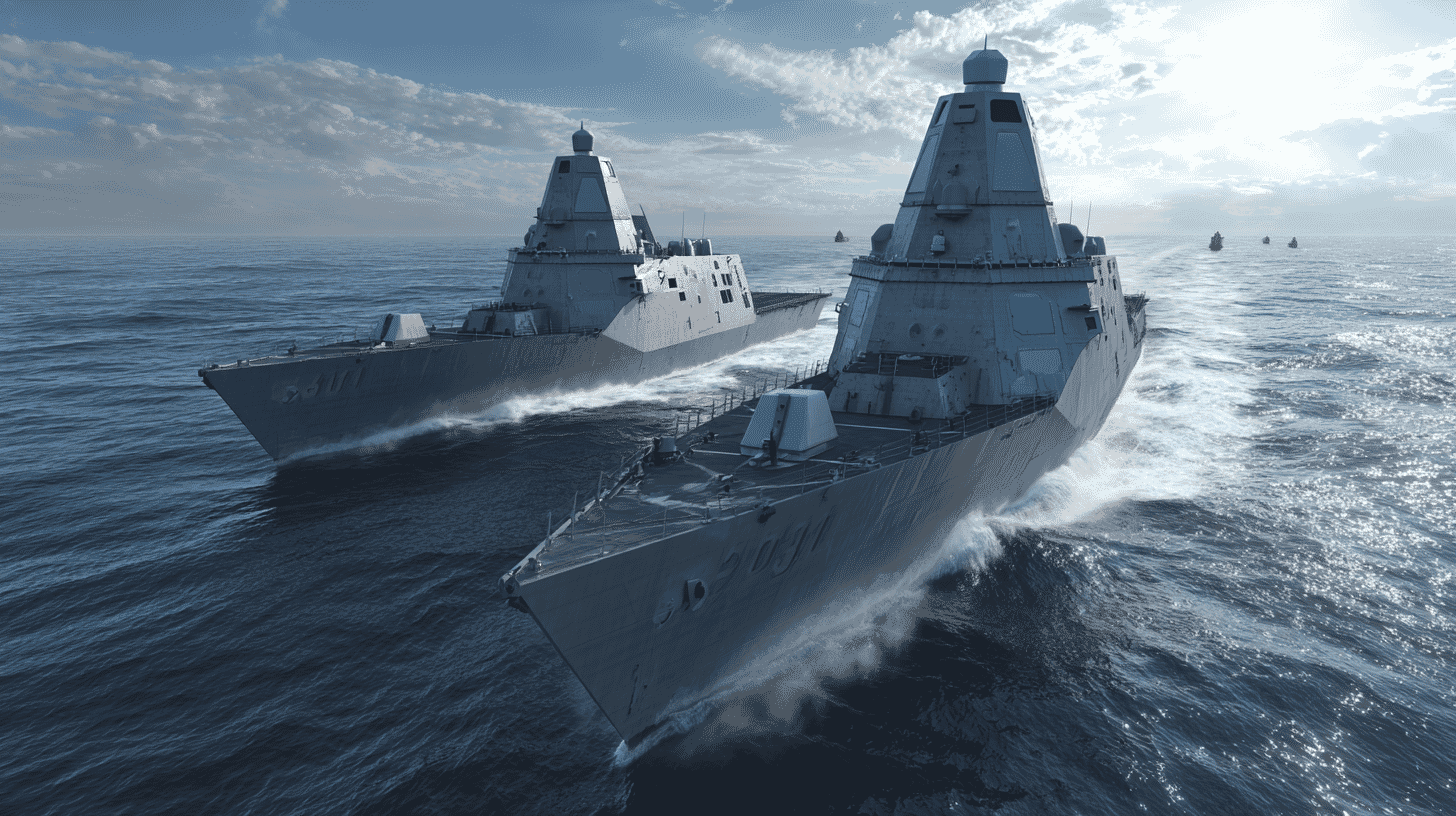
Japan's first Aegis destroyer, Kongō, was commissioned in 1993. More than three decades on, this cornerstone of Japanese air defense is finally facing a generational change. The radar for its successors has become the subject of a fierce contest between RTX's SPY-6 and Lockheed Martin's SPY-7. Interoperability with the US Navy, or affinity with existing equipment? This is a look at the choice of the "eye" that will shape Japan's air defenses.
What Is the Kongō-Class?
The JMSDF's Aegis destroyers are the core of Japan's modern air and missile defense. As of 2026, the service operates eight Aegis destroyers: four Kongō-class, two Atago-class, and two Maya-class.
The Kongō-class is the oldest of them. The lead ship, Kongō, was commissioned in 1993, and the fourth, Chōkai, in 1998, so all four are now around 30 years old. The JMSDF generally treats 40 years as the retirement benchmark for its vessels, so the Kongō-class is expected to begin phased retirement from around 2030.
The Kongō-class originally carried Baseline 4.1 and was upgraded to Baseline 5.3 in the 2000s to add ballistic-missile intercept capability. The later Atago- and Maya-class ships carry Baseline 9, leaving the Kongō-class behind in handling the latest missiles. With capability upgrades reaching their limits, replacing the hulls themselves has become the realistic option.
FY2025 Budget Launches Serious Successor Study
Japan's fiscal 2025 defense budget includes ¥3.3 billion (about $22 million) for "Aegis ship research," specifically technical studies tied to "planning successors as the Kongō-class Aegis destroyers are decommissioned," including studies of the Aegis system and radar to be installed.
Notably, this study could influence a much broader radar decision. Beyond replacing the four Kongō-class ships, the Ministry of Defense plans to grow the Aegis fleet from the current eight ships to ten within roughly ten years. Once the successor design is settled, the additional ships are likely to be built to the same design, making this a huge business opportunity for radar makers.
Two Next-Generation Radar Candidates
The two cutting-edge radars under consideration for the Kongō-class successors are the SPY-6 and the SPY-7.
The SPY-6 (AN/SPY-6), developed by RTX (formerly Raytheon Technologies), is built from Radar Modular Assemblies (RMAs), roughly 60 cm cubic modules combined to form the full array. The US Navy has adopted it for its Flight III Arleigh Burke-class destroyers, with USS Jack H. Lucas becoming the first operational ship in 2023. The Navy plans to install it across seven ship classes and 65 ships by 2033.
The SPY-7 (AN/SPY-7), developed by Lockheed Martin, is built from Subarray Suites (SAS) and is based on the technology of the Long Range Discrimination Radar (LRDR) in Alaska. Because it comes from Lockheed Martin, the same maker as the earlier SPY-1, it integrates readily with the Aegis system.
Both radars offer far greater detection range than the current SPY-1D. The SPY-1D's range is put at about 500 km, but through higher output and other improvements, the SPY-6 is said to reach roughly three times that and the SPY-7 about 3.3 times (around 1,650 km). According to Lockheed Martin, during ballistic-missile defense the SPY-7 expands the search volume about 20-fold and the defended area about tenfold.
The Modular Revolution
A major feature common to both radars is their modular structure. Because small radar units combine to form one large array, the scale of the radar can be adjusted freely to suit the size and role of the ship carrying it.
This structure also brings big maintenance advantages. With the older SPY-1D, damage to even part of the antenna could seriously degrade performance, but with a modular design only the damaged unit needs to be swapped out from the rear. Survivability improves even after battle damage.
Interoperability with the US Navy Is Key
The biggest issue in choosing between SPY-6 and SPY-7 is interoperability with the US Navy.
The US Navy has adopted SPY-6 as its next-generation radar, installing it on the Flight III Arleigh Burke class as well as the Constellation-class frigates and Gerald R. Ford-class carriers. If Japan, an ally, adopts SPY-6, shared systems would smooth data-sharing and mutual support in joint operations.
SPY-7 has its own strengths. The two Aegis System Equipped Vessels (ASEVs) now under construction use SPY-7 and are due to enter service in FY2027 and FY2028. Adopting SPY-7 for the Kongō successors would unify Japan's domestic radar operations, and because it is made by Lockheed Martin like the SPY-1, no new interface would be needed to connect it to the existing Aegis system. That said, the Ministry of Defense says it will study the successor radar "from a blank slate," and that the successors will not automatically use SPY-7 simply because the ASEVs do.
The Massive Aegis System Equipped Vessel
Due to enter service from FY2027, the ASEV is a very large ship: about 12,000 tons standard displacement, 190 m long, and 25 m wide. It far exceeds the US Navy's Flight III Arleigh Burke class (about 9,800 tons) and is set to be one of the largest surface combatants in the Western world outside of carriers.
The ASEV effectively puts to sea the SPY-7 radar originally procured for the land-based Aegis Ashore missile-defense sites. When that ground-based plan was abandoned, the already-ordered SPY-7 was repurposed for ships.
With 128 Vertical Launch System (VLS) cells, among the most of any surface combatant in the world, the vessels will carry SM-3, SM-6, Tomahawk, and other missiles, in a program whose construction costs alone run very high.
Germany's Choice May Influence Japan
Interestingly, Germany's naval decisions could influence Japan's selection. Germany is reported to be planning to equip its Type F-127 frigates with SPY-6.
If Germany formally commits to SPY-6, that could further cement the radar's standing as the "Western standard" from a NATO interoperability standpoint, and Japan might have to reconsider going it alone with SPY-7.
Outlook: Two Scenarios
Broadly, two scenarios are conceivable for the Kongō successor radar. In one, Japan prioritizes interoperability with the US Navy and adopts SPY-6, potentially backfitting the existing Atago- and Maya-class ships with SPY-6 as well to unify the fleet's radar systems. In the other, Japan leverages the SPY-7 operational base built for the ASEVs and adopts SPY-7 for the successors too, prioritizing efficiency in domestic maintenance.
Either way, with North Korea's ballistic-missile threat and China's maritime expansion, Japan's security environment is growing more severe. The choice of the radar that will serve as the successors' eyes will shape Japan's air defenses for the next 20 to 30 years, a decision weighed on both technical and political grounds.
There are many views in Japan on the Aegis successor question. What debates are there in your country about naval modernization and the choice of air-defense systems? Please let us know in the comments.





Global Discussion
16 comments