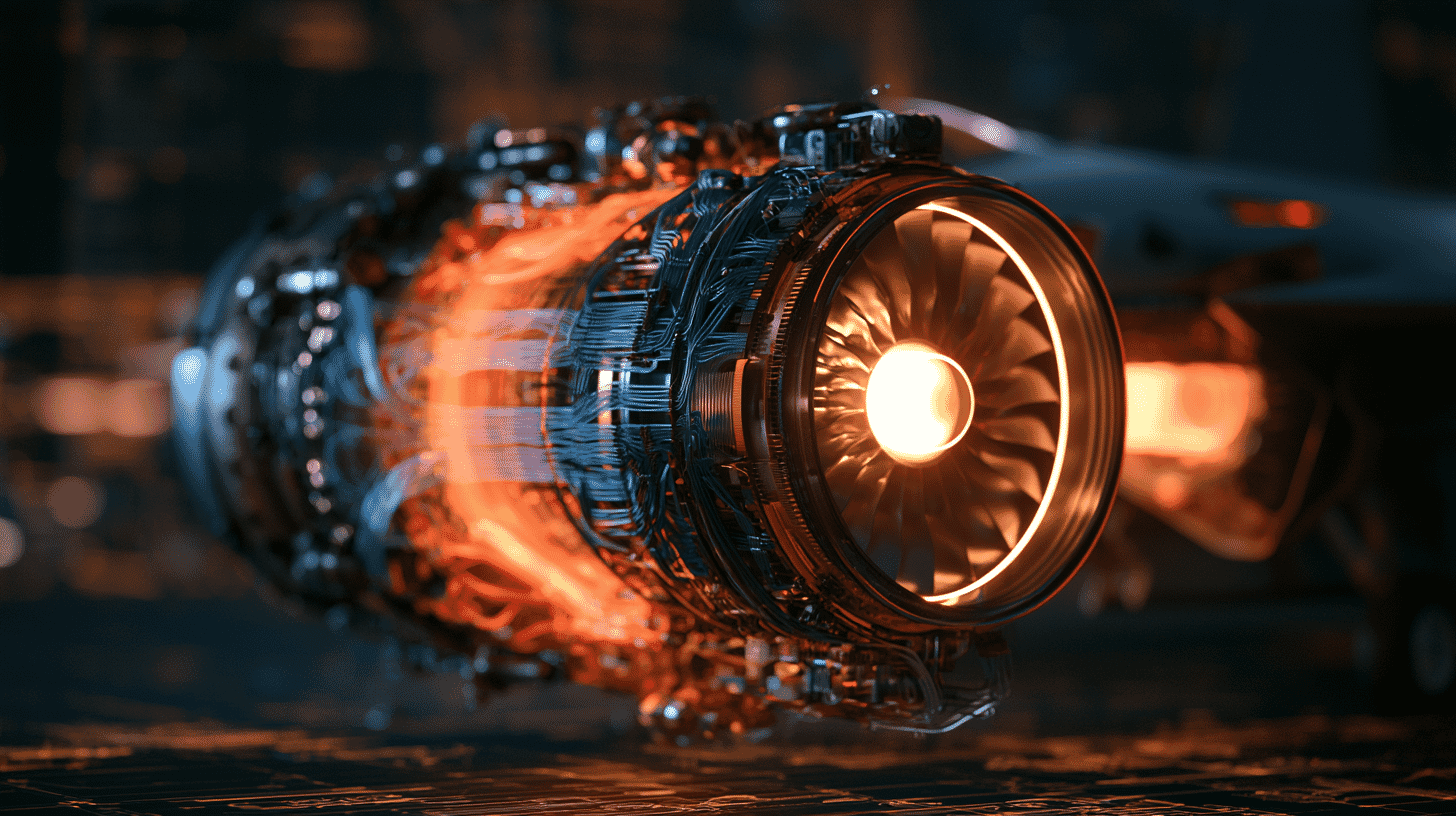
✈️ The hardest part of a next-generation fighter is not the airframe. It is the engine. On July 20 the three companies building the powerplant for the Japan-UK-Italy GCAP fighter said their engine demonstrator is one step away from final design approval, with more than 100 component tests behind them and ground running ahead. And the thing they are building is not really a thrust machine.
An airframe can improvise. An engine cannot
Rolls-Royce of Britain, Japan's IHI Corporation and Italy's Avio Aero issued a joint update on July 20, 2026, timed to the Farnborough International Airshow. Repeated design reviews have brought the drawings for their new demonstrator engine to the last stage before sign-off. Parts are being made in all three countries. And the partners have now run more than 100 tests on scaled-down hardware, checking individual components rather than whole engines. IHI published a Japanese-language version on July 21. GCAP is the three countries' joint sixth-generation fighter programme, aiming for service entry in 2035.
But 100 refers to component tests, not to 100 runs of a complete engine. The harder milestone is still ahead, when the assembled demonstrator goes on a test stand for the first time. Rolls-Royce puts the parts count for a full technology demonstrator at roughly 40,000.
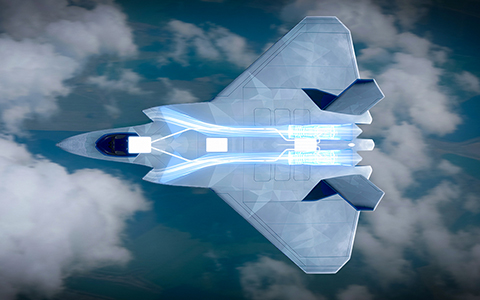
Source: Rolls-Royce
Over the past year the three firms have opened a shared site in Reading, England, which they call a Collaboration Hub. The point is to let their teams work in one room with the trinational GCAP Agency and with Edgewing, the joint venture responsible for the aircraft itself. IHI says the programme now sustains about 9,000 highly skilled roles worldwide.
What they are actually building is a flying power station
The most striking line in the announcement was not a number. Phil Townley, Rolls-Royce's Director of Future Programmes, Defence, described what his teams are building as a "flying power station" rather than a thrust machine: something that can absorb both the electrical draw and the waste heat of the sensors and weapons a sixth-generation aircraft is meant to carry.
That sounds like marketing until you consider what sixth-generation aircraft are supposed to carry. High-powered radar. Electronic warfare suites. Datalinks to uncrewed wingmen. Serious onboard computing. All of it runs on electricity, and electricity becomes heat.
Heat is a particular problem for a stealth aircraft, which cannot simply dump it overboard. Radiate enough infrared and you undo the work the radar-defeating shaping was doing. In practice, modern fighters use their fuel as a coolant, which means generation, cooling and propulsion are a single coupled system. You cannot optimise one of them in isolation. That is why the engine has to be settled early rather than treated as something bolted on once the airframe is drawn.
Noriyuki Nakamura, Senior Technical Advisor in IHI's Aero Engine, Space and Defence Business Area, described the system in the same release as the "heart" of tomorrow's combat aircraft.
Japan's running start: the XF9-1
Why does IHI get a seat at the design table rather than a production licence? The answer sits in the 2010s.
In fiscal 2010 the Air Systems Research Center at Japan's Acquisition, Technology and Logistics Agency began studying a fighter engine that would be slim enough for an internal-weapons stealth layout and still produce serious thrust. IHI designed and built it, delivering the XF9-1 prototype on June 29, 2018. According to IHI's own technical journal, subsequent test-cell runs confirmed the research targets of more than 15 tonnes of thrust with afterburner and more than 11 tonnes dry. The engine is about 4.8 metres long, with a fan inlet roughly 1 metre across.
The technical story is one of temperature and materials. Testing confirmed that the core engine underneath the XF9-1 could run properly with its high-pressure turbine inlet sitting at 1,800C. That sits far above the melting point of the nickel superalloys turbine sections were traditionally made from. The parts have to hold their shape in conditions that would otherwise destroy them. IHI's journal lists turbine blades in a fifth-generation nickel single-crystal alloy with increased rhenium and ruthenium content, alongside a domestically produced nickel-cobalt forged disc material. The turbine shroud is made of ceramic matrix composite, a class of material lighter than metal and better at surviving heat.
Then there is power generation. The same paper notes that the gearbox was shaped to carry a large starter-generator, because radar and electronic warfare gear would be drawing the current. In a developer interview published at the time, that generator was described as being in the 180 kW class, built by merging the starter motor and the generator into a single unit to save space rather than carrying both.
Japan, in other words, had already started walking toward the flying power station by 2018, before anyone in this consortium used the phrase. Nakamura, the Japanese voice in this trilateral announcement, is himself a co-author of the XF9-1 overview paper IHI published in 2020.
From building someone else's engine to drawing your own
The F-2 began as a joint Japan-US development agreed in October 1987, with a memorandum of understanding signed in November 1988. Then the US Congress pushed back, and an April 28, 1989 clarification rewrote the terms. Washington's share of production work was pinned at around 40 percent. The flight-control system's source code would not be released to Japan. American access to the associated Japanese technology was guaranteed. It was called co-development, but the lines were drawn in Washington.
The engine followed the same pattern. According to the Japanese transport outlet Norimono News, the F-2 flies on the F110-IHI-129, a version of General Electric's F110 that IHI produces under a paid licence. You learn to manufacture. You do not get to decide why the design is what it is.
Inside the GCAP engine consortium, IHI is on the design side. Rolls-Royce notes on its own site that while it has a long history with Italy on fighter engines, most obviously Tornado and Typhoon, IHI, Avio Aero and Rolls-Royce working directly together is new territory.
America decoupled. Europe stalled
In the United States, Boeing's F-47 was still tracking toward a 2028 first flight as of late July 2026. Its intended adaptive-cycle engine, a design that shifts bypass ratio in flight to trade efficiency for thrust as the mission demands, is not expected to be ready for aircraft integration until around 2030. Dale R. White, the US Air Force's Director of Critical Major Weapon Systems Programs, spoke to that timing in Dayton, Ohio on July 27, 2026. Early flight testing will therefore rely on an interim propulsion arrangement. This is not a stalled programme: GE's XA102 cleared its assembly readiness review on May 11, 2026, and Pratt and Whitney's XA103 did the same three days earlier.
Europe is in worse shape. In June 2026 the crewed-aircraft pillar of FCAS was halted following an agreement between German Chancellor Friedrich Merz and French President Emmanuel Macron. EUMET, the Safran and MTU joint venture with Spain's ITP Aero as main partner, had long been described as the healthiest part of FCAS since its creation in 2021. But its Phase 1B contract lapsed in April 2026 with nothing to follow, and no full-scale engine ground demonstrator was ever built.
On July 28, 2026, presenting first-half results, Safran chief executive Olivier Andriès said the FCAS-related funding runs out in September 2026 and that the company has the resources for only one next-generation combat engine, which would follow French requirements. Two days later MTU chief executive Johannes Bussmann warned that the partnership does not work if French and German requirements keep diverging.
Line the three up and the shape is clear. America is flying the aircraft first and letting the engine catch up. Europe has lost its footing on both. Japan, Britain and Italy are moving an airframe demonstrator and an engine demonstrator forward at roughly the same pace.
The clock that is left
None of this means GCAP is safe. As of July 2026 the 2035 target had not moved, and the engine's thrust class, whether it uses an adaptive cycle, and when ground testing actually starts were all still unpublished.
The membership question now has a deadline too. At Farnborough, according to reports, BAE Systems chief executive Charles Woodburn and Leonardo chief executive Lorenzo Mariani both said the same thing: the window for a new partner nation is closing. The reason is straightforward. Adding a country after requirements are locked puts the schedule at risk.
Still, on the part of a fighter you can least afford to get wrong, Japan is one of the countries holding the pen. That was not the job on offer in the F-2 years. Every country answers the fighter question differently: build alone, build with equals, or buy from the strongest supplier available. Which answer has yours settled on?
References
- https://www.rolls-royce.com/media/press-releases/2026/20-07-2026-the-consortium-for-the-gcap-power-and-propulsion-system-progresses-toward-ground-testing-engine-demonstrator.aspx
- https://www.ihi.co.jp/all_news/2026/aeroengine_space_defense/1202142_13805.html
- https://www.jwing.net/news/111096
- https://www.rolls-royce.com/products-and-services/defence/future_combat_air_capability/tempest/gcap-power-and-propulsion.aspx
- https://www.ihi.co.jp/technology/techinfo/contents_no/__icsFiles/afieldfile/2023/06/17/07_ronbun1.pdf
- https://www.aviationwire.jp/archives/150545
- https://news.livedoor.com/article/detail/22256768/
- https://jbpress.ismedia.jp/articles/-/9170
- https://www.armyrecognition.com/news/aerospace-news/2026/boeing-f-47-fighter-specs-2028-flight-ngap-engine-delay
- https://www.aerotime.aero/articles/safran-french-fighter-engine-fcas-funding-ends
- https://ukdefencejournal.org.uk/new-gcap-fighter-jet-could-enter-service-two-years-early/
- https://aerospaceglobalnews.com/news/europes-last-remaining-fcas-partnership-comes-under-pressure-after-mtu-warning/
- https://trafficnews.jp/post/126910









Global Discussion
4 comments