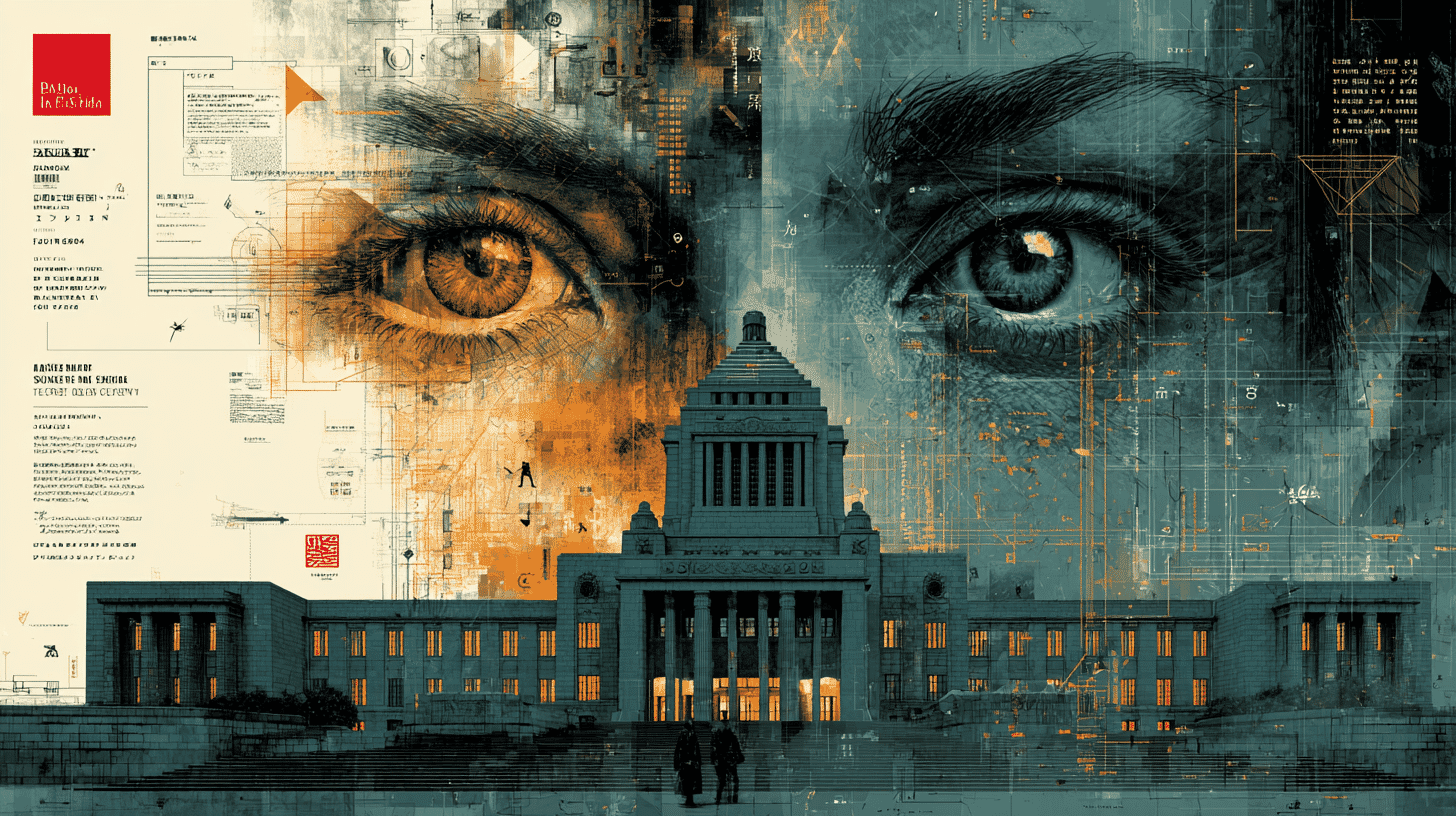
Japan has never had a full-fledged intelligence agency like the CIA or MI6. For the past 80 years, intelligence functions have been scattered across the Ministry of Foreign Affairs, Ministry of Defense, National Police Agency, and Public Security Intelligence Agency, each collecting information independently, handling national security through bureaucratic silos.
That structure is about to change fundamentally.
On March 13, 2026, the Japanese government approved the "National Intelligence Council Establishment Bill" at a Cabinet meeting. The bill began deliberations in the House of Representatives on April 2, and expert testimony was heard on April 16. The bill cleared the House of Representatives on April 23 and passed the House of Councillors on May 27, becoming law. The creation of a "National Intelligence Council" chaired by the Prime Minister, and a "National Intelligence Agency" serving as its secretariat, represents Japan's largest postwar intelligence reform.
But a look around the world reveals that similar organizations have produced serious scandals. Election interference. Mass surveillance. Wiretapping of allied leaders. "Centralizing intelligence" carries both promise and peril. Which path will Japan take?
Why Reform Now?
Japan's security environment has shifted dramatically in just a few years.
China has intensified activity around the Senkaku Islands, and tensions across the Taiwan Strait are rising. North Korea continues its nuclear and missile development. Russia's invasion of Ukraine showed the world an era in which kinetic military action is inseparable from cyberattacks and information warfare.
Economic security challenges have also mounted: semiconductor and rare earth supply chains, preventing leakage of advanced technology, and countering foreign influence operations through social media. These new threats cannot be captured by military intelligence alone.
In November 2025, China's Consul-General in Osaka, Xue Jian, posted an incendiary attack on Prime Minister Sanae Takaichi on social media, a reminder that Japan's ability to respond to activities by foreign government personnel operating within its borders is again being tested.
In an age of intensifying information warfare, the vulnerabilities of Japan's siloed system have become impossible to ignore.
What the Bill Actually Does
Let's briefly map Japan's current intelligence landscape. The Cabinet Intelligence and Research Office (CIRO, commonly called "Naicho") sits within the Cabinet Secretariat and has been responsible for aggregating information from ministries and reporting to the Prime Minister. But CIRO has never had authority to order ministries to share intelligence, what gets reported has been left to each ministry's discretion.
In practice, information inconvenient to a ministry rarely reaches the Prime Minister's Office. In 2016, former Japan-China Youth Exchange Association chairman Eiji Suzuki was detained in China; during interrogation, he was reportedly shown photographs of Public Security Intelligence Agency personnel. Sloppy Japanese information management ended up endangering a private citizen's safety.
The new National Intelligence Agency will replace CIRO through a "developmental dissolution." Three major changes stand out.
First, the agency's director will be elevated to political-appointment rank, on par with the head of the National Security Secretariat (NSS), the foreign policy and security coordinator. This is no longer a civil-service desk job, it carries political weight.
Second, the agency will receive legal authority to coordinate intelligence sharing across ministries. The shift is from request-based cooperation to legally grounded information consolidation.
Third, a National Intelligence Council chaired by the Prime Minister will convene relevant cabinet ministers to deliberate on critical intelligence activities and responses to foreign espionage. The Agency will serve as its secretariat.
Beyond this first step, the coalition agreement between the ruling Liberal Democratic Party and the Japan Innovation Party commits to creating a "Foreign Intelligence Agency" for overseas human intelligence by the end of FY2027, along with an intelligence officer training institution and anti-espionage legislation. The National Intelligence Agency is only the opening move.
Lesson ① South Korea: When Intelligence Becomes a Political Weapon
The country with a structure closest to what Japan is building (and with the most severe history of abuse) is South Korea.
The National Intelligence Service (NIS) reports directly to the President and wields enormous authority. Its predecessor, the Korean Central Intelligence Agency (KCIA), was founded in 1961 immediately after a military coup. While its stated primary mission was intelligence against North Korea, it functioned as an "executioner of fear politics", detaining, torturing, and sometimes killing domestic dissidents.
In 1973, KCIA agents kidnapped opposition leader Kim Dae-jung from a Tokyo hotel, causing an international incident over violation of Japanese sovereignty. In 1979, KCIA Director Kim Jae-gyu shot and killed President Park Chung-hee himself.
The agency was reorganized in 1999 as the "National Intelligence Service" with a pledge of political neutrality. Problems persisted. In the 2012 presidential election, the NIS director ordered agents to post systematic online attacks against the opposition candidate. In 2024, former NIS chief Cho Tae-yong was arrested in November 2025 for allegedly knowing in advance about President Yoon Suk-yeol's martial law plans and failing to report them to the National Assembly. In a separate case, the former NIS chief was indicted for ordering subordinates to delete information inconvenient to the Moon Jae-in administration regarding a 2020 incident in which a South Korean man was shot by North Korean troops in the Yellow Sea.
The lesson from Korea is stark: when an intelligence agency fuses with political power, it can become a surveillance apparatus against citizens, an election interference tool, or a mechanism for suppressing inconvenient truths.
Lesson ② The United States: Mass Surveillance and the 9/11 Paradox
The American intelligence structure has the world's largest budget and scale, 17 intelligence agencies integrated under the Director of National Intelligence (DNI). This is essentially the prototype for the "intelligence command center" model Japan aims to build.
But its history is a cycle of success and abuse.
The 1975 Church Committee revealed that the NSA, together with Britain's GCHQ, had routinely intercepted communications of anti-Vietnam War leaders. The FBI maintained roughly 17,000 pages of surveillance files on Martin Luther King Jr., treating the civil rights movement as a "domestic threat."
The September 11, 2001 attacks delivered the opposite lesson. The CIA, FBI, and NSA each held fragmentary pieces of intelligence on the plotters, but cross-agency sharing broke down and the attacks were not prevented. The reaction to this "intelligence siloing" produced the Intelligence Reform and Terrorism Prevention Act of 2004, which created the DNI and an integrated intelligence command.
But the mass surveillance architecture built after 9/11 was exposed by Edward Snowden in 2013. Through the PRISM program, the NSA collected user information from Google, Apple, Microsoft, and other major tech companies, intercepting communications worldwide including those of American citizens. Illicit access to the UN's video conferencing system and wiretapping of Chancellor Angela Merkel's personal phone (an ally's head of state) came to light.
Equally problematic: NSA-collected intelligence was quietly passed to domestic law enforcement, and agents then used a practice called "parallel construction" to fabricate alternative investigative trails hiding the actual source. Information gathered for counterterrorism was being repurposed for ordinary criminal cases.
There are genuine successes too. In 2006, the transatlantic aircraft bombing plot, an attempt to destroy up to 10 transatlantic flights with liquid explosives, was foiled through Five Eyes intelligence cooperation (US/UK/Canada/Australia/New Zealand). In the UK, more than 13 terrorist plots have reportedly been disrupted by intelligence activity since 2013.
Lesson ③ The United Kingdom: When "Weak Laws" Become a Selling Point
Britain's GCHQ (Government Communications Headquarters) operated the Tempora program, which intercepted and stored massive volumes of communications data from undersea fiber optic cables. Snowden documents revealed that the UK's comparatively permissive surveillance laws became a "selling point" for the NSA.
The structure was troubling: large-scale data collection illegal under US domestic law could be performed on the UK side where legal constraints were weaker, with collected data then shared back to America. It illustrates how legal "loopholes" can be exploited among allies.
Lesson ④ Germany: Surveillance at an Ally's Request
Germany's BND (Federal Intelligence Service) was shown to have transferred massive intercepted data to the NSA through Snowden's documents. More disturbingly, the BND had monitored European defense officials and politicians within Germany, at the NSA's request. The German Bundestag established an investigative committee, and it became clear that Germany's own intelligence service had crossed into constitutionally questionable territory.
The German case demonstrates that even within alliances, intelligence services can put their own citizens under surveillance at foreign request.
Points of Contention in Japan's Legislative Debate
The April 16 expert testimony session in the House Cabinet Committee laid out the core issues.
Attorney Yutaka Saito warned that "strong political pressure could distort intelligence" and that easier information sharing within government creates "new privacy concerns." Professor Yoshiki Kobayashi of the Institute of Information Security noted that to preserve intelligence objectivity, "policymakers must exercise restraint in secrecy protection and in resisting partisan use."
These concerns aren't theoretical, they're precisely the problems that materialized in Korea and the United States.
Several fault lines will now define the rest of the debate:
First, legislative oversight mechanisms. The US has intelligence committees in both chambers of Congress; the UK has its Intelligence and Security Committee (ISC). Japan currently lacks any dedicated parliamentary committee overseeing intelligence agencies.
Second, institutional safeguards against political exploitation. As Korea has demonstrated, a PM-led intelligence agency carries a persistent incentive to surface information favorable to the sitting government while burying what's inconvenient.
Third, balancing anti-espionage legislation against civil liberties. The "Foreign Agent Registration Law" included in the coalition agreement mirrors tools adopted by many democracies against foreign influence operations, but depending on how it's implemented, it could chill legitimate civic activity and journalism.
How Democracies Control the Power of Intelligence
Global intelligence reform history teaches two things.
One: information fragmentation invites catastrophic failure. The cost of not sharing intelligence across agencies was paid in full on 9/11. Japan's reform of its siloed system is a rational response to that lesson.
Two: information centralization always carries the risk of abuse. Korean election interference. American mass surveillance. British legal loopholes. German surveillance of citizens at foreign request, all were committed under the banner of "national security."
Japan's new intelligence agency, established by the law passed in May, must be designed between these two lessons. The true test of this bill is whether it can respond to an increasingly harsh security environment while maintaining democratic guardrails.
How is the intelligence agency in your country held democratically accountable? What debates take place in your country about the balance between security and civil liberty?







Global Discussion
0 comments