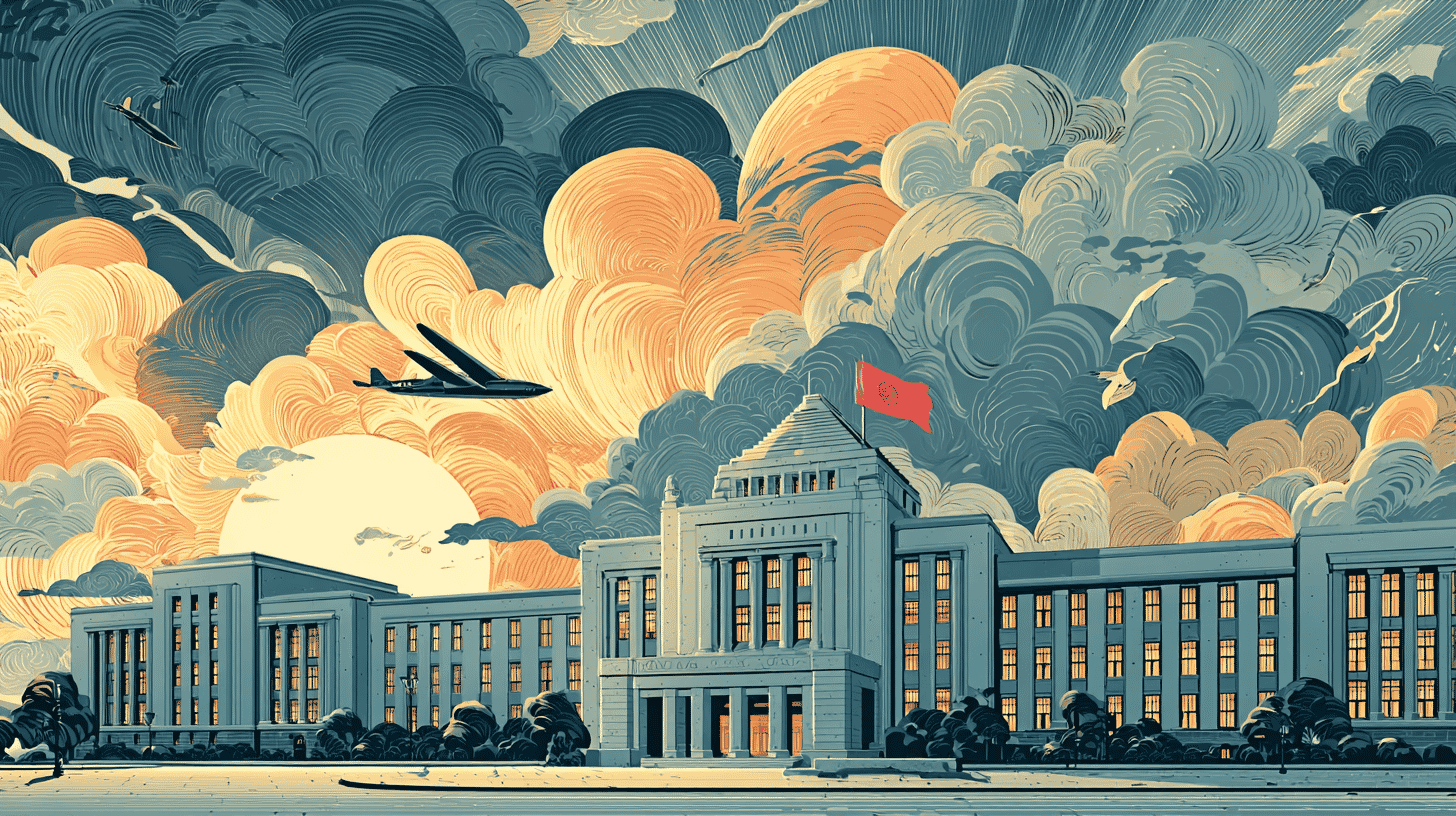
On the morning of April 21, 2026, one of the most enduring pillars of postwar Japan, the self-imposed restraint on weapons exports, officially came down. The Takaichi cabinet voted to revise the Three Principles on Transfer of Defense Equipment and Technology. The "Five Categories" rule is gone. Warships, missiles, and fighter jets can now be legally exported. "Is this actually law now?" Yes, as of today. Here's what changed, what didn't, and how the world is reading it.
This is the third article in our series on Japan's defense transformation. Our earlier pieces covered Japan's shipbuilding capability via the launch of the Mogami-class frigate "Yoshii" and the Japan-Australia FFM deal and the proposed overhaul of defense export rules. This piece focuses on the moment the proposed reform became binding policy.
What the April 21 Cabinet Actually Decided
On the morning of April 21, 2026, Prime Minister Sanae Takaichi chaired a cabinet meeting at the Kantei. One of the items: revisions to the Three Principles on Transfer of Defense Equipment and Technology and their implementation guidelines. The National Security Council (NSC) had approved the package the day before in a circulated decision.
The core of the revision:
① Abolition of the "Five Categories"
Until now, finished defense equipment could only be exported under five non-combat uses: rescue, transport, warning, surveillance, and minesweeping. That restriction is now entirely removed. Warships, missiles, tanks, and fighter jets, items classified as "weapons" under the Self-Defense Forces Act, can now in principle be exported.
② The "Weapon" vs "Non-Weapon" Classification
The new framework divides equipment by whether it has lethal or destructive capability:
- Weapons (warships, missiles, firearms, etc.): Exportable only to countries with a "Defense Equipment and Technology Transfer Agreement" with Japan. Currently 17 countries, the US, UK, Australia, Philippines, Indonesia, and others. Canada, Spain, and Finland are expected to sign next.
- Non-weapons (air-defense radars, bulletproof vests, helmets, etc.): No destination restrictions.
③ NSC Review and Ex Post Facto Diet Notification
Weapon export approvals are decided by the "Four-Minister Meeting" of the NSC, the Prime Minister, Chief Cabinet Secretary, Foreign Minister, and Defense Minister. When approval is granted, a written notice is sent to all members of the Diet after the fact. No prior Diet approval is required.
④ The "Special Circumstances" Exception for Conflict Countries
Exports to a country "determined to be actively engaged in combat as part of an armed conflict" are in principle prohibited. However, "if there are special circumstances" rooted in Japan's own security needs, exports may be allowed as an exception.
⑤ Strengthened Post-Export Monitoring
A system will be built to verify that exported equipment is properly managed by the receiving country, and to detect diversion or loss.
⑥ Relaxation of Outbound Direct Investment Rules
Japanese firms can now invest in foreign defense companies and pursue M&A with foreign defense industry players.
⑦ A New Coordination Body
A director-general-level coordination framework across ministries (Defense, METI, and others) will be set up as a command center for promoting arms exports.
Kyodo News called this "a major shift in the security policy of a nation that has long held itself out as a 'peace-loving nation' under its pacifist constitution." Mainichi Shimbun framed it as "a major turning point in postwar security policy."
Why Abolish the "Five Categories" Now?
Three structural forces drove this change.
① The hollowing out of Japan's defense industrial base
Japanese defense contractors have effectively had a single customer: the Ministry of Defense. Forced into low-volume, high-variety production, more than 100 firms have exited the defense business over the past two decades, Komatsu (armored vehicles), Yokogawa Electric (cockpit displays), Sumitomo Heavy Industries (machine guns), and more. Opening foreign markets means scale economies, lower unit costs, and more resilient supply chains.
② The need to strengthen ties with allies and partners
Building interoperable, mutually supportive defense relationships with the US, UK, Australia, the Philippines, Indonesia, and other Indo-Pacific partners requires equipment sharing, joint development, and technology transfer. The Five Categories were a brake on all of it.
③ The political conditions finally aligned
The October 2025 coalition agreement between the LDP and Nippon Ishin no Kai explicitly called for abolishing the Five Categories. In March 2026, the security policy chiefs of both parties (LDP's Yasukazu Hamada and Ishin's Seiji Maehara) jointly submitted the formal proposal to PM Takaichi. After the LDP won a single-party majority (316 seats) in the February 2026 lower house election, the political room to push this through was cleared. Komeito, the previous coalition partner that had long acted as a brake on defense policy expansion, had left the coalition in autumn 2025.
"Weapons" vs "Non-Weapons", Concrete Examples
The framework's key hinge is the "lethal/destructive capability" test.
Weapons (exportable only to the 17 agreement countries)
- Warships (Mogami-class, new FFM class)
- Anti-ship missiles (Type 12 surface-to-ship guided missile, etc.)
- Tanks and armored vehicles
- Fighter jets (finished GCAP next-generation fighter)
- Submarines
- Firearms and ammunition
Non-weapons (no destination restrictions)
- Air-defense radars (Mitsubishi Electric J/FPS-3ME, already exported to the Philippines)
- Bulletproof vests and helmets
- Transport aircraft, some surveillance aircraft
- Communications equipment
- Training systems and simulators
The net effect: non-weapons become effectively freely exportable, while weapons get conditional release limited to the 17 treaty countries, a two-track liberalization. The 17 countries span Western partners (the US, UK, Australia, France, Germany, Italy, and Sweden) alongside Indo-Pacific and other partners such as India, the Philippines, Indonesia, Vietnam, Thailand, Malaysia, Singapore, the UAE, Mongolia, and Bangladesh, per the April 2026 Cabinet Secretariat document. Canada, Spain, and Finland are expected to sign next.
What Changes for Japan's Defense Industry
The policy change reshapes the business landscape for Japanese defense firms.
Mitsubishi Heavy Industries is lined up with export candidates: the new FFM class, the F-X next-generation fighter (via GCAP), and the upgraded Type 12 anti-ship missile. Australia's August 2025 selection of the new FFM (up to AUD 20 billion / roughly USD 12.6 billion) was already locked in under the "joint development" framework. With the Five Categories gone, straight finished-product exports are now also on the table.
Kawasaki Heavy Industries brings submarines (Soryu and Taigei classes) and the C-2 transport aircraft.
IHI provides F-X engines, gas turbines for warships, and missile-related propulsion.
Mitsubishi Electric supplies air-defense radars (with a proven Philippines export record).
The relaxation of outbound direct investment rules opens the door to M&A and capital tie-ups with global giants like Lockheed Martin, BAE Systems, and Leonardo. Until now, Japanese defense firms were effectively walled into the domestic market. The path to participating in the vertical and horizontal consolidation of the global defense industry is now open.
Do the Safeguards Hold?
The moment the decision dropped, critics started poking holes.
Concern 1: The elasticity of "special circumstances"
Exports to countries "engaged in armed conflict" are prohibited in principle, but "special circumstances" can create exceptions. What constitutes a "special circumstance" is left to political judgment and is not written into the rules. Does supplying lethal equipment to a country like Ukraine qualify? What about shipping weapons to Taiwan in a Taiwan Strait contingency? The answer cannot be determined in advance, it depends on the government of the day.
Former defense bureaucrat Kyoji Yanagisawa has warned that "the brake on the proliferation of the arms industry is being lost."
Concern 2: The Diet is only informed after the fact
Weapon export decisions are made by the NSC Four-Minister Meeting, with written notification sent to Diet members after approval. No prior Diet approval is required. The CDP (Constitutional Democratic Party) and other opposition parties had pushed for prior notification and a Diet vote. Neither made it into the government plan.
Concern 3: The cost to Japan's "pacifist nation" brand
Since the end of WWII, Japan has built international credibility partly on the pacifist pledge to "not make, not sell, not possess" weapons. Some analysts worry that eroding this brand could weaken Japan's ODA effectiveness, UN diplomacy, and soft power.
Komeito, the former coalition partner that exited in autumn 2025, has voiced strong concerns. Leader Toshiko Takeya said the party is "deeply worried about the change to the Five Categories" and has called for the government to explain itself fully to the Diet and the public.
How the World Is Reading It
Foreign media moved quickly and covered the details.
Nikkei Asia and Kyodo News framed the revision as scrapping "the Five Categories, rescue, transport, warning, surveillance, and minesweeping, that had limited exports to non-combat uses," and positioned it as a pivotal moment in postwar Japanese security policy.
The Diplomat (US) had already analyzed, in late 2025, how Komeito's departure and Ishin's entry gave the Takaichi government an opening to push defense export expansion.
ANI (India) described it as a "landmark shift" for a nation that had "defined itself as a peace-loving nation under its pacifist Constitution for decades."
PM Takaichi has consistently positioned defense equipment transfers as "an important policy tool to deter unilateral attempts to change the status quo by force and to help create a security environment favorable to Japan." This cabinet decision is that policy's operationalization.
What's Next
The cabinet decision is not the finish line but the starting gun.
Before year-end: Japan's three core security documents, the National Security Strategy, National Defense Strategy, and Defense Buildup Plan, are scheduled to be revised. Expect priority export items and priority partner countries to be named more explicitly.
New Defense Equipment and Technology Transfer Agreements with Canada, Spain, and Finland, expanding the list of eligible weapon-export destinations.
Concrete deals already in motion:
- Australia's new FFM (selected August 2025, contract signed April 2026, first ship delivered 2029)
- Philippines' Abukuma-class frigate (agreed in principle July 2025)
- GCAP fighter jet (UK-Italy-Japan joint development; third-country export of the finished product was already unlocked in March 2024)
M&A and capital deals: Mitsubishi Heavy, Kawasaki Heavy, and others may now pursue capital tie-ups or joint ventures with Lockheed Martin, BAE Systems, and other global defense primes.
The Japanese Public Is Split
Within hours of the Mainichi Shimbun report, Yahoo News had accumulated over 1,300 comments. The reaction is sharply polarized. On one side: "Finally, Japan becomes a normal country." "Deterrence requires this." On the other: "This violates the spirit of Article 9." "We'll be dragged into wars." "The safeguards aren't strong enough."
Small-scale anti-abolition demonstrations have been reported. Mainichi profiled a "first-time protester", a woman driven to the streets by a sense of urgency about militarization.
A retired Maritime Self-Defense Force admiral welcomed the move, saying "demand is high, and this directly raises Japan's standing." Defense industry figures, long frustrated by restricted market access, are openly pleased.
For 81 postwar years, Japan carried an identity as a country that does not export weapons. On April 21, 2026, that framework was formally rewritten. Whether this is "adapting to reality" or "a dangerous turn" will depend on how it's implemented from here.
How does your country regulate arms exports? Do you distinguish between "finished weapons" and "non-weapons" (radars, body armor)? Does the legislature decide, or the government alone? We'd love to hear how your country handles this.
References
- https://news.yahoo.co.jp/articles/3a20a474dc804313f2a7a4a3d6641b77bc5fcf54
- https://www.sakigake.jp/news/article/20260421CO0038/
- https://asia.nikkei.com/politics/defense/japan-eases-arms-export-rules-to-enable-weapons-sales
- https://bharatshakti.in/japan-opens-door-to-arms-exports-in-major-policy-shift/
- https://aninews.in/news/world/asia/peace-loving-nation-japan-eases-arms-export-curbs-to-allow-global-weapon-sales20260421090101/
- https://thediplomat.com/2025/11/takaichi-government-moves-to-expand-japans-defense-exports-after-komeitos-exit/







Global Discussion
14 comments