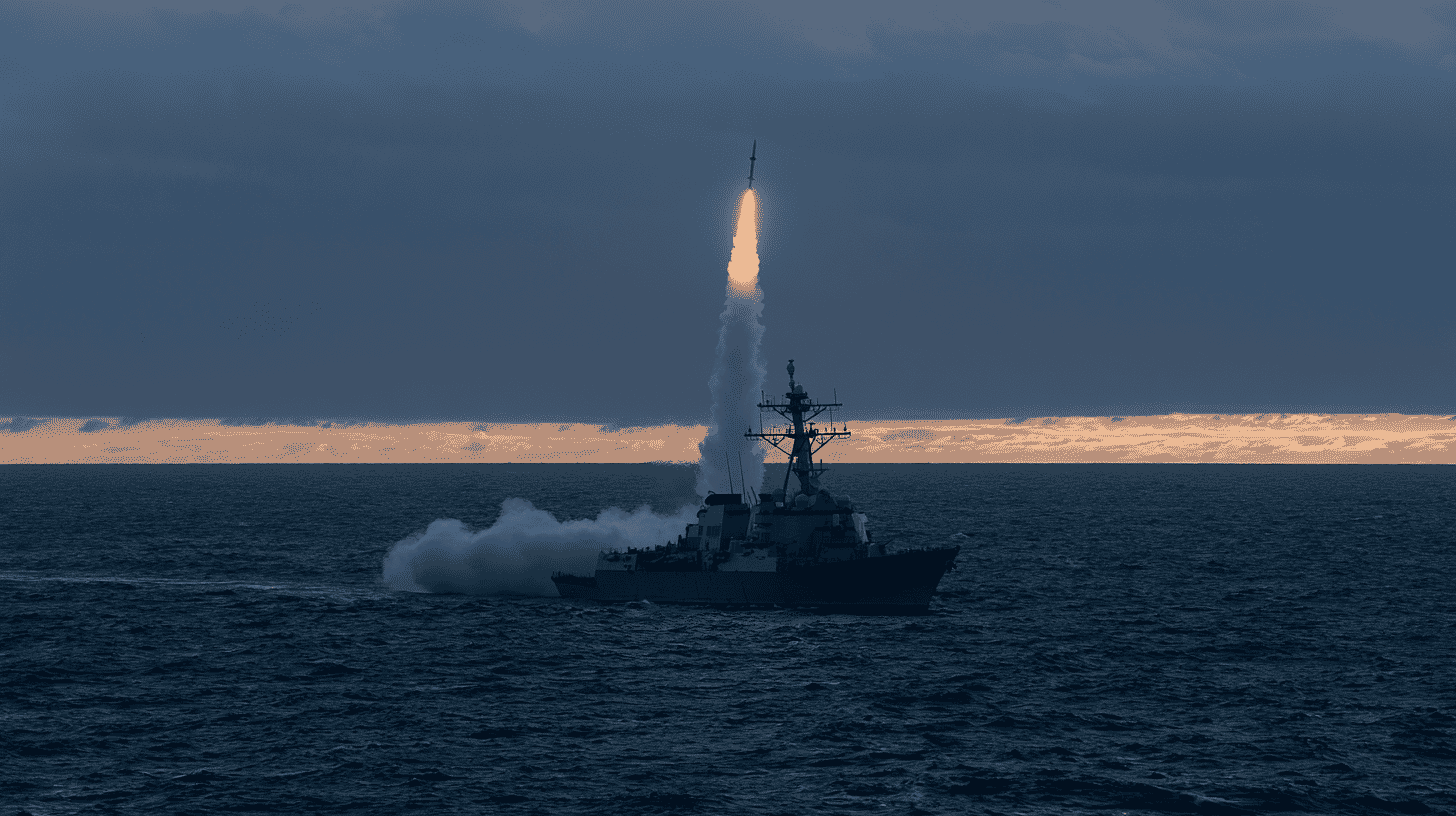
🚢 On July 29, a Japanese warship fired a Tomahawk cruise missile into the Pacific. It was the first time Japan had ever done it, and it took roughly ten months in San Diego, a fleet-wide modification programme worth 113.6 billion yen, and a policy reversal that Japan spent more than seventy years avoiding. Here is what actually changed, and what did not.
July 29, somewhere in the Pacific
The ministry's announcement went up on the evening of July 30 and ran to a few lines. Chokai, deployed to the United States, had gone ahead with the launch the previous day, July 29 in Japan and July 28 on the American side, over the Pacific and with the US Navy's cooperation. The sequence held together end to end, crew handling included.
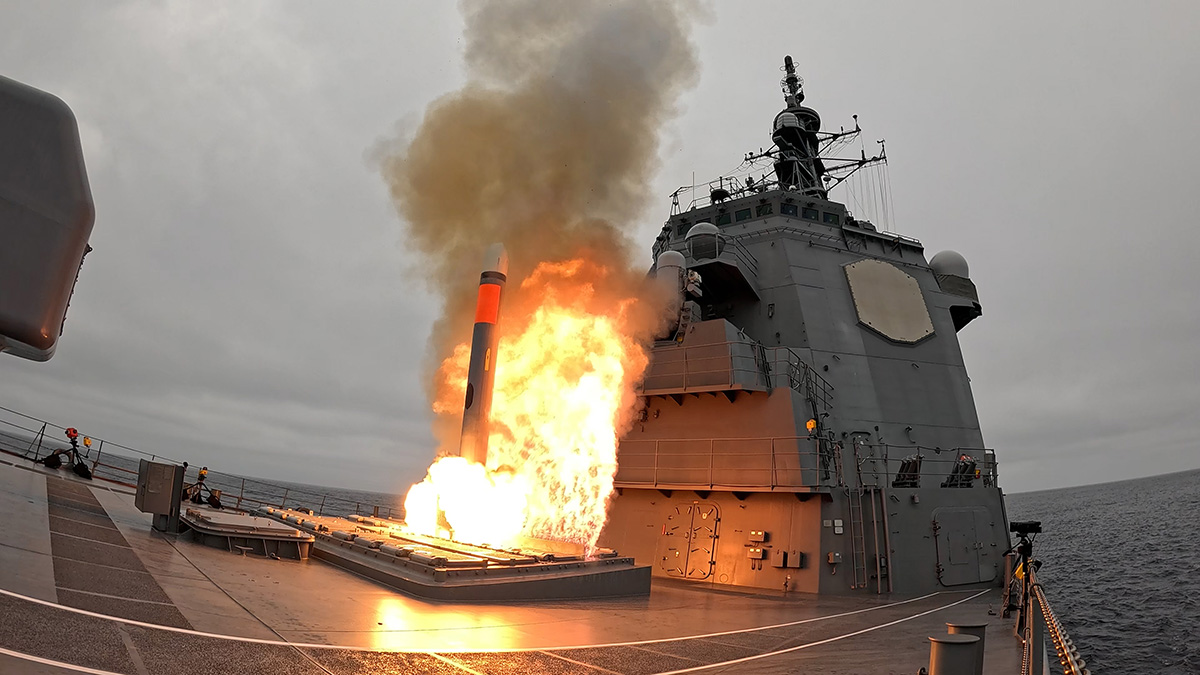
Source: Japan Ministry of Defense
The missile has a published maximum range of around 1,600 kilometres, which puts a great deal of the East Asian mainland inside a circle drawn from Japanese waters.
That is close to everything the ministry said. It did not disclose the location, the number of rounds, whether the missile was a Block IV or the newer Block V, or whether the target was on land or at sea. According to Norimono News, the American side asked for the details to be withheld. Japanese and Korean outlets both noted the same gaps.
Naval News reported that officials do not consider further shipboard live-fire tests necessary, since the Mk 41 vertical launching system and the Tomahawk launch equipment already carry long operational records with the US Navy. What Chokai had to prove was narrower: that an American missile, a Japanese crew and a Japanese combat system could get through the firing sequence together.
As of late July 2026, the ship is due back at Sasebo, its home port in Nagasaki Prefecture, around September.
Why Japan never owned a missile like this
For anyone outside Japan, the strange part of this story is that it took until 2026.
Japan's postwar defence posture rests on a doctrine usually translated as "exclusively defence-oriented policy," or senshu boei. Under it, the Self-Defense Forces were built to blunt an attack once it had begun, on or near Japanese territory, and not to reach the place the attack came from. That interpretation shaped procurement for decades. Japan bought interceptors, not strike weapons. Its Aegis destroyers were optimised for fleet air defence and ballistic missile defence, and for nothing that flew the other way.
At the end of 2022, the government revised its three core security documents and wrote counterstrike capability into them. The Tomahawk purchase followed directly from that decision.
Defence Minister Shinjiro Koizumi has been careful about how he frames it. Japan's existing missile defence network, he told reporters in March, may not be able to stop everything, and preventing further attack requires the ability to strike back. He also insisted the capability remains the minimum necessary for self-defence, usable only in the event of an armed attack by another country, and not a threat to anyone else.
Not everyone reads it that way. Benjamin Blandin, a research fellow at Taiwan's Institute for National Defense and Security Research, told Defense News in March that Japan is shifting from strict homeland defence toward what he called "semi-regional deterrence." Critics inside Japan use blunter language, arguing that senshu boei has been hollowed out while the phrase itself is kept for political cover.
Why Chokai, and which ships come next
Chokai is not the newest ship in the fleet. She is the fourth Kongo-class destroyer, commissioned in 1998, 7,250 tons standard displacement, 161 metres long, with a crew of around 300. She got the job largely because her scheduled overhaul lined up with the programme.
She left Japan in late September 2025 and arrived at Naval Base San Diego in October for modification and crew training with the US Navy. The hardware and software work was finished by late March 2026. Everything between then and July was qualification: mission planning, missile handling, launch procedures.
Funding approved through fiscal 2026 comes to roughly 113.6 billion yen, about 700 million dollars, and covers five of the eight Aegis destroyers: Chokai, Kirishima, Haguro, Myoko and Atago. Work on Kirishima and Haguro began in fiscal 2025, and Myoko and Atago are scheduled to start in fiscal 2026. The remaining three, Kongo, Ashigara and Maya, depend on budget requests from fiscal 2027 onward.
Two more hulls are coming. The Aegis System Equipped Vessels now under construction are due to enter service in fiscal 2027 and 2028, which would eventually give Japan ten Tomahawk-capable ships.
Is 400 missiles a lot, or very few?
In January 2024 Japan signed a contract with the US Department of the Navy for up to 400 Tomahawks, budgeted at 169.4 billion yen, roughly 1.08 billion dollars. Deliveries began in fiscal 2025 and split evenly between the two variants, with up to 200 Block IV rounds arriving through fiscal 2027 and up to 200 Block V rounds in fiscal 2026 and 2027.
Spread across ten ships, that is about forty missiles per hull. The defence ministry says it has no plans to order more.
Whether forty per ship means anything depends entirely on the scenario, and the honest answer is that nobody expects it to last long in a serious one. Asahi Shimbun quoted a government official saying Japan will probably enter full operation with its ammunition stocks short, because American missile production has been strained by the Middle East. Defense News reported in March that, according to reports it cited, more than 800 Tomahawks were expended in four weeks of the US campaign against Iran, and that manufacturer RTX had announced five agreements with the Pentagon in February to push annual output above 1,000. Blandin's assessment was that Japan's deliveries are unlikely to be hit immediately, and that Washington would probably prioritise a key Indo-Pacific ally, though a longer campaign could cause delays.
The fifth member of a very small club
The Tomahawk was an American and British weapon for most of its life. Britain fires it only from submarines. The club has widened recently: Australia launched one from the destroyer HMAS Brisbane off San Diego in 2024, and the Royal Netherlands Navy fired from the frigate HNLMS De Ruyter off the US East Coast in March 2025.
That makes Japan the fifth operator, and the third country other than the United States to fire a Tomahawk from a surface combatant. Germany agreed with Washington in July 2026 to acquire the missile, though for the ground-based Typhon launcher rather than for ships.
The US and the UK acquired the Tomahawk as an expeditionary strike weapon and have used it in combat repeatedly since the 1990s. Japan is buying the same missile and attaching a completely different set of conditions to it: no employment outside an armed attack on Japan and, at least officially, no capability that constitutes a threat to another country. The hardware is identical. The doctrine wrapped around it is not.
The real bet is a domestic missile
The ministry can say it will stop at 400 because, inside Japan's planning, the Tomahawk is only a bridge. The centre of the long-range programme is supposed to be domestic. The Type 25 surface-to-ship missile, formerly known as the upgraded Type 12, has a range of roughly 900 to 1,500 kilometres and is due to enter service on the destroyer Teruzuki in fiscal 2027, with plans to spread it across non-Aegis escorts. The ground-launched version, according to reports, began deployment to a garrison in Kumamoto Prefecture in March 2026.
But the Type 25 is what its name says it is: an anti-ship missile. Japan currently has no domestically built ship-launched weapon that can hit a target on land. That gap is what the Tomahawk fills. The eventual replacement is a new precision-guided anti-ship and land-attack missile that the Acquisition, Technology and Logistics Agency has scheduled from fiscal 2024 to 2032, with the first development contract awarded to Mitsubishi Heavy Industries in March 2025. For now it is an army programme, though the Type 12 precedent suggests ship-launched and air-launched versions are plausible later.
All of this sits inside a defence budget that reached 10.6 trillion yen in fiscal 2026, or 1.9 percent of GDP measured against the 2022 baseline the government uses. Another revision of the three security documents is expected by the end of 2026, and the size of the missile inventory is likely to be one of the arguments.
Japan spent more than seventy years deciding it should not own a weapon like this, and about ten months learning to fire one. Where does your country draw that line, and who gets to move it?
References
- https://www.mod.go.jp/j/press/news/2026/07/30a.html
- https://www.jwing.net/news/111468
- https://trafficnews.jp/post/694056
- https://trafficnews.jp/post/693897
- https://www.navalnews.com/naval-news/2026/07/japan-conducts-first-tomahawk-live-fire-aboard-js-chokai/
- https://news.usni.org/2026/07/30/japanese-destroyer-launches-tomahawk-for-the-first-time-in-drill-with-u-s-navy
- https://www.defensenews.com/global/asia-pacific/2026/03/30/japanese-destroyer-can-now-fire-tomahawk-missiles-extending-nations-combat-punch/
- https://www.aerotime.aero/articles/japan-first-tomahawk-cruise-missile-warship-launch
- https://www.nikkei.com/article/DGXZQOUA170ZV0X10C26A4000000/





Global Discussion
5 comments