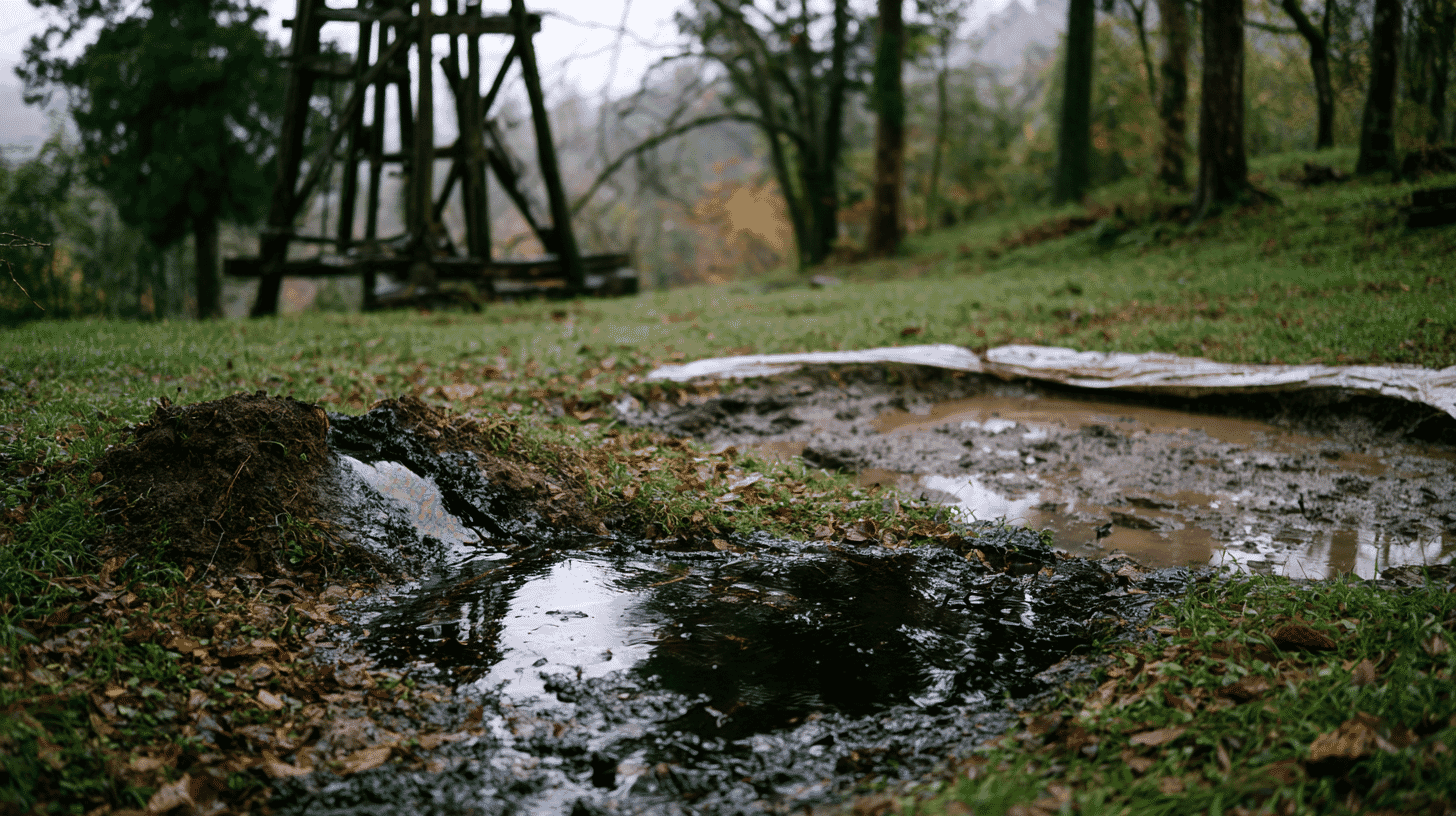
🛢️ Japan imports almost every drop of crude it uses. Yet in Niigata City, the site of what was once the country's most productive oil field, oil is still seeping out of old wells, and the local ward has set aside 120 million yen (about $760,000) in the fiscal 2026 budget just to plug them. The hard part is that nobody knows exactly where the pipes are.
When Niigata Led Japan in Oil
According to Japan's Agency for Natural Resources and Energy, the country's crude self-sufficiency has long been below 0.5%. The agency's May 2026 policy briefing says more than 90% of Japan's crude comes from the Middle East. That is why every flare-up in the Gulf turns into a story about where Japan will buy its next barrel, a thread we have followed in our look at the pipelines bypassing the Strait of Hormuz.
But Japan was not always only a buyer. According to the Niigata Nippo, the Niitsu oil field, in what is now Akiha Ward, Niigata City (formerly the city of Niitsu), produced more oil than anywhere else in Japan in the late Meiji to early Taisho years, roughly the 1900s and 1910s. The Japan Society of Mechanical Engineers puts its peak at 150,000 kiloliters a year in 1916. A local businessman, Nakano Kan'ichi (1846–1928), won mining rights, expanded the business and became known as Japan's "oil king." One corner of the field, the Kanazu site, kept working from 1874 to 1996.
A National Historic Site, and a Liability
The Kanazu site was designated a national historic site on October 15, 2018. Niigata City says it was the first national historic site tied to Japan's modern oil industry. Derricks still stand there, along with a "pumping power" engine that drove several wells at once through a web of wires. It is now a public park.
Elsewhere in the same ward, oil keeps leaking. A ward official told the Niigata Nippo newspaper: "Our oil history is the ward's pride, but it left a negative legacy too."
The Pipes Were Cut Underground
The root of the problem is that old wells were never properly sealed. According to Niigata City, oil from abandoned wells has reached rivers several times since July 2021. The ward is thought to contain more than 600 old wells, and for most of them nobody has confirmed where the pipes run.
The ward began a sealing program in the Asahi and Oguchi districts in fiscal 2023. The method is simple: find the pipe underground, pull it out, fill the hole with cement. Finding it is where the work stalls. In Asahi, three of four pipes were cut 40 to 120 meters underground, so there is nothing at the surface to show where they are. In Oguchi, it took about four years to seal a single well, finished in fiscal 2025. The ward expects the Asahi work to take at least 10 years to finish, even if all goes well. Bears have been sighted near the site, and workers carry bear spray.
Why were the pipes cut partway down? The Niigata Nippo's headline raised war as a possible factor, with a question mark. Minutes from a city expert committee meeting in May 2026 are more specific. The committee's secretariat said the three Asahi pipes were cut and recovered at different times: one in the Meiji era, one in the Taisho era "during the war," and one after the war, in the Showa era. The minutes do not say which war, and the Taisho era overlapped with World War I. They also give no reason why the steel was cut and taken away. Nor can the old records be trusted: for the Oguchi well that was eventually sealed, they said two bags of cement had been poured in, yet oil kept seeping out.
Oil Nobody Can Sell
In fiscal 2021, the ward collected and disposed of about 18,000 liters of oil in Oguchi and about 70,000 liters in Asahi, the equivalent of 440 oil drums. According to the committee secretariat, a layer of oil 30 to 40 centimeters thick built up on a settling pond that year, then washed out with rainy-season downpours and reached the mouth of the Shinano River. Water intake for the city supply briefly stopped, and pumps that lift irrigation water had to be shut down.
With oil prices high, why not sell it? When oily mud burst from under a house in the ward's Takiya-cho neighborhood in April 2013, Kyodo News reported that the oil was too impure to use or sell. By summer, about 300 liters were erupting every 15 to 20 hours, and residents were skimming it off with ladles. Because the land was private, no public help was available, and one landowner had already spent more than 800,000 yen (about $5,000 at today's rate) of their own money. According to the Niigata Nippo, the flow lasted about four years, then stopped on its own. On January 2, 2024, the day after the Noto Peninsula earthquake, flammable gas and oil erupted at a house in Takiya again. That episode subsided in about two days.
Unlike in 2013, the ward is now going after the wells itself. It uses a national scheme under which the national government covers three-quarters of the cost when oil leaks from abandoned production equipment and needs fixing. The ward runs its program on national and prefectural subsidies, and budgeted 120 million yen for fiscal 2026.
America Has Hundreds of Thousands of Unrecorded Wells
The same problem exists abroad, on a far larger scale. According to a National Academies report, in the United States 141,959 documented orphaned wells, wells whose owners are unknown or insolvent, were on record at the end of 2023, with 29 states reporting. States estimate another 250,000 to 740,000 undocumented wells. The Interior Department's Office of Inspector General notes that such wells are sometimes found when landowners notice oil leaking on their property. That is exactly what happened in Takiya-cho. The Bipartisan Infrastructure Law set aside $4.7 billion to plug them, and in May 2026 the Interior Department issued new guidance for its state grants.
In Alberta, Canada, 2,980 wells from one company were handed to the province's Orphan Well Association in April 2026. Here the industry pays: according to its annual report, the association is funded by an industry levy, which came to C$141.3 million in 2025/26.
Who Pays for the Last Barrel
The people who got rich from Niitsu oil lived in the Meiji and Taisho eras. Someone between the Meiji era and the postwar years cut the pipes and recovered the steel. Production ended in 1996. The people paying to seal the wells now are the national, prefectural and city governments, which is to say taxpayers. In Niitsu, the generation that profited from the oil and the generation paying for the cleanup are clearly not the same.
Where you live, who pays to close the old wells and mine shafts that nobody remembers digging?
References
- https://www.niigata-nippo.co.jp/articles/-/906853
- https://www.niigata-nippo.co.jp/articles/-/887865
- https://www.city.niigata.lg.jp/akiha/torikumi/seisaku/oilwell_blockade.html
- https://www.city.niigata.lg.jp/akiha/torikumi/seisaku/oilwell_blockade.files/R0801-3_gijiroku.pdf
- https://www.city.niigata.lg.jp/akiha/torikumi/seisaku/oilwell_blockade.files/R0601-4_gijiroku.pdf
- https://www.city.niigata.lg.jp/akiha/torikumi/seisaku/oilwell_blockade.files/R0602-3_gijiroku.pdf
- https://www.nikkei.com/article/DGXNASDG1504Y_X10C13A8CC0000/
- https://www.city.niigata.lg.jp/kanko/bunka/rekishi/bunkazai/shokai/niituyuden.html
- https://www.city.niigata.lg.jp/akiha/about/kankou/oil/shiseki_kanadu.html
- https://iju.niigata.jp/gatapra/data/570
- https://www.jsme.or.jp/kikaiisan/heritage_096_jp.html
- https://www.enecho.meti.go.jp/about/energytrends/202506/html/s-1-3.html
- https://www.meti.go.jp/shingikai/enecho/shigen_nenryo/pdf/046_03_00.pdf
- https://www.nationalacademies.org/read/28035/chapter/3
- https://www.doioig.gov/sites/default/files/2021-migration/Flash%20Report_DOI%20OrphanedWells.pdf
- https://www.doi.gov/pressreleases/biden-harris-administration-releases-final-guidance-new-orphaned-well-program
- https://www.doi.gov/pressreleases/interior-unlocks-funds-orphaned-well-clean
- https://cdn.prod.website-files.com/66a3c445f4f5971ff979146e/6a564c15bfe0a61b022f5257_OWA%202025-26%20Annual%20Report.pdf







Global Discussion
4 comments