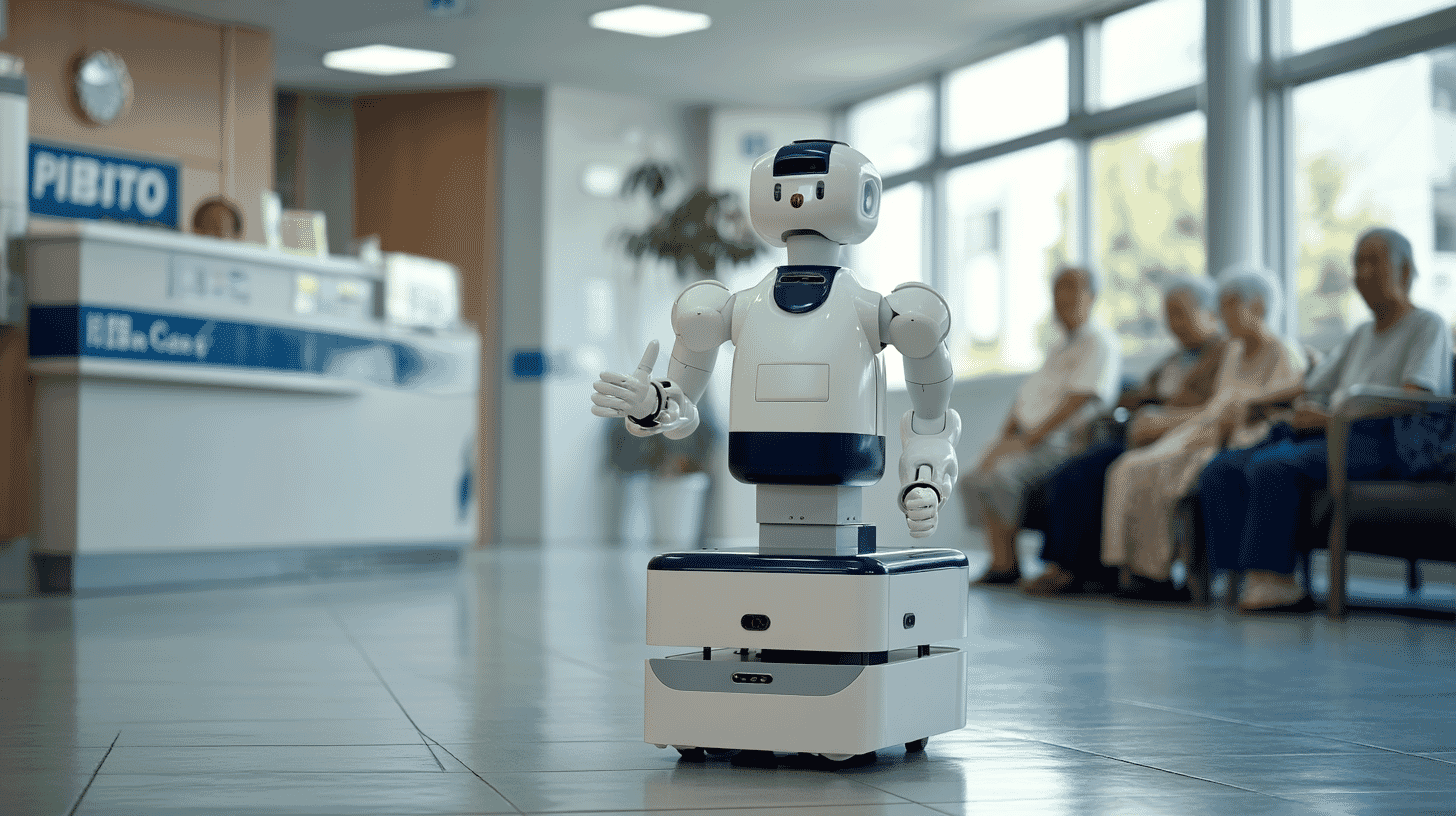
🤖 A Tokyo startup has done something almost nobody in the humanoid robot business does. It published a price.
Five million yen, about $32,000. Order book open the same day. And then, instead of calling the machine Japanese, it called it "semi-domestic" and spent several pages explaining why that hedge is the entire strategy.
A ¥5 million price tag on a 129 cm body
On August 5, 2026, ZEALS, an AI company headquartered in Meguro, Tokyo, announced D1, a compact humanoid designed for Japanese indoor spaces. The ¥5 million is before tax, and a support contract runs from ¥200,000 a month, about $1,300, on top. Dollar figures here use the August 5, 2026 rate of ¥157.6 to the dollar.
D1 is not the sprinting, backflipping machine that dominates humanoid demo reels. It is a two-armed torso mounted on a wheeled base. It stands about 129.3 cm, and the base is about 48 cm across, which ZEALS says is narrow enough for the corridors, doorways and elevators of Japanese hospitals and hotels. Each arm has seven axes and carries up to 5 kg. The whole machine has 21 or more degrees of freedom, runs for up to about eight hours on a charge, finds its way with LiDAR, and does its thinking on an NVIDIA Jetson module.
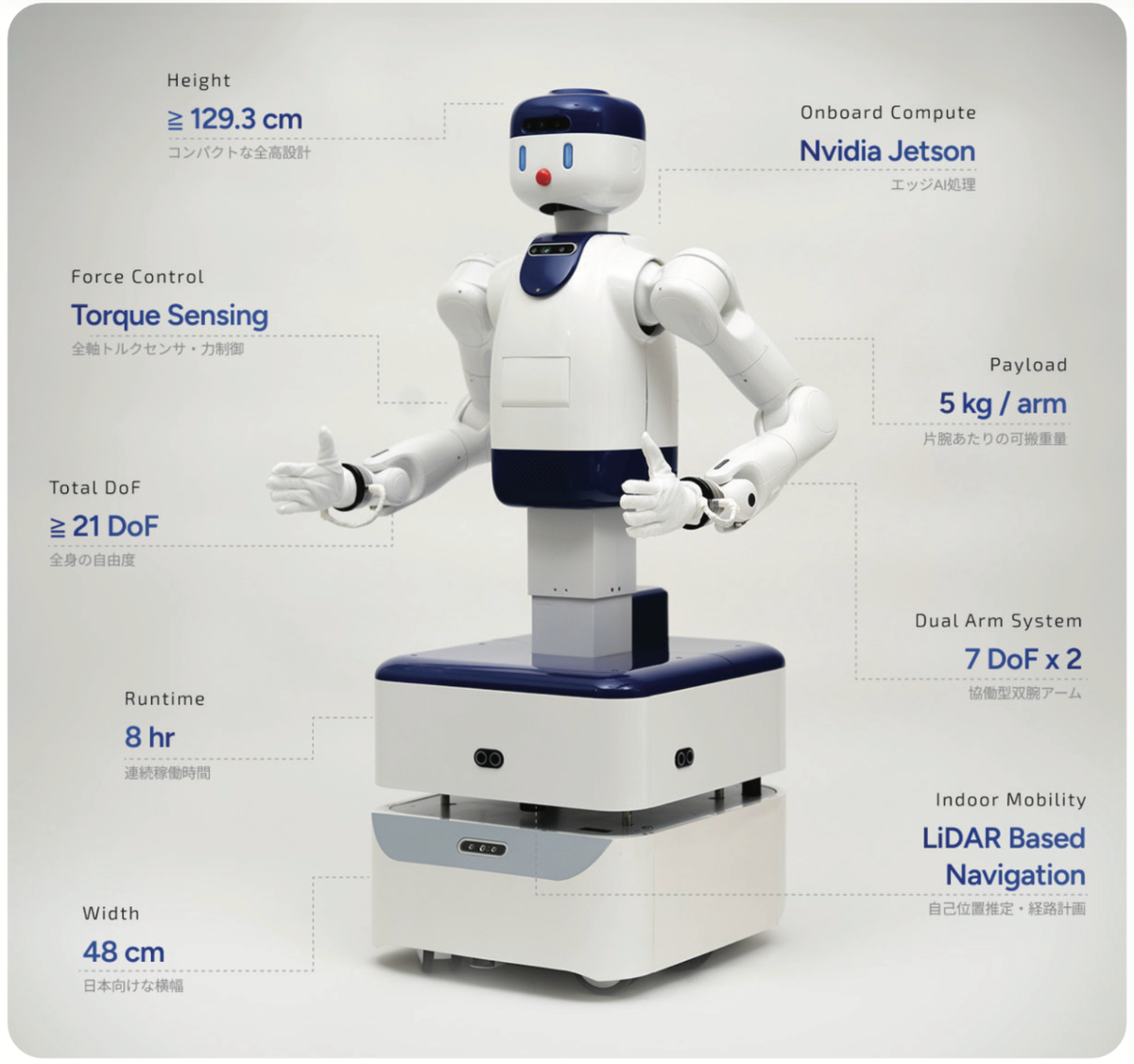
Source: ZEALS press release
The safety story is incomplete, and the company says so. Torque sensors sit on every axis of both arms, meant to halt motion the moment the robot touches a person or an object. ZEALS describes that mechanism as still being implemented rather than finished.
What "semi-domestic" is actually admitting
The two words are homophones. 純国産, "purely domestic," and the phrase ZEALS chose, 準国産, are pronounced identically and differ by a single character. The first means made entirely at home. The second carries the sense of "quasi," of not quite qualifying. Putting that word on your own flagship product is an unusual move.
The reasoning is blunt. Insisting on all-Japanese parts today, ZEALS argues, would push the price up and lock the machine out of the best available components, which would delay what the company treats as the priority above all others: getting robots into real workplaces. So D1 buys world-class parts wherever they come from, while Japan keeps the layers ZEALS considers strategic. CEO Masahiro Shimizu lists them: AI, software, control, assembly, and deployment.
What the company has not published is a number. There is no stated percentage of Japanese content, and no parts list. "Semi-domestic" describes who holds the design and integration, not how much of the hardware was made where. The stated ambition is to work with Japanese suppliers over time and localize the major components, with D1 as the starting point rather than the destination.
Four months ago, the same company was running a Chinese robot
From March 23 to 25, 2026, ZEALS and Quick, a University of Tsukuba spinout, ran a three-day trial in the ground-floor lobby of Tsukuba University Hospital, working evenings after outpatient clinics closed. The robot walking around that lobby was a Unitree G1, made in Hangzhou. What belonged to ZEALS was the brain: its own robotics operating system, Omakase OS, handling autonomous walking, obstacle avoidance, spoken directions and carrying tasks.
Just over four months later, the software has a body of its own. A company that had been renting someone else's hardware now sells a machine whose design it controls, and the label it chose points straight at that shift.
The week Washington shut the door on foreign robots
D1 arrived eight days after a US decision that changed who is allowed to sell robots in America.
On July 28, 2026, the Federal Communications Commission added foreign-produced advanced robotic devices to its Covered List, the register of equipment considered a national security risk. In practice, as IEEE Spectrum reported, mobile robots over 2 kg that carry sensors and communications are no longer eligible for import if they are made abroad, unless the Defense Department decides a particular device or class of devices is safe. Drones, connected vehicles and medical equipment are exempt, and machines already certified can still be sold. Anyone wanting a conditional approval has to file with the DOD and FCC by January 1, 2028, and submit a time-bound plan to build or expand manufacturing on US soil.
The FCC insists the rule is country-neutral. Nobody in the industry reads it that way, and China's Ministry of Commerce objected at a press conference the following day. But the wording matters for Japan, because country-neutral means allied manufacturers are caught too. A Japanese-designed robot assembled with parts from several countries does not automatically clear a bar written around where a device is produced.
ZEALS has not connected D1 to the FCC decision, and the robot is aimed squarely at the Japanese market first. The timing is still hard to ignore. Japan's own government has been circling the same question: an interagency policy on deploying AI robotics was adopted in March 2026 and revised in May, and a working group earlier that year singled out motors, gear reducers and computing platforms as the components whose design and manufacturing capacity Japan needs to shore up.
Line up the price tags
Against the field, ¥5 million is an awkward number.
Unitree lists the G1 at $13,500 on its own store, about ¥2.13 million. D1 costs about 2.3 times that. But the two are not the same product: the G1 is a bipedal research platform, while D1 is a wheeled service machine with dual seven-axis arms, sold with insurance, leasing and deployment partners attached. ZEALS has lined up Mitsui Sumitomo Insurance for liability and cyber cover, three leasing companies including Mitsubishi HC Capital, and GMO AI & Robotics Trading plus Quick to handle installation.
Look the other way and the comparison flips. Tesla told investors in July 2026 that its first Optimus units are for collecting training data and developing functionality, not for customers. Figure's robots work at BMW's Spartanburg plant on logistics sequencing, but that is an enterprise deployment rather than an open sale. There are Japanese precedents, though. ugo's ugo Pro is a domestically built machine with two arms on a wheeled base, already handling multilingual interaction, patrol security and wayfinding. What is new about D1 is less the human shape than the attempt to put a general-purpose machine that both talks and carries into healthcare at a published price.
100 units, 10,000 hours, and what that divides into
ZEALS says it will judge itself on hours worked rather than units shipped. The target for Japan's 2026 fiscal year, which ends in March 2027, is 100 machines built and 10,000 cumulative hours of real work across them.
Divide one by the other and the ambition comes into focus: 100 hours per robot per year, roughly two hours a week. That is a pilot program, not a rollout. Production ramps through the year, so measured over the stretch a machine is actually deployed the intensity is somewhat higher, but framing the goal in operating hours still makes it harder to inflate. The first-year cost tells a similar story. A body plus twelve months of support comes to ¥7.4 million, close to $47,000, before anyone has calculated what the robot saved.
The reason healthcare comes first is demographic. Japan's health ministry estimates the country will need about 2.72 million care workers in fiscal 2040, up from about 2.15 million in fiscal 2022, meaning roughly 570,000 more people have to be found. D1's early tasks are deliberately unglamorous: reception and wayfinding, checking in on older residents, scheduled patrol rounds, preparing and handing over supplies. ZEALS states plainly that the robot does not replace medical procedures.
Shimizu's pitch is that Japan cannot win the humanoid race on capital or chips, so it should win on use cases, becoming the country that works out what these machines are actually for. Whether ¥5 million is the right number for that bet is something the first buyers are about to find out.
In Japan, the argument about humanoid robots is rarely about job losses. It is about who will still be around to do the work at all. Does that framing sound familiar where you live, or does a robot in a hospital lobby read very differently there?
References
- https://prtimes.jp/main/html/rd/p/000000206.000019209.html
- https://www.itmedia.co.jp/aiplus/article/2608/05/2000000401/
- https://zeals.ai/jp/news/unitree-tsukuba-poc/
- https://spectrum.ieee.org/fcc-covered-list-mobile-robots
- https://shop.unitree.com/collections/humanoid-robot
- https://ugo.plus/products/ugo-pro/
- https://www.cnbc.com/2026/07/22/tesla-tsla-q2-2026-earnings-report.html
- https://www.press.bmwgroup.com/global/article/detail/T0458778EN/bmw-group-advances-the-use-of-physical-ai-in-production-with-figure-03-project-in-spartanburg?language=en
- https://www.mhlw.go.jp/stf/newpage_02977.html
- https://www.meti.go.jp/policy/mono_info_service/mono/robot/index.html
- https://www.meti.go.jp/policy/mono_info_service/joho/conference/seichosenryakuwg/aisemicon01/shiryo04.pdf





Global Discussion
4 comments