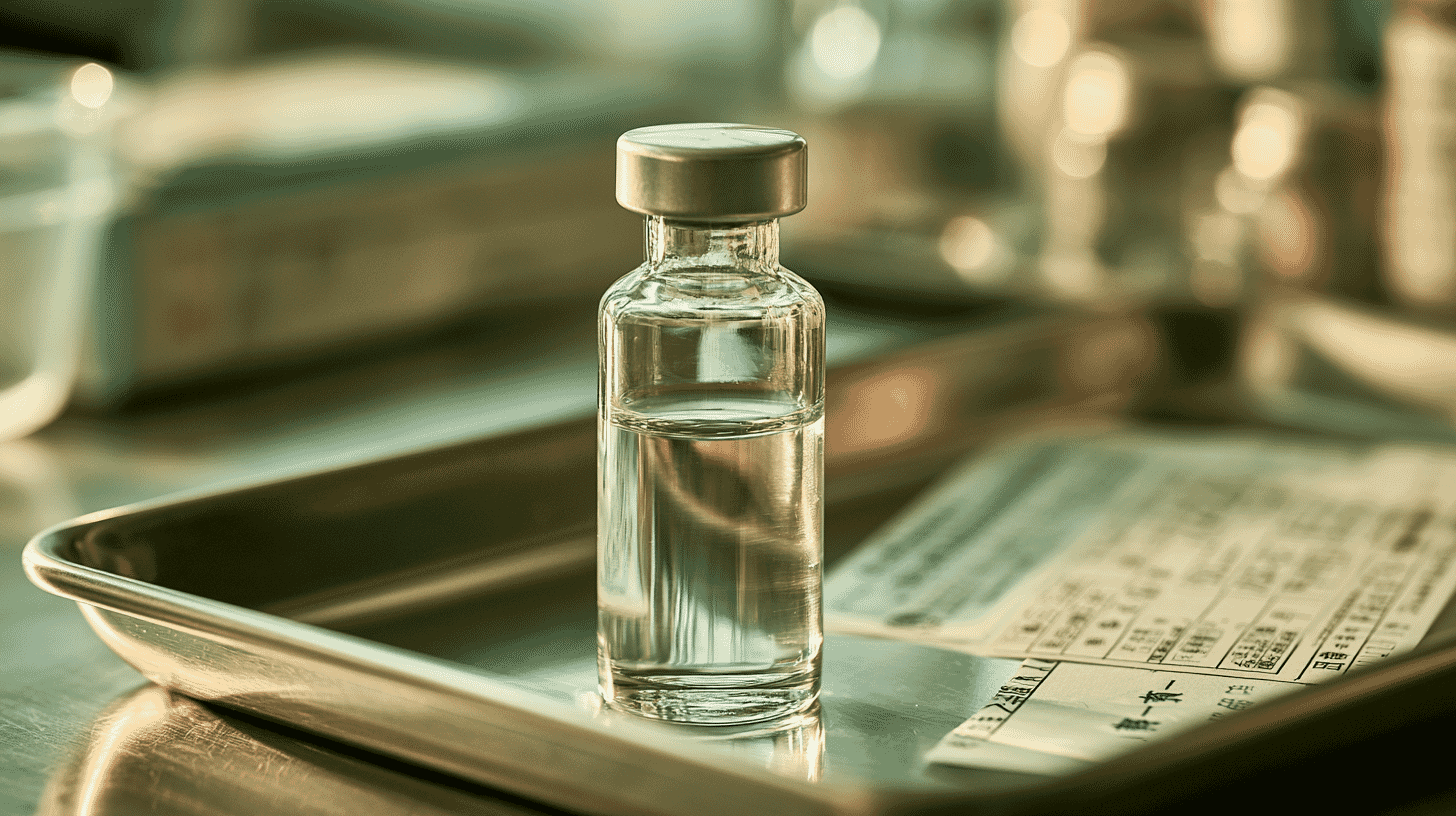
Take a common cold virus, rewire it so it can only copy itself inside cancer cells, then push it down someone's throat with an endoscope and inject it straight into the tumor. That drug went on sale in Japan on August 21, 2026, under the name Telomelysin.
Oncolys BioPharma, the company behind it, says no oncolytic virus has been approved anywhere for esophageal cancer before this one. The list price is 9,307,467 yen for a three-dose course, roughly $58,000. Japan's national insurance covers it, so that is not what the patient pays.
An injection instead of an incision
Telomelysin (generic name suratadenoturev) came out of a biotech spun off from Okayama University, with Fujifilm Toyama Chemical handling distribution. Regulators approved it on June 8, 2026, it joined the national reimbursement price list on August 13, and it reached the market on August 21. Professor Toshiyoshi Fujiwara and Associate Professor Shinji Kuroda at Okayama University began clinical research in 2013, so 13 years passed before it reached patients outside a trial.
The label is narrow: esophageal cancer that can be neither surgically removed nor treated with standard chemoradiotherapy. It is given alongside radiotherapy. One milliliter, containing a trillion viral particles (1×10^12), goes into the tumor under endoscopic guidance, roughly every two weeks, three times in total.
Not every hospital can offer it. A site has to be a designated cancer care hospital, an advanced treatment hospital or similar, with radiotherapy on hand; it has to handle the genetically modified virus under Japan's Cartagena Act biosafety rules; and it has to enroll patients in post-marketing surveillance. The physician in charge needs a specified number of years in cancer chemotherapy or gastrointestinal oncology, plus a training course run by the manufacturer.
The switch only cancer cells are pressing
The chassis is adenovirus type 5, one of the ordinary causes of the common cold. Every time a cell divides, the telomeres capping its chromosomes get shorter, and normal cells eventually run out of room to divide. Most cancer cells switch on an enzyme called telomerase, keep rebuilding their telomeres, and escape that limit.
In Telomelysin, the on-switch for the E1 region genes the virus needs in order to replicate has been swapped for the promoter of hTERT, the telomerase gene. The virus therefore copies itself and bursts the cell only where telomerase is running, which in practice means inside cancer. Drop it into a healthy cell and, by design, nothing happens.
When the cancer cell ruptures, tumor antigens spill out along with fresh virus and the immune system takes notice. Oncolys BioPharma also reports that the virus interferes with DNA repair and works synergistically with radiation, which is why the approval covers the combination rather than the virus alone. In a Phase 1 study run in the United States, the company says it saw abscopal effects, where lesions that were never injected shrank anyway.
What 37 patients showed
The approval rests on a Phase 2 trial, OBP101JP, run at 17 sites across Japan. It enrolled 37 patients. At 18 months, the local complete response rate was 50.0%. Overall survival at the same point is reported at 56.6% and cancer-specific survival at 70.1%. About 76% of participants were 80 or older, and nearly all had squamous cell carcinoma.
According to the Japan Esophageal Society's national survey, 86.2% of esophageal cancers in Japan are squamous cell, and alcohol and tobacco account for most of them. Patients cluster in their sixties and seventies. For older people whose bodies cannot take surgery or chemoradiotherapy, the usual course until now was radiotherapy on its own or palliative care. Telomelysin is going after that gap.
But it is a single-arm study of 37 people with no randomized comparator. Half the patients seeing their tumors clear locally is a striking result, though there was no control group to measure it against. The most common side effect was fever, reported in 51.4% of patients. The domestic forecast Oncolys BioPharma filed with the health ministry is correspondingly modest: 241 patients and 2.2 billion yen a year at peak.
How it differs from Imlygic
For a field with such a long research history, oncolytic viruses have produced very few products. A 2026 review counted six approved worldwide: Gendicine (2003) and Oncorine (2005) in China, Rigvir (2004) in Latvia, Imlygic (2015) and Adstiladrin (2022) in the United States, and Delytact (2021) in Japan. None of them targets esophageal cancer.
Imlygic is a modified herpes simplex virus type 1 engineered to produce GM-CSF, an immune-stimulating protein. The US Food and Drug Administration approved it on October 27, 2015. In the Phase 3 OPTiM trial, 16.3% of patients had a response lasting six months or more, against 2.1% on GM-CSF alone. It goes directly into skin, subcutaneous and lymph node lesions.
The two sit in the same category but get used very differently. Imlygic goes after lesions a doctor can see or feel; Telomelysin travels down an endoscope to an organ inside the body. The immune play differs too. Imlygic loads a cytokine onto the virus to call the immune system in, while Telomelysin ties the replication switch to a condition of the cancer cell and leans on radiation for the rest. The gap in duration is blunter still: Imlygic means coming back for injections over six months or more, Telomelysin three doses two weeks apart.
The form of the approval matters as much as the biology. Japan has a pathway that lets regenerative medicine products onto the market on a conditional, time-limited basis once efficacy is merely probable. Delytact, approved for malignant glioma on June 11, 2021, took that route. Telomelysin did not. Clearing a full approval on a single-arm trial is unusual for this product class in Japan.
The sticker price, and the bill patients see
One 2 mL vial is priced at 3,102,489 yen, so the standard three doses come to 9,307,467 yen. At 159.3 yen to the dollar, the rate on August 27, 2026, that is about $58,000, close to the $65,000 average cost Amgen set out for Imlygic when it was approved in 2015.
What the patient pays is a separate question, because Japan's public insurance caps monthly out-of-pocket spending through the high-cost medical expense benefit. The health ministry's own worked example: for someone under 70 earning roughly 3.7 to 5.1 million yen a year, a bill of 1 million yen leaves about 93,000 yen to pay. The insurance system absorbs most of a 9.3 million yen course the same way. The cap runs by calendar month, so a schedule of three doses two weeks apart can straddle two of them.
From the payer's side the scale is small. Peak demand is projected at 241 patients and 2.2 billion yen, about $14 million, a year. The price was calculated using Delytact as the comparator drug, with three 10% premiums stacked on top for pioneer status, small-market status and clinical usefulness.
Worldwide, just over 490,000 people are diagnosed with esophageal cancer each year and more than 440,000 die of it; 72.0% of those cases are in Asia. The squamous cell form that dominates in Japan and China behaves differently from the adenocarcinoma rising in Europe and North America. A cancer that falls hardest on Asia got its new treatment from an Asian lab first. How much would your country's insurance put up against 37 patients' worth of data and a 9.3 million yen price tag?
References
- https://www.oncolys.com/jp/relation/telomelysin.html
- https://www.oncolys.com/en/pipeline/telomelysin.html
- https://www.fujifilm.com/fftc/ja/news/352
- https://www.okayama-u.ac.jp/up_load_files/press_r7/press20251218-1.pdf
- https://hokuto.app/regimen/3ZPcXgXBbZLvzv2BBM4W
- https://www.carenet.com/news/general/carenet/63014
- https://www.carenet.com/news/general/carenet/63483
- https://answers.and-pro.jp/pharmanews/32978/
- https://gemmed.ghc-j.com/?p=76107
- https://ganjoho.jp/public/cancer/esophagus/treatment.html
- https://www.esophagus.jp/public/cancer/02_epidemiology.html
- https://www.mhlw.go.jp/stf/seisakunitsuite/bunya/kenkou_iryou/iryouhoken/juuyou/kougakuiryou/index.html
- https://www.amgen.com/newsroom/press-releases/2015/10/fda-approves-imlygic-talimogene-laherparepvec-as-first-oncolytic-viral-therapy-in-the-us
- https://www.ajmc.com/view/cost-questions-will-follow-the-approval-of-amgens-oncolytic-viral-treatment-imlygic
- https://www.daiichisankyo.com/files/news/pressrelease/pdf/202106/20210611_E_47.pdf
- https://pmc.ncbi.nlm.nih.gov/articles/PMC12960624/
- https://gco.iarc.who.int/media/globocan/factsheets/cancers/6-oesophagus-fact-sheet.pdf









Global Discussion
3 comments