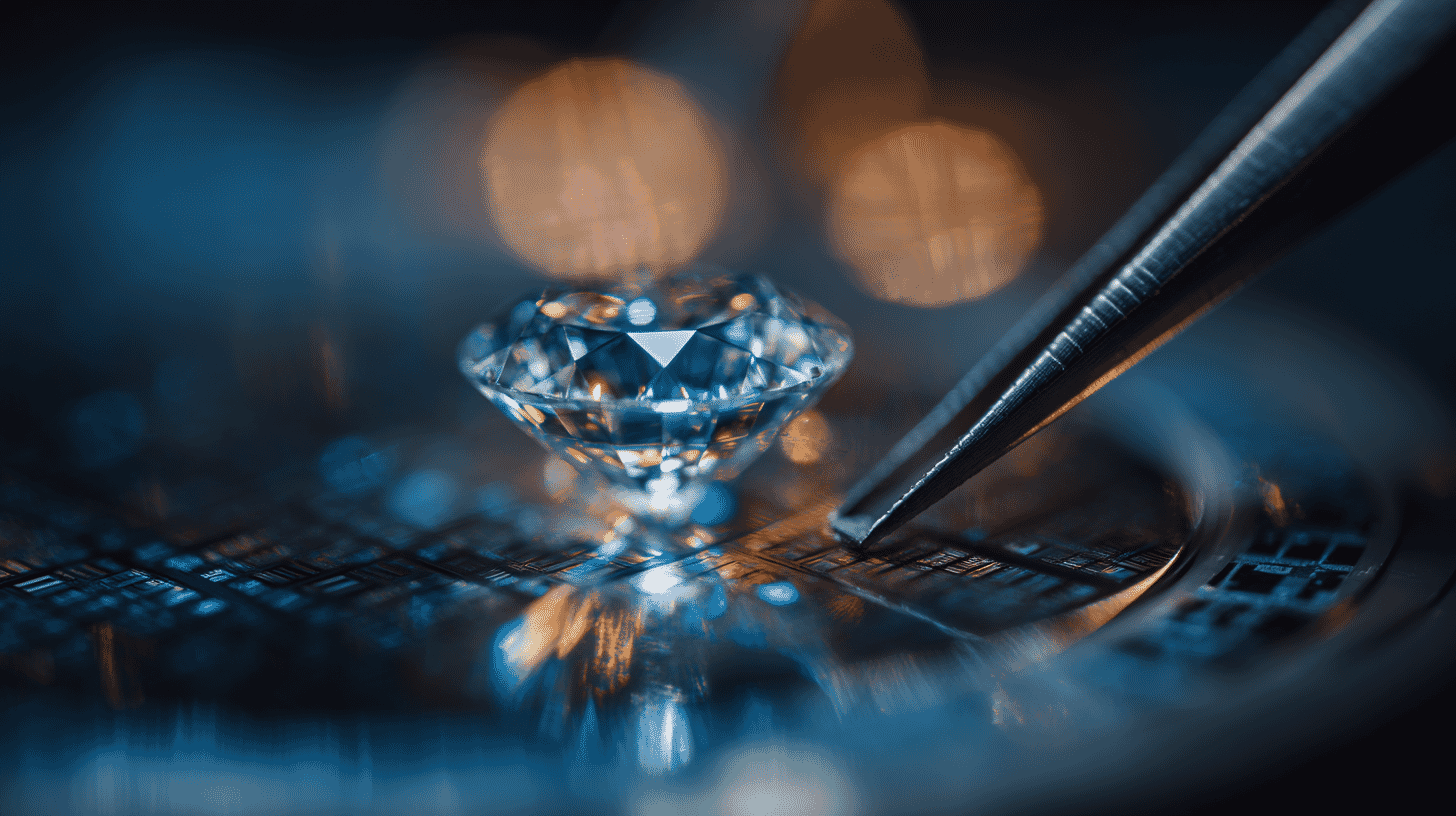
No semiconductor wafers, no precision car parts, no next-gen chips: without this one material, modern industry grinds to a halt. China controls over 60% of global lab-grown diamond production, and Japan just bet $36 billion that it can break free. But is the deal fair, or a high-risk gamble with taxpayer money?
Japan's $36 Billion US Investment Kicks Off with Three Major Projects
On February 18, 2026 (February 17 US Eastern time), the governments of Japan and the United States jointly announced the first tranche of projects under their bilateral investment agreement. It followed five rounds of consultative committee meetings between December 2025 and February 2026, and a February 12 meeting in Washington between economy minister Ryosei Akazawa and Commerce Secretary Howard Lutnick. This marks the official launch of a $550 billion investment plan that Japan committed to in July 2025 as part of tariff negotiations with the Trump administration.
The three projects decided are as follows.
They are a lab-grown industrial diamond factory in Georgia ($600 million), a crude oil export terminal in the Gulf of Mexico ($2.1 billion), and a gas-fired power plant in Ohio to supply AI data centers ($33.3 billion), totaling roughly $36 billion.
President Trump hailed the deal as "historic for both countries." Japanese Prime Minister Sanae Takaichi posted on X, saying the projects would "strengthen the Japan-US bond by building supply chains together." According to Japan's trade ministry, the interested parties break down by project: Asahi Diamond Industrial and Noritake, both diamond tool makers, want to buy from the diamond plant; Mitsui O.S.K. Lines, Nippon Steel, JFE Steel and Modec are eyeing equipment supply for the oil terminal; and Toshiba, Hitachi, Mitsubishi Electric and SoftBank Group are looking at the gas power project.
Why Lab-Grown Diamonds Are a Strategic Priority
Among the three projects, the diamond factory may have the smallest price tag, but it's drawing the most attention, for reasons that go far beyond jewelry.
About 70% of all diamonds in circulation are for industrial use, and most of those are synthetic. Lab-grown diamonds are prized for their extreme hardness, making them essential for slicing semiconductor wafers, grinding automotive parts, polishing aircraft engine components, and manufacturing medical instruments. Without industrial diamonds, modern high-tech manufacturing simply cannot function.
There's an even more futuristic angle: "diamond semiconductors." Because diamond has exceptional thermal conductivity and heat resistance, it could potentially replace silicon in next-generation power chips. This would allow dramatic miniaturization of electric vehicle powertrains by eliminating bulky cooling systems. Some researchers call it "the ultimate semiconductor material."
China's 60%+ Market Share: A Rare Earth Déjà Vu
The problem is that production is dangerously concentrated in China. According to Chinese government data, China controls approximately 63% of the world's lab-grown diamond production capacity. Some industry estimates put the figure as high as 90%.
In October 2025, China added synthetic diamond products to its export control list. While a full export ban hasn't been implemented, the move clearly signals that Beijing views synthetic diamonds as a potential diplomatic weapon, much like rare earth minerals.
The parallels to the rare earth crisis are striking. In 2010, during a territorial dispute over the Senkaku Islands, China effectively restricted rare earth exports to Japan, causing severe disruptions to Japan's electronics and automotive industries. Rare earth elements are critical for EV motors, wind turbines, and military systems, and China still controls about 90% of global refining capacity.
If synthetic diamonds follow the same trajectory, industries from semiconductors to automobiles to aerospace could face serious supply disruptions. Experts estimate that building a China-independent diamond supply chain will take 5 to 10 years and require massive investment, and even today, high-end production lines still depend on Chinese suppliers.
Who Benefits? Japan Puts Up the Money, Element Six Runs the Show
The Georgia diamond project will be operated by Element Six Holdings, a subsidiary of De Beers, the world's largest natural diamond mining company. This is an important detail.
Japan provides the financing, through government-affiliated financial institutions, but the project is managed by a foreign company, and final project selection authority rests with the Trump administration. Japanese companies like Asahi Diamond Industrial and Noritake will participate primarily as purchasers of the diamonds produced, not as operators.
Asahi Diamond Industrial told Reuters that the arrangement offers "merit in terms of procurement risk mitigation," essentially diversifying its supply sources away from China. That's a real benefit, but it also means Japanese firms are customers, not decision-makers.
The "High Risk, Low Return" Problem
The financial structure of the deal has sparked significant criticism in Japan. Patrick Harlan (known as "Pakkun"), an American-born TV commentator fluent in Japanese, laid out the math on national television:
Japan funds 100% of the investment. If a project loses money, Japan absorbs 100% of the losses. If a project turns a profit, the returns are split 50/50 between Japan and the US under the terms of the 2025 Memorandum of Understanding (MOU). And once Japan's original investment is recouped, the split shifts dramatically to 10% for Japan and 90% for the US.
In other words: all the downside risk belongs to Japan, while the US enjoys almost no risk and the majority of the upside. As Harlan put it: "For America, this is low risk, high return. For Japan, it's high risk, low return."
Takahide Kiuchi, an economist at the Nomura Research Institute (NRI), has called the arrangement "extremely unequal" and has questioned why Japan's government-affiliated banks, which exist to support Japanese companies, are being used to finance American business ventures, all without parliamentary oversight.
What Japan Actually Gains
Despite these concerns, the investment isn't without merit for Japan.
Start with supply chain diversification. Having a non-Chinese source for industrial diamonds is genuine insurance for Japan's semiconductor and automotive sectors. The rare earth crisis taught Japan that backup supply routes are not optional, they're essential.
There are business opportunities too. Companies can benefit from supplying equipment and technology to these projects. Noritake and Asahi Diamond may not run the factory, but a stable, non-Chinese source of raw material strengthens their businesses.
And there is the stepping stone to diamond semiconductors. Japan has world-class researchers in diamond semiconductor technology. Startups like Diamond Semiconductor (a Saga University spinoff) and EDP (born out of Japan's National Institute of Advanced Industrial Science and Technology) are leading the charge. A reliable diamond supply chain could accelerate commercialization of this next-generation technology.
The Road Ahead: $550 Billion and Counting
This first tranche accounts for only about 7% of Japan's total $550 billion commitment. The remaining $510+ billion is still under negotiation.
If Republicans lose the midterm elections in November, the Trump administration could become a lame duck, potentially stalling the investment program. And the biggest uncertainty of all, the Supreme Court ruling on tariffs, landed days after this article went up. See the update below.
The tension at the heart of this story is straightforward: Japan needs to reduce its dependence on Chinese strategic materials, but the terms under which it's being asked to do so appear heavily tilted in America's favor.
Whether Japan can transform this investment from a "forced tribute" into a genuine strategic asset depends on how skillfully it negotiates the second and third tranches to come.
Update: The Court Struck the Tariffs Down, and the Investment Went Ahead Anyway
Several of the premises above moved after publication.
The Supreme Court ruled the reciprocal tariffs unlawful on February 20, 2026. By six votes to three, the court held that the International Emergency Economic Powers Act does not grant the president authority to impose tariffs, reasoning that when Congress has delegated its taxing power it has always done so in explicit terms and with strict limits. The IEEPA-based reciprocal tariffs, along with the blanket tariffs on China, Canada and Mexico, lapsed. Trump signed an order the same day imposing a flat 10% levy under Section 122 of the Trade Act of 1974, and said the next day he would raise it to 15%. The legal basis changed; the burden on importers largely did not. The Court of International Trade ordered refunds of IEEPA duties on March 4, and Customs and Border Protection began phasing in refund applications from April 20, covering roughly 330,000 importers and about $166 billion.
The investment programme continued regardless, with a second tranche on March 19, 2026. At a summit in Washington during Prime Minister Takaichi's visit, the two governments announced the next set of projects: small modular reactors in Tennessee and Alabama from GE Vernova Hitachi, a gas-fired plant in Pennsylvania (up to $17 billion) and another in Texas (up to $16 billion). The economic-security framing that dominated the first tranche gave way to power infrastructure.
The same day, the two governments released a Japan-US action plan on critical minerals supply chain resilience. Thirteen projects were selected for support, including a rare earth recycling venture by the American firm ReElement, and they signed a memorandum on deep-sea mineral development covering the rare earth mud and manganese nodule projects around Japan's Minamitorishima. The dependence problem that surfaced with synthetic diamonds has been widened to minerals generally.
The first tranche is moving in practice as well. On April 17, the Japan Bank for International Cooperation signed a loan agreement of up to roughly $104 million with the US entity it established for the crude oil terminal project, part of a co-financing package with private lenders totalling about $313 million.
In Japan, people are fiercely debating whether this massive US investment deal is a smart strategic move or an unfair extraction of money by a powerful ally. How would people in your country react if an ally asked for huge investments in the name of economic security?








Global Discussion
15 comments