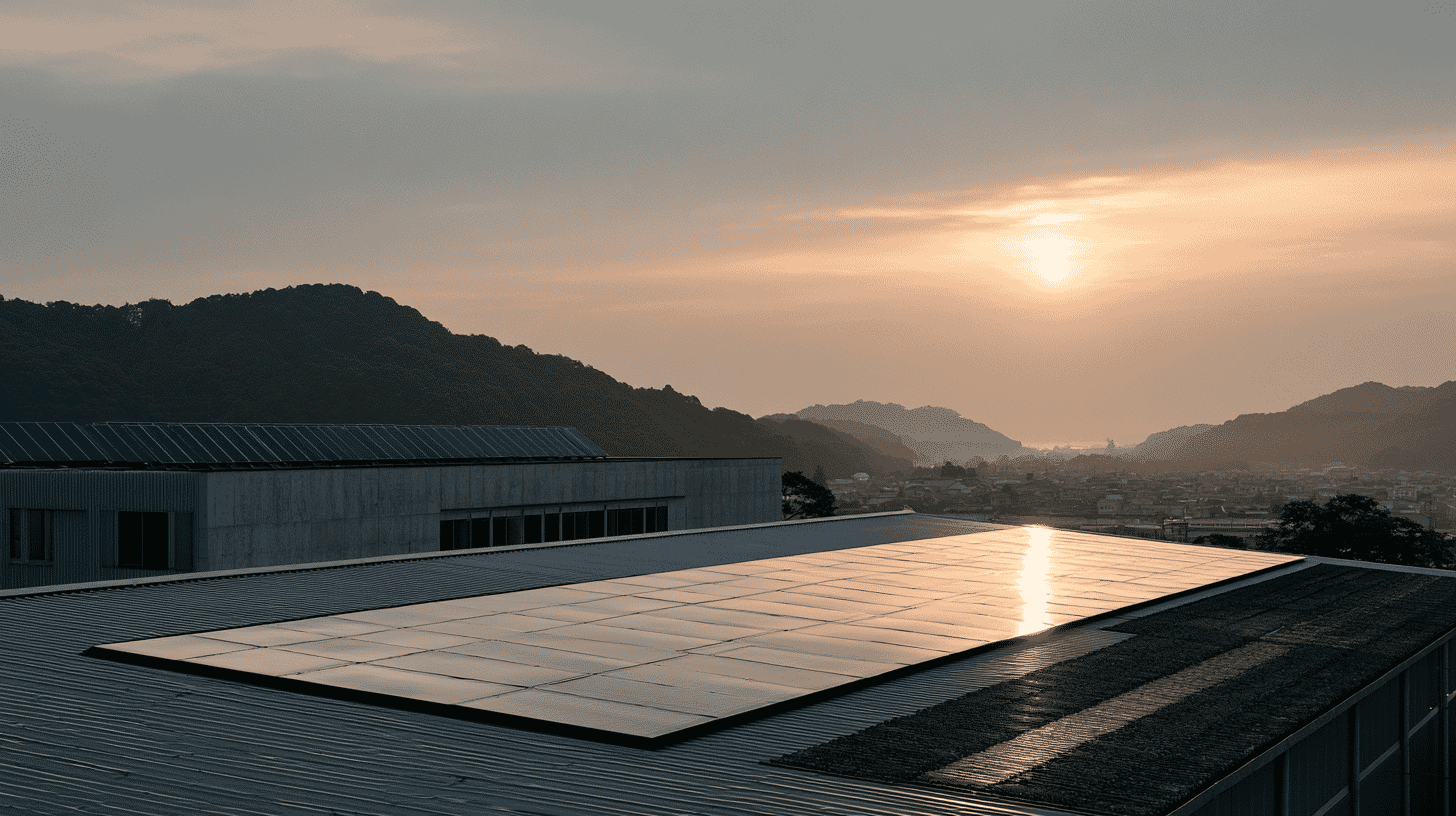
☀️ Japan is about to stop helping people buy solar panels. Not because the panels stopped working, but because they got cheap, and because nine out of ten of them are imported. From fiscal 2027, the money moves to a technology that is barely in production yet.
A subsidy that died of success
On August 26, 2026, Jiji Press reported that Japan's Ministry of the Environment has settled on a plan to drop panel hardware from its renewable energy subsidy program. For projects newly built from fiscal 2027 onward, the purchase cost of the silicon panels themselves will no longer qualify. Installation work stays covered, and projects already underway keep their support.
The stated reason is almost cheerful: panels have become too cheap to need help. Driven by mass production worldwide, prices have fallen to roughly half their peak.
Most subsidies end because they failed, or because a government ran out of money, or because a new administration disliked them. This one is ending because the product it supported turned into a commodity, which is precisely what the subsidy was supposed to achieve.
"Limited benefit to domestic industry"
Before the review, the government ran a public consultation on its subsidy programs. According to Jiji, a large number of responses said much the same thing: support for panels was producing limited benefit for domestic industry. The Mainichi Shimbun reported a second common complaint, that the effects of the support were unclear.
The International Energy Agency puts China's share of every key manufacturing stage of solar panels, from polysilicon through to finished modules, above 80 percent. Inside Japan, per Mainichi, more than 90 percent of panels in circulation are imported, mostly Chinese. So the subsidy was, mechanically, a payment that ended up supporting a supply chain located somewhere else.
The same IEA analysis also credits Chinese industrial policy with driving global solar costs down by more than 80 percent, which is a large part of why solar is now the cheapest electricity in much of the world. Japan is buying a genuinely cheap product from the country that made it cheap. What has changed is that Tokyo no longer wants to pay a premium on top of that price.
The same year, a second tap closes
In December 2025, a ministerial meeting adopted a package of measures on large-scale solar farms after a string of local disputes over hillside developments. Out of that package came a decision at the Agency for Natural Resources and Energy: from fiscal 2027, ground-mounted commercial solar is excluded from new support under the feed-in tariff and feed-in premium schemes, the mechanisms that drove Japan's solar boom after 2012. The agency's July 2026 briefing notes that the enabling ordinances were published at the end of the last fiscal year and take effect on April 1, 2027. This one is not a proposal. It is scheduled.
Trade minister Ryosei Akazawa has pushed back on the word "crackdown." His framing, in a post-cabinet press conference, was that legal rules would tighten around inappropriate projects, while lightweight new technology that can go on roofs and walls would get concentrated support, because renewables need local acceptance to spread at all.
So fiscal 2027 removes both the purchase subsidy and the feed-in support from the workhorse version of solar power, and points what is left at roofs, walls, and a cell that barely exists commercially.
The roofs nobody used
In a June 2026 briefing, the Agency for Natural Resources and Energy stated that Japan's installed solar capacity per unit of land area is already among the highest of any major economy, and that suitable sites for ground-mounted systems in particular are running short.
The constraint is not raw hectares. What is running short is land that is flat enough, close enough to the grid, legal to develop, and acceptable to the people living beside it. That last condition is the one that tightened. When the easy sites filled, developers went up the slopes, into forests and above towns, and the objections followed.
Meanwhile the roofs sit empty. A potential study cited by the agency estimates the capacity available on commercial rooftops at 137.2 gigawatts. What the agency estimates is actually installed on them under the feed-in schemes is about 6.1 gigawatts. More than twenty times the room, barely touched, largely because most of those roofs cannot carry the weight of a conventional panel.
The Environment Ministry's perovskite program targets sites whose roofs can bear about 10 kilograms per square metre or less. Old gymnasiums, warehouse roofs, factory sheds: the money is aimed at a specific list of surfaces the existing technology cannot use.
Perovskite cells are thin, light and bendable, and their main raw material is iodine. The US Geological Survey ranks Japan as the world's second-largest producer after Chile and lists Japanese iodine reserves as by far the largest of any country; the Japanese government puts Japan's share of global supply at around 30 percent. The target is 20 gigawatts of perovskite generation by 2040, a figure Jiji describes as roughly 20 nuclear reactors' worth. As of August 2026, the ministry is expected to write about 28 billion yen, about $176 million, into its fiscal 2027 budget request for perovskite deployment, four times the previous year's initial budget.
What happens if the bet is wrong
A budget request is not a budget. The figure now goes to the Finance Ministry for review and to the Diet for approval, and the number that emerges next spring may not be the number that went in.
The technology also has to arrive on schedule. Japan had 78 gigawatts of solar installed at the end of December 2025, against a 2030 target of 103.5 to 117.6 gigawatts. Reaching it needs 5 to 8 gigawatts a year; the recent pace has been 3.5 to 5. The country is already adding solar more slowly than its own target requires, and is now withdrawing two forms of support from the version of solar that installs today.
Kimiko Hirata, who founded the climate policy think tank Climate Integrate and serves as its director, put that risk to Mainichi. As the paper reports it, tilting everything toward perovskite could stall ordinary solar deployment in the years before the new cell is ready, and what is needed instead is regulatory reform and funding to clear the barriers around the technology that already works. Mainichi also notes that perovskite still faces hurdles on production volume and cost, with no clear timeline for solving them.
And the domestic advantage is not locked. Nikkei Asia reported in May 2026 that by cumulative valid patents filed in more than one country, China overtook Japan in perovskite by the end of 2025. Japan invented the cell in 2009 and is now second in the paperwork around it. Japan has been here before with silicon.
What makes this decision unusual is not that a government is doing industrial policy with its climate budget. Plenty do. It is that Japan wrote the reason down. The consultation response was not about carbon or grid stability; it was that the domestic industry wasn't benefiting, and that was enough to move the money.
When your country spends on clean energy, who is it actually meant to help, the atmosphere or the factory next door? And has anyone there said it out loud?
References
- https://www.jiji.com/jc/article?k=2026082600265&g=soc
- https://news.yahoo.co.jp/articles/056db4c3c598a90ee45b93efe0dfde2f4503a64f
- https://www.meti.go.jp/shingikai/enecho/denryoku_gas/saiene_shuryoku/pdf/003_02_00.pdf
- https://www.meti.go.jp/shingikai/enecho/denryoku_gas/saiene_shuryoku/pdf/001_03_00.pdf
- https://www.env.go.jp/press/press_00623.html
- https://www.env.go.jp/earth/earth/ondanka/enetoku/2026/
- https://www.iea.org/reports/solar-pv-global-supply-chains/executive-summary
- https://asia.nikkei.com/business/energy/china-outpaces-japan-in-next-gen-perovskite-solar-cell-patent-filings
- https://pubs.usgs.gov/periodicals/mcs2026/mcs2026-iodine.pdf
- https://climateintegrate.org/kimikohirata
- https://solarjournal.jp/information/62152/



Global Discussion
4 comments