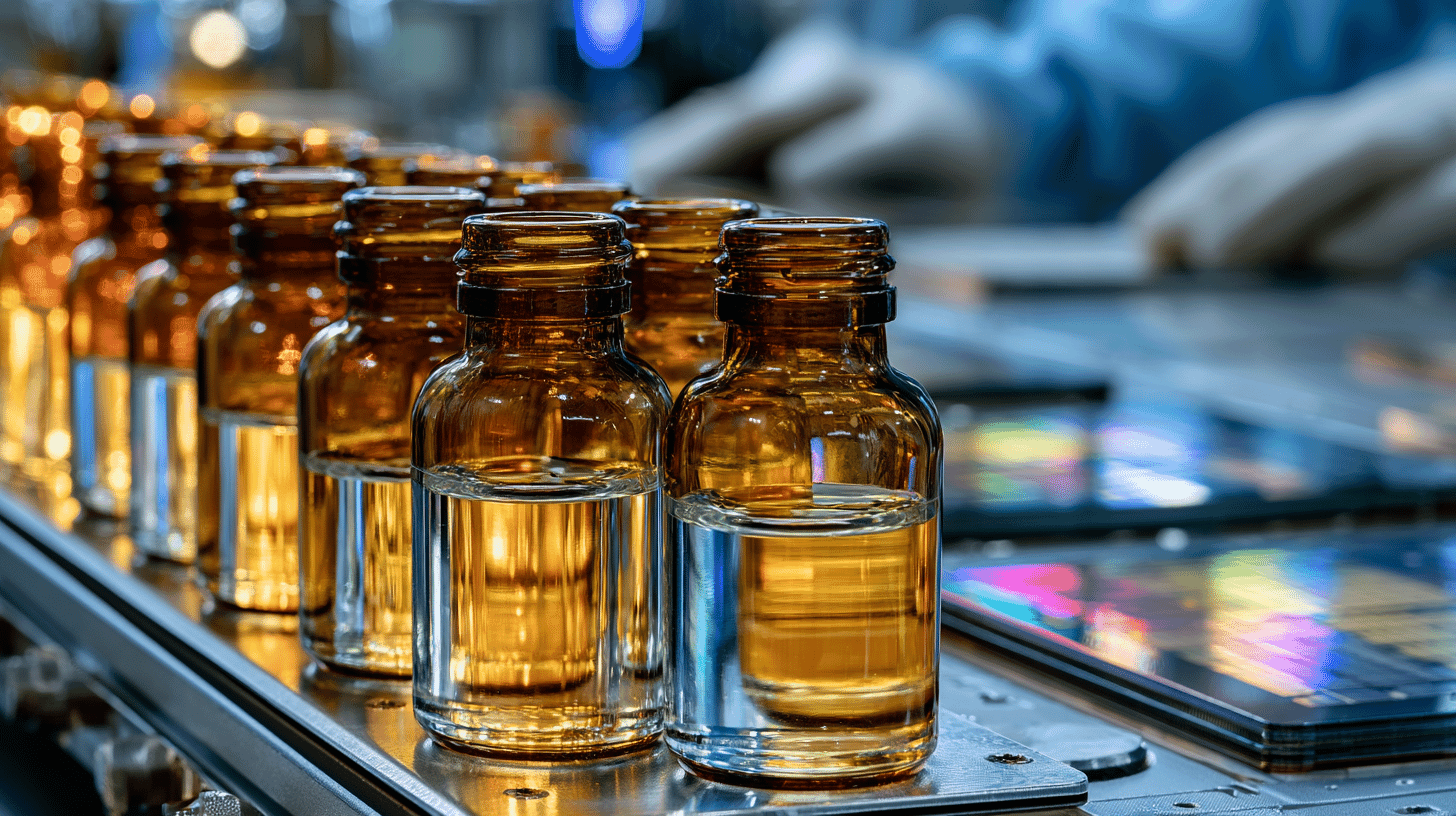
🔬 Photoresist is a Japanese specialty. The light-sensitive chemical used to "draw" circuits onto a chip is dominated by Japanese firms: Tokyo Ohka Kogyo, JSR and a handful of others hold more than 90% of the world market. But photoresist doesn't react to light at all without one ingredient: the photoactive compound. No compound, no photoresist. And one company dominates the world's supply of that sensitizer: Toyo Gosei, a chemical maker with its main plants in Chiba and roughly $240 million in annual sales. It appears on virtually no map of the semiconductor supply chain, yet it holds about 70% of the global market. This is a look at the company that makes the "material inside the material."
The material inside the material
To turn a blank silicon wafer into a processor, you have to draw circuits onto it with light. That's done with photoresist: a liquid coating that changes its chemistry wherever light hits it. Project the circuit pattern through a lens, develop away the exposed (or unexposed) parts, etch what's left, and repeat, dozens of times, until billions of transistors take shape.
The Japanese roster is well known: Tokyo Ohka Kogyo, JSR, Shin-Etsu Chemical, Sumitomo Chemical and Fujifilm. What's less known is that Toyo Gosei's sensitizer goes into the products of all five. The celebrated "Japanese strength in photoresist" rests on a company sitting one layer beneath it.
Part of that strength is range. Toyo Gosei can produce essentially every type of sensitizer the industry uses: the older PAC compounds for g-line and i-line resists, the photoacid generators (PAG) that chemically amplified resists need as features shrink, and materials built for EUV, the extreme-ultraviolet light used to make today's most advanced chips.
From medicine to microchips
The company was founded in 1954, making and purifying chemicals for the pharmaceutical industry. Two skills carried over from those early years and still define it: organic synthesis, and refining things to extreme purity. In the mid-1970s it made an early bet on semiconductors, commercializing its first positive (PAC) and negative sensitizers in 1981. As circuits kept shrinking, it added photoacid generators and resist polymers in 1997, and in the 2000s the same sensitizers found a second home in the panels of LCD televisions.
The real moat is purity. Toyo Gosei controls impurities in its materials down to the parts-per-billion and even parts-per-trillion level. At nanometer scale, even a trace of metal contamination can ruin a chip, so a supplier that can guarantee that cleanliness batch after batch, for years, is extraordinarily hard to replace. It isn't size that protects the company; it's trust built one shipment at a time.
A $240 million firm with outsized weight
The numbers are almost comically small for a company this important. In the year ended March 2025, Toyo Gosei reported revenue of ¥38.7 billion, about $240 million at ¥163 to the dollar, up 21%, with operating profit of ¥4.1 billion (around $25 million) and net profit up 37%. Roughly 60% of revenue comes from its photosensitizer business, and about 90% from semiconductors, displays and other electronics combined. A third of revenue comes from abroad, through direct trade with 26 countries.
A company smaller than many regional supermarket chains sits at a pinch point of a global chip industry worth hundreds of billions of dollars. Investors eventually noticed. The stock traded around ¥800 in early 2019 and pushed past ¥10,000 in 2020, roughly a 14-fold jump in two years, according to Nikkei, almost entirely on expectations for its EUV materials. Under a five-year plan it calls "Beyond 500," the company has been spending ahead of demand: a new sensitizer R&D and analysis building finished in 2024, followed by a large advanced-materials plant that October. This year's profit forecast actually dips, weighed down by depreciation on all that new capacity: the cost of building for an AI-driven boom before it fully arrives.
Update: On May 8, 2026, after this article was published, Toyo Gosei reported results for the year ended March 2026: record revenue of ¥41.96 billion, up 8.5%, with operating profit of ¥3.67 billion, down 10.6% as depreciation on the new plants landed. For the year to March 2027 it guides to ¥47.5 billion in revenue and ¥5.0 billion in operating profit, a 36% increase, and plans to lift the annual dividend by ¥10 to ¥50.
The chokepoint no map shows
When governments sketch the semiconductor supply chain, they mark the obvious nodes: fabrication (TSMC), lithography machines (ASML), silicon wafers (Shin-Etsu, SUMCO). The sensitizer layer almost never appears on those maps. Yet a serious disruption there would travel straight up through the resist makers and into every fab on earth.
That concentration cuts both ways. It's a genuine strength for Japan, and a single point of fragility for everyone who depends on it, which, in the chip era, is everyone. Rivals in South Korea and China, along with chemical majors in the US and Europe, are all working to build alternatives. But decades of process know-how and obsessive purity control don't transfer with money alone; that's exactly why a tiny firm has held its lead this long.
Which leaves an uncomfortable question. Is it reassuring that one small company does this so well? Or is a single quiet supplier propping up the entire chip era a risk worth worrying about? In your country, would you rather depend on the best, or spread the bet?
References
- https://toyokeizai.net/articles/-/913200
- https://www.toyogosei.co.jp/business/exposure/
- https://www.toyogosei.co.jp/ir/investor/
- https://www.toyogosei.co.jp/news/20250509_FY2024financial_results.pdf
- https://www.toyogosei.co.jp/news/20260508_FY2025financial_results.pdf
- https://www.nikkei.com/article/DGXZQODZ071240X01C20A2000000/




Global Discussion
0 comments