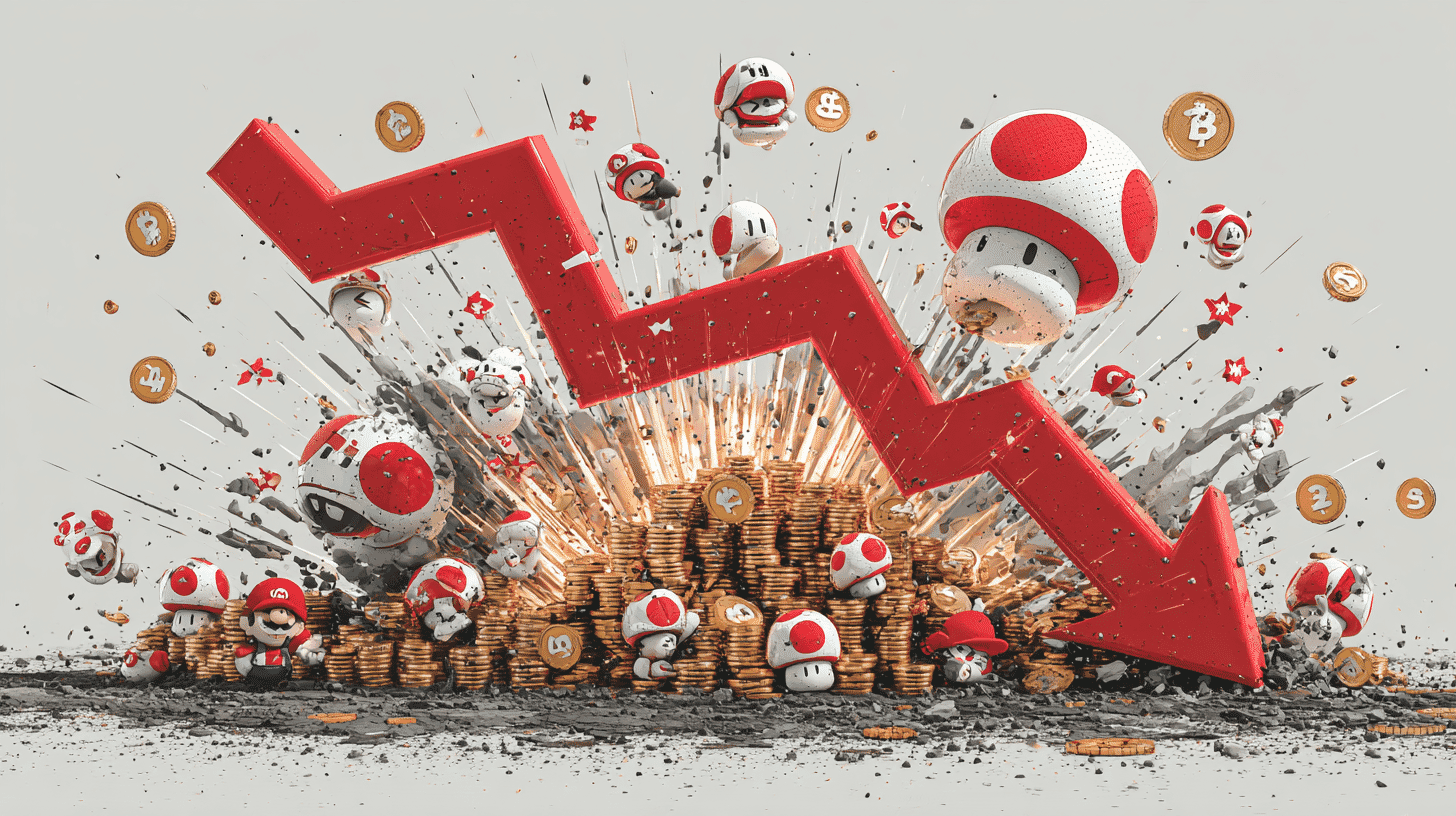
On March 24, 2026, while the Nikkei 225 surged 736 points in a broad rally, one major stock went the other way: Nintendo. A Bloomberg report on Switch 2 production cuts triggered a sell-off that sent shares down as much as 6.3%. In Japan, Switch 2 software is flying off shelves. Mario Kart World has sold 2.86 million copies domestically; Pokémon Pokopia crossed 658,000 in two weeks. The software works. The market still sold. The answer involves weak US demand, soaring semiconductor costs, and trade policy.
Six Million Units Down to Four
Bloomberg reported on March 24 that Nintendo is slashing Switch 2 production for the January–March 2026 quarter from a planned 6 million units down to approximately 4 million, a 33% reduction. According to unnamed sources familiar with the matter, this reduced output rate may continue into April and beyond.
Nintendo's stock immediately reacted. Shares fell 597 yen (6.32%) to 8,835 yen (approximately $56) in afternoon trading, making it the worst performer among major gaming stocks on a day when the broader market was firmly in the green. The sell-off rippled through the supply chain, dragging down component maker Hosiden as well.
Why the Cut? America's Holiday Hangover
The primary driver behind the production reduction is disappointing sales during the 2025 holiday season in the United States. Nintendo president Shuntaro Furukawa acknowledged during an earnings call that "overseas sales were somewhat weaker than expected."
Several factors converged to dampen American demand. The December 2025 release of Metroid Prime 4: Beyond underperformed expectations. At $450, the Switch 2 is a premium-priced device entering a market where consumers are squeezed by rising energy costs and economic uncertainty. The combination created a holiday season that fell short of Nintendo's internal targets.
Context matters. The Switch 2 launched on June 5, 2025 and moved 3.5 million units in its first four days, the fastest launch in Nintendo history. By December 2025, cumulative sales reached 17.37 million units, tracking 45% ahead of the original Switch at the same point in its lifecycle.
The regional split is where the problem sits. Of those 17.37 million units, the Americas accounted for 5.98 million, against 4.78 million in Japan and 4.10 million in Europe. Given the relative size of those markets, the Americas number is the one that stands out. This is not a console that is failing; it is a console that missed Nintendo's internal target, and it missed it in the biggest market.
It is also worth noting that six million units in a non-holiday quarter was an aggressive plan to begin with. The preceding holiday quarter, October to December, produced 7.01 million. Planning for something close to that in the new year, then trimming it, reads as much like ordinary inventory correction as it does like alarm.
Meanwhile in Japan: Software Sales Are Booming
The contrast between Wall Street's alarm and the Japanese retail reality is striking.
According to the latest Famitsu weekly sales data (March 9–15, 2026), Switch 2 titles dominate the charts.
Pokémon Pokopia has sold 658,400 copies in Japan in just two weeks. Globally, it surpassed 2.2 million units within four days of its March 5 launch. Nintendo officially announced the milestone, and industry observers see the title as a potential new system seller that could reignite hardware demand.
Mario Kart World continues its remarkable run nine months after launch, with cumulative domestic sales of 2,865,062 copies. It topped Japan's 2025 annual software chart with 2.668 million units and remains the definitive Switch 2 title.
Third-party games are performing well too. Resident Evil Requiem has exceeded 191,000 copies across PS5 and Switch 2 combined, and Dragon Quest VII Reimagined has surpassed 440,000 copies across Switch, Switch 2, and PS5 versions. The Japanese software ecosystem around Switch 2 is maturing nicely.
Three Global Headwinds
Nintendo's challenges extend far beyond one quarter of slower US sales. The company is navigating a trio of macro-level risks that are reshaping the economics of console gaming.
Semiconductor Memory Prices
The global AI boom has created intense competition for memory chips. Data centers serving large language models and AI training systems are consuming vast quantities of the same types of memory used in gaming hardware. This has driven up costs for every console manufacturer, but Nintendo, whose margins depend on selling hardware at or near break-even, is particularly exposed.
Bloomberg reported in February that Nintendo was considering raising the Switch 2's price in response to these cost pressures. While the production cut itself was driven by demand rather than supply constraints, the margin squeeze is real: Nintendo's Q3 operating profit of 155.2 billion yen ($980 million), while up 23% year-over-year, fell short of market expectations of 180.7 billion yen.
US Tariff Policy
The Trump administration's tariff policies have added another layer of cost uncertainty. Although Nintendo is a Japanese company, Switch 2 manufacturing relies heavily on factories in China and Vietnam. Import tariffs on goods entering the US directly impact Nintendo's cost structure. Reports indicate the company has even pursued legal challenges against certain tariff measures.
Iran Conflict and Logistics
The ongoing military conflict involving Iran has disrupted global shipping routes and created export delays. For a company that ships millions of units across oceans, these disruptions add unpredictability to production schedules and delivery timelines.
Can Nintendo Still Hit 19 Million?
Despite the production cut, most analysts believe Nintendo can still reach its revised full-year target of 19 million Switch 2 units. With 17.37 million already sold by December 2025, the remaining 1.63 million is well within reach even at reduced production rates.
The bigger question is what happens next fiscal year. Amir Anvarzadeh, Japan equity strategist at Asymmetric Advisors, warned that "this hardware shortfall in its first year, during its big holiday season, is awful news" and pointed to the thin software lineup as a fundamental concern. The looming November 2026 launch of Grand Theft Auto VI on competing platforms adds competitive pressure that Nintendo hasn't faced in the Switch 2 era.
On the positive side, Pokémon Pokopia's strong debut suggests that the right software can still drive hardware sales. Nintendo's track record of strategic Direct announcements and surprise title reveals means the software pipeline could improve rapidly.
What Happened Next: Target Met, Price Raised
May's earnings gave the answers.
On units, Switch 2 finished its first year at 19.86 million, above the revised 19 million target. The production cut did not translate into the stall it seemed to signal.
But units were not what the market was watching. Alongside the results, Nintendo announced a price increase. In Japan the Switch 2 went from 49,980 yen to 59,980 yen on May 25, 2026, a 10,000 yen jump; US and European prices rose from September 1. The company's stated reason: it wanted to avoid losing money on every unit sold. The semiconductor costs and tariffs this article flagged in March arrived, in the end, on the price tag.
The FY2027 outlook is heavier still. Net profit is guided at 310 billion yen, down 26.9% year on year, with roughly 100 billion yen of memory price increases and tariff effects baked into cost of goods, and Switch 2 hardware sales projected at 16.5 million units, down 16.9%. The dividend was cut from 219 yen to 162 yen. Investors read the price increase as a brake on adoption, and the shares did not recover after the results.
Software is the brighter side. Pokémon Pokopia, released in March 2026, passed 4 million units worldwide in five weeks, and February's Pokémon FireRed and LeafGreen did the same in six. Nintendo guides FY2027 software to 60 million units, up 23.2%. If the hardware cannot carry the margin, the software has to. Which is, in the end, Nintendo's original business model.
What to Watch Next
The Switch 2 story is still in its first chapter. It holds the record for Nintendo's fastest-ever launch and simultaneously faces headwinds no previous Nintendo console met: semiconductor competition with AI, trade tariffs, and geopolitical supply chain risk. In 2026, the price of a game console is set by memory spot prices and customs schedules rather than by how good the games are. The headwind this article described in March turned into a specific number in May: 10,000 yen.
The next question is how a more expensive console sells, and whether new entries in the Zelda and Super Mario lines can cover the gap.
In Japan, Switch 2 software sales remain strong, but the stock market is sending warning signals. How is the Switch 2 doing in your country? Do you think $450 is too expensive for a gaming console? How are semiconductor shortages and trade policies affecting tech prices where you live? Share your perspective!









Global Discussion
15 comments