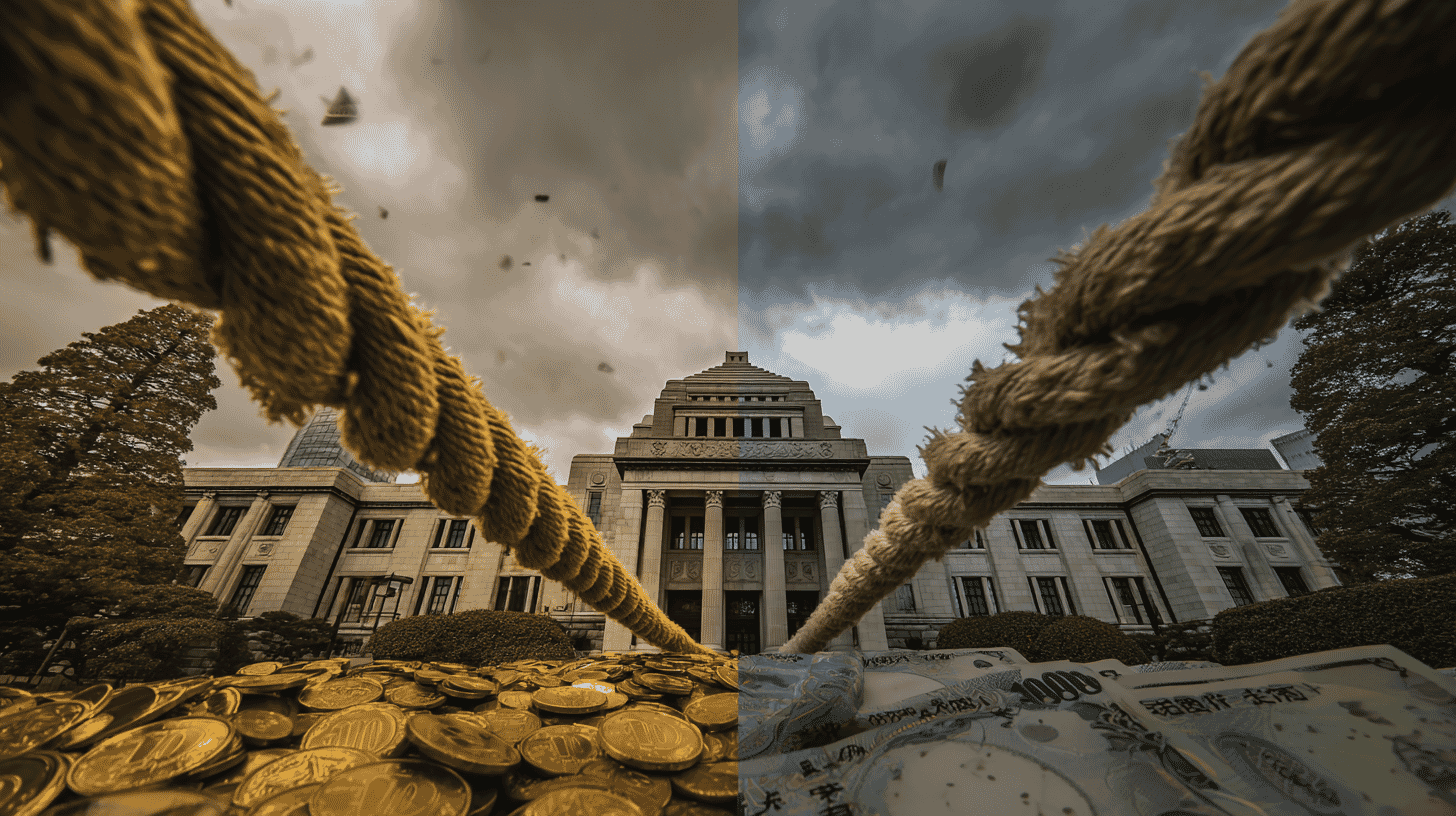
🏦 The Bank of Japan wants to raise rates. The Prime Minister says no. The clash between central bank policy and political power has resurfaced in Japan, and markets reacted instantly. The yen plunged to 156 per dollar moments after the news broke. This power struggle mirrors battles playing out worldwide, from Trump vs. the Fed to Erdogan vs. Turkey's central bank.
PM Takaichi Pushes Back Against BOJ Rate Hikes
On February 24, 2026, Japan's Mainichi Shimbun newspaper broke a significant story: Prime Minister Sanae Takaichi had expressed resistance to further interest rate increases during a 15-minute meeting with Bank of Japan (BOJ) Governor Kazuo Ueda at the Prime Minister's official residence on February 16.
According to multiple sources familiar with the meeting, Takaichi's stance was "tougher than during her previous meeting in November 2025." Officially, both sides played it down. Takaichi called it "a routine exchange of views on economic and financial conditions," while Ueda told reporters there were "no specific requests regarding monetary policy."
But the market reaction told a different story. Bond futures surged, and the yen immediately dropped to 156 per dollar, its weakest level since February 10. Bloomberg reported that expectations for an early BOJ rate hike retreated sharply.
Why the Prime Minister Opposes Rate Hikes
Takaichi's resistance to rate increases is rooted in her economic philosophy. She is known as a "reflationist," a term describing policymakers who believe in combating deflation (persistent price declines) through aggressive monetary easing combined with expansive government spending. The idea is to keep borrowing costs low while the government invests heavily to stimulate economic growth.
This isn't just talk. Takaichi has appointed reflationist advisors to the Council on Economic and Fiscal Policy, one of Japan's key economic decision-making bodies. When she became Liberal Democratic Party (LDP) president in October 2025, she stated explicitly: "It is the government that must take responsibility for both fiscal and monetary policy," a clear signal of her intent to influence BOJ decisions.
Her rise to the premiership after winning the LDP leadership race in October 2025 has likely reinforced this posture. Takahide Kiuchi, a former BOJ policy board member now at Nomura Research Institute, has noted that Takaichi's political ascendancy could embolden her to reassert pressure on the central bank.
The BOJ's Position: "We're Still in Easing Territory"
Meanwhile, the BOJ has been methodically working toward monetary normalization. In December 2025, it raised interest rates for the first time in about a year, bringing the policy rate to 0.75%, the highest level in roughly 30 years.
Yet Governor Ueda has emphasized that current conditions still constitute "monetary easing." The real interest rate, the policy rate minus inflation, remains "extremely low," meaning monetary policy is still supporting economic activity rather than restraining it. In other words, the BOJ sees room for further increases.
At the time of the report, markets had priced in a strong probability of another rate hike by the BOJ's June meeting, with some speculation pointing to the March 18-19 session. The leak put that timeline in doubt.
A Global Pattern: Central Bank Independence vs. Political Pressure
Japan's situation echoes a familiar struggle playing out across the world's major economies.
United States: Trump vs. the Federal Reserve
The most dramatic example is unfolding in the United States. President Donald Trump has repeatedly demanded that the Federal Reserve cut interest rates faster, at one point reportedly drafting a termination letter for Fed Chair Jerome Powell. In January 2026, the Department of Justice issued a subpoena to Powell, prompting an unprecedented emergency video statement in which the Fed chair declared: "This is about whether the Fed will be able to continue to set interest rates based on evidence and economic conditions, or whether monetary policy will be directed by political pressure and intimidation."
A CNBC survey found that 82% of respondents viewed Trump's actions as an attempt to limit or eliminate Fed independence. JPMorgan analysts warned that political appointments "fuel an existential threat" to the central bank's autonomy.
Turkey: Erdogan's Cautionary Tale
Turkey provides perhaps the starkest warning. President Recep Tayyip Erdogan, who holds the unorthodox belief that high interest rates cause inflation rather than cure it, fired multiple central bank governors and forced through rate cuts. The result was devastating: the Turkish lira collapsed, and inflation soared above 80%. Turkey eventually reversed course with aggressive rate hikes starting in 2023, but the economic damage was severe and lasting.
As the Atlantic Council has noted, "Countries that have compromised central bank independence, from Turkey to Argentina, have experienced currency volatility, capital flight, and higher inflation."
Market Impact: The Yen, Interest Rate Gaps, and Carry Trades
The implications of political interference in BOJ policy extend far beyond Japan.
The US-Japan Interest Rate Gap: With the BOJ rate at 0.75% at the time and the Fed funds rate at 3.50-3.75%, the gap was substantial. If political pressure delays further BOJ rate hikes, this differential persists, keeping downward pressure on the yen. Making matters more complex, Japan's inflation rate has actually exceeded America's since mid-2024, meaning the real interest rate gap is even wider than nominal rates suggest.
Carry Trade Dynamics: The yen carry trade, borrowing cheaply in yen to invest in higher-yielding currencies, thrives on this interest rate differential. If markets believe political intervention will keep Japanese rates artificially low, carry trade positions could expand further, amplifying yen weakness. This is the same dynamic that contributed to the dramatic yen sell-off in 2024 and the subsequent sharp unwinding that rattled global markets in August of that year.
Cost of Living Squeeze: A weaker yen makes imports more expensive, pushing up prices for food, energy, and everyday goods in Japan. Ironically, while Takaichi resists rate hikes to protect economic growth, the resulting yen depreciation accelerates inflation, creating a vicious cycle that hits Japanese households hardest.
What Happened Next: The BOJ Went to 1.0% in June
Update as of the end of July 2026.
The BOJ held rates at its March 18-19 meeting. The move came instead on June 15-16, when the policy rate went from 0.75% to 1.0%, the first increase since December 2025. Governor Ueda was absent, hospitalized at the time, and Deputy Governor Ryozo Himino chaired the meeting. Seven of the eight members present voted in favor; the sole dissent came from board member Toichiro Asada.
The personnel question resolved as well. Asahi Noguchi was succeeded on April 1 by Toichiro Asada, professor emeritus at Chuo University, and Junko Nakagawa by Ayano Sato, a professor at Aoyama Gakuin University. Both are regarded as reflationists who favor monetary easing and expansionary fiscal policy, and both were Takaichi's first appointments to the BOJ. Even so, the nine-member board did not tilt decisively, and the June rate hike went through.
At the July 31 meeting, the BOJ left the rate at 1.0%. Eight of nine members voted in favor, with Hajime Takata dissenting in favor of a further increase. Ueda, back at work, told reporters that underlying inflation carries a risk of overshooting the 2% target and that the pace of rate increases could accelerate. He cited higher oil prices tied to Middle East tensions, semiconductor price increases driven by AI demand, and the weak yen as upside risks to prices.
In the United States, Powell left the Fed chairmanship on May 22, 2026, and Kevin Warsh was sworn in as the 17th chair. The Senate confirmed him 54-45, the narrowest margin since the current process was established in 1977. Powell remains on the Board of Governors. The Fed held its policy rate at 3.50-3.75% again on July 29, narrowing the US-Japan gap to 2.50-2.75 points. The yen has stayed weak regardless, and the argument over how much distance politics should keep from monetary policy continues.
In Japan, the balance between central bank independence and the will of a democratically elected government is once again being tested. Rate hikes mean higher mortgage payments and tighter conditions for small businesses, but without them, the yen weakens and inflation bites harder. What's the relationship between your government and central bank like? Do you think politicians should have a say in interest rate decisions? Share your thoughts!
References
- https://news.yahoo.co.jp/articles/259cb2476566b708e0d7a651f19d2ed17bbc2665
- https://www.bloomberg.com/jp/news/articles/2026-02-24/TAYC0ZT96OSJ00
- https://www.nikkei.com/article/DGXZQOUB207580Q6A220C2000000/
- https://www.nri.com/jp/media/column/kiuchi/20260216_2.html
- https://www.nri.com/jp/media/column/kiuchi/20260219_3.html
- https://www.atlanticcouncil.org/blogs/econographics/trumps-challenges-to-the-feds-independence-loom-over-jackson-hole-symposium/
- https://www.cnn.com/2026/01/29/economy/federal-reserve-independence-trump








Global Discussion
15 comments