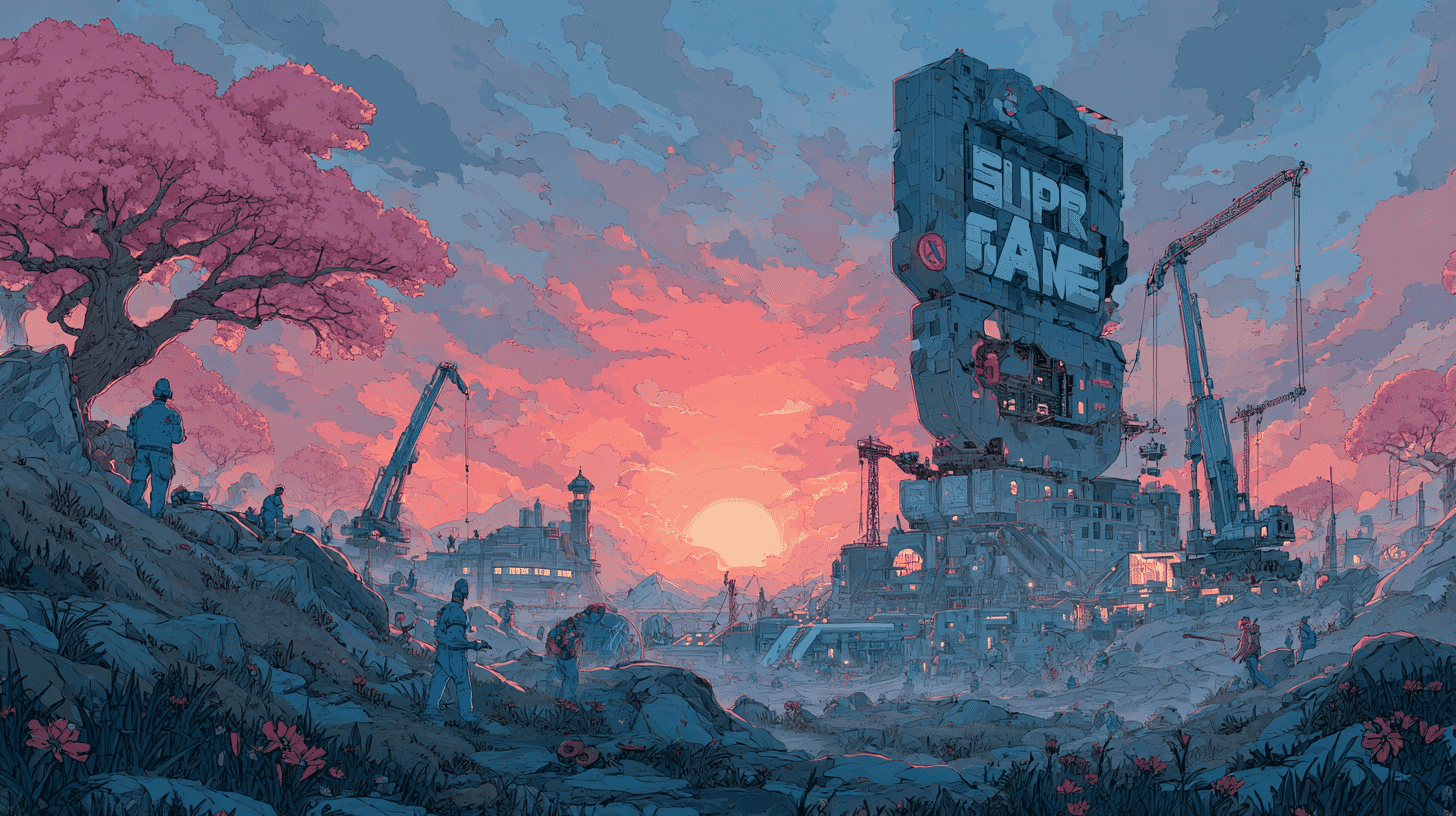
🎮 Five years ago, SEGA told investors it would build something extraordinary: a globally connected, AAA-scale online title called "Super Game" with lifetime sales targeting 100 billion yen (about $640 million). On May 12, 2026, that ambition quietly died on slide 32 of an earnings deck. SEGA Sammy has officially cancelled Super Game, and in doing so, has joined a growing list of major publishers retreating from the live-service gold rush.
What Just Happened
SEGA Sammy Holdings held its FY2026 (April 2025–March 2026) earnings presentation on May 12. Tucked inside the slide titled "Review of the GaaS Strategy" was a single decisive line: the company has decided to cancel Super Game. Footnotes also confirmed that there were "no additional costs associated with the cancellation."
The reasoning is laid out plainly. The mobile party game Sonic Rumble Party, a free-to-play release co-developed with newly acquired Rovio (the Angry Birds studio), underperformed badly. The Rovio acquisition itself has failed to generate the "economic value" SEGA expected at the time of the deal. Several other titles slipped on their release dates. Taken together, these forced a hard look at the company's medium- to long-term growth pillars, and Super Game didn't survive the review.
More than 100 developers who had been working on free-to-play projects have already been reassigned to full-game (premium, single-purchase) development teams centered on SEGA's mainstay intellectual properties.
What Was "Super Game," Anyway?
This is the question many international fans have been asking for years, and the honest answer is: nobody outside SEGA's boardroom ever really knew.
Announced in May 2021 as the centerpiece of SEGA's five-year mid-term plan, Super Game was described in successive annual reports as "a major title that scales globally, standing head and shoulders above normal games." It was supposed to be AAA-class, built on Unreal Engine 5, released worldwide simultaneously across multiple platforms in multiple languages, with an online ecosystem reaching streamers and viewers, not just players. The internal team was said to be in the early stages with around 50 people, scaling toward several hundred. Bloomberg reported the broader initiative carried a budget of roughly $800 million.
In other words: SEGA wanted its own Fortnite.
There were, briefly, fingerprints. Hyenas, the live-service first-person shooter from UK studio Creative Assembly, was widely understood to be part of the Super Game initiative, until SEGA cancelled it in 2023 over the unsustainable cost of running a live game. The revivals of Crazy Taxi, Jet Set Radio, Streets of Rage, Golden Axe, and Shinobi were also lumped into the Super Game framework at various points, though most were eventually re-positioned as more conventional releases.
Here's the strange thing: with Super Game now formally cancelled, the public has still never seen what it actually was. As one ResetEra commenter put it, "the Super Game wording existing for so many years only to be unceremoniously cancelled without anyone getting to know what it was is one of the funniest things in the industry."
Why It Collapsed: A Perfect Storm
Three factors converged.
First, the F2P slate underperformed. Of three new free-to-play titles launched in FY2026 (Persona 5: The Phantom X, Sonic Rumble Party, and SEGA Football Club Champions), two missed targets. Sonic Rumble Party in particular failed to translate the Rovio collaboration into either monetization or staying power. As reported by Final Weapon, SEGA reviewed its Games as a Service approach after the weak performance of free-to-play games like Sonic Rumble Party.
Second, the Rovio acquisition continued to disappoint. SEGA bought the Finnish studio for roughly $776 million in 2023, hoping its Angry Birds catalog and live-ops expertise would catalyze SEGA's mobile push. In February 2026, SEGA booked an impairment loss of about ¥30.4 billion ($200 million) against Rovio's value, citing increased competition and rapid user-base deterioration in mobile. Further write-downs in FY2026 pushed the company to a net loss of ¥5.76 billion for the year despite revenue growing 13.7% to ¥487.5 billion.
Third, and this is the part the financial reports don't say out loud: the entire industry's live-service gold rush has imploded. Sony's Concord peaked at under 700 concurrent players before being shut down two weeks after launch in 2024, with all copies refunded and the studio closed. Suicide Squad: Kill the Justice League haemorrhaged Rocksteady's reputation. Sony has quietly cancelled live-service projects at Bend Studio, Bluepoint, and London Studio (the last shuttered entirely). Within SEGA's own portfolio, Hyenas was the canary in the coal mine.
Continuing to pour resources into a flagship online title in 2026, knowing all of this, would have been the most expensive form of denial available.
What's Safe: The Mainstay IPs
Here is the good news for fans of SEGA's classic franchises, and the reason this announcement is being read as a positive by most overseas commentators.
The revival titles continue. SEGA confirmed that Crazy Taxi, Jet Set Radio, Streets of Rage, Golden Axe, and Shinobi are unaffected by Super Game's cancellation. Shinobi: Art of Vengeance is already scheduled. Reports from Twisted Voxel note that over 80% of SEGA's current development spending is now allocated to games planned for FY2027 and FY2028, with at least four major full-game releases expected each year, built around mainstay IPs.
The Like a Dragon engine keeps roaring. Just last week, on May 7, the studio unveiled STRANGER THAN HEAVEN, a completely new RGG Studio title that doesn't carry the Like a Dragon name, a 50-year saga spanning 1915 to 1965 with a cast including Yu Shirota, Dean Fujioka, Snoop Dogg, and Ado. The internal narrative has shifted hard back toward single-player premium experiences, with RGG Studio and Atlus now the cornerstones of SEGA's gaming output.
The Rovio relationship continues, but with priorities flipped. Rovio will keep pursuing global live-service work, but its immediate task is to restructure itself. The Angry Birds Movie 3 arrives in December 2026, and Rovio's licensing operations have already merged into SEGA's global transmedia framework.
SEGA UNIVERSE was announced in April 2026 as a separate project to celebrate anniversary milestones for legacy SEGA IPs, a much more catalog-friendly use of those classic brand identities than wedging them all into a single live-service framework.
A Note on Timing: Why This Matters Now
There's a clean cultural read on what's happening across Japanese publishers right now. Capcom's Pragmata (a brand-new single-player IP) launched to widespread acclaim in April 2026 after a five-year delay. Resident Evil Requiem and Like a Dragon: Pirate Yakuza in Hawaii both succeeded as full-priced, finite, story-driven experiences. Monster Hunter Wilds moves units measured in tens of millions without a battle pass.
Meanwhile, every major Japanese live-service swing of recent memory has missed. Bandai Namco's Blue Protocol ended service less than 18 months from launch despite an eight-year development cycle. Square Enix's Babylon's Fall and Foamstars are footnotes. Persona 5: The Phantom X has not been the breakout success P5 itself was.
SEGA reading this room and pivoting back toward what Japanese studios actually do well (finite, polished, premium single-player experiences with deep mechanics and strong storytelling) is, frankly, the most rational thing the company could have done.
How the International Community Is Reacting
Reactions on ResetEra, r/Games, and gaming media have leaned cautiously positive. The dominant tone is finally. There's also some gallows humor: one popular comment imagined SEGA's roadmap reading "June 2024: announce Super Game. June 2025: cancel Super Game. June 2026: ship another Mega Drive compilation to make up for it." Another simply read, "Gasp. It's almost like most of us easily foresaw the long-term failure of GaaS games."
The deeper concern in international forums is for the developers. Cancellation of large projects almost always implies turbulence even when no layoffs are announced, and 100+ people being "moved" from F2P teams to full-game teams is the kind of phrasing that can mean anything from a smooth transition to substantial role changes. SEGA has not announced layoffs tied to this decision, but the broader industry context (Sony's London Studio, Firewalk, multiple Embracer closures) makes everyone wary.
What's It Like in Your Country?
In Japan, the headline "1000億円規模のSuper Game中止" is being read with a mix of relief (single-player Sonic, Like a Dragon, Persona, and the upcoming revivals are still safe) and weariness (yet another grand corporate pivot, with the usual gap between strategy decks and ground-level execution).
How is the live-service / GaaS bust being reported where you live? Are players in your region still spending on F2P giants, or has that money started moving back toward premium single-player releases? And which classic SEGA IP would you most want to see come back as a proper full game, not as a Super Game?
References
- https://automaton-media.com/articles/newsjp/20260512-442556/
- https://www.segasammy.co.jp/cms/wp-content/uploads/pdf/en/ir/20260512_q4_presentation_en.pdf
- https://www.nintendolife.com/news/2026/05/sega-has-officially-cancelled-its-super-game
- https://finalweapon.net/2026/05/12/sega-cancels-super-game-project-revival-games-still-in-development/
- https://twistedvoxel.com/sega-cancels-800-million-super-game-initiative-as-focus-shifts-back-to-core-franchises/
- https://gamesbeat.com/sega-sammy-earnings-game-slate-unveiled-through-march-2027/
- https://www.resetera.com/threads/sega-has-cancelled-their-super-game-initiative-and-will-focus-less-on-gaas-titles-moving-forward.1517335/







Global Discussion
14 comments