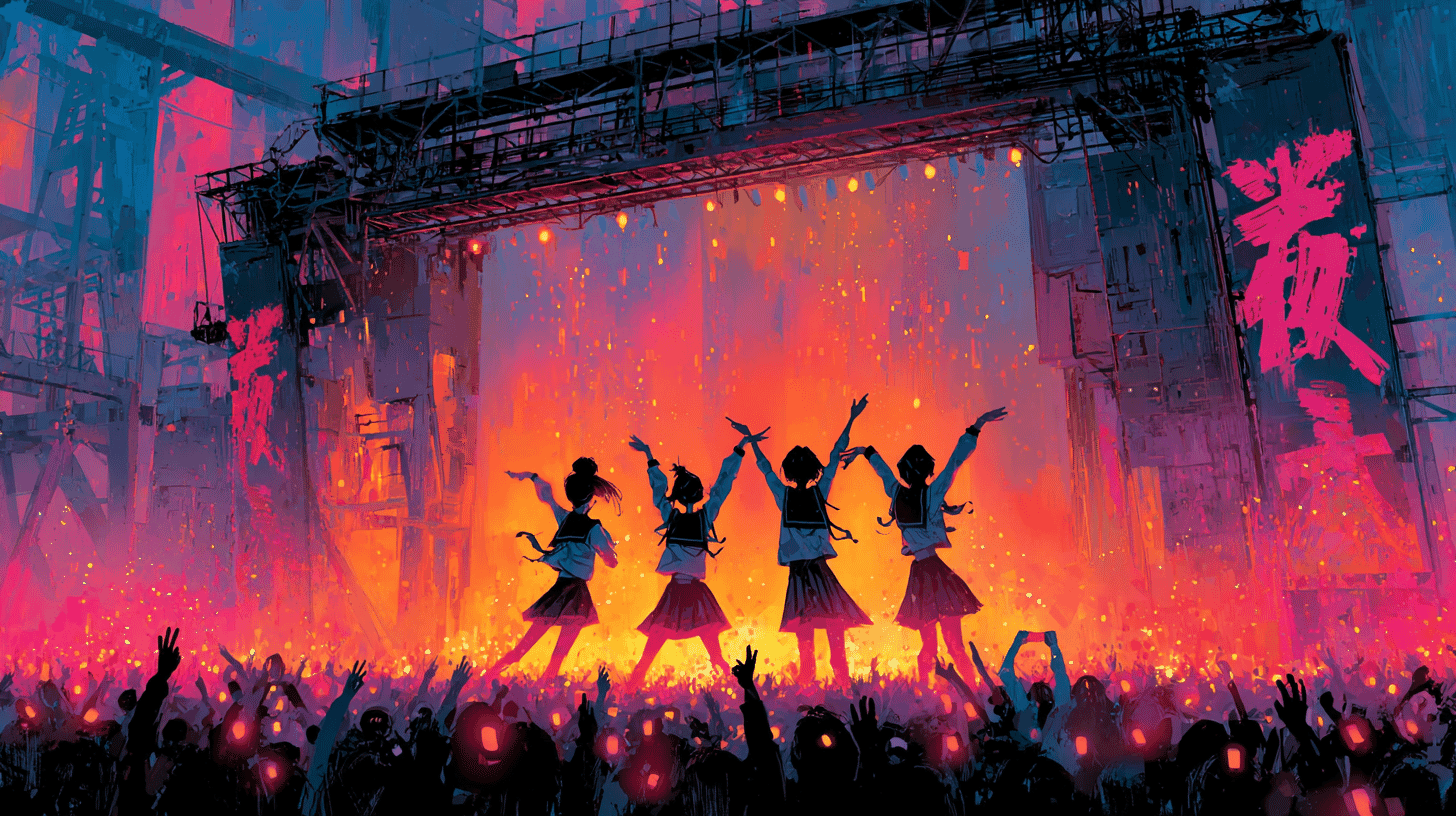
🎒 Five years after their global debut on 88rising, the four sailor-uniformed members of ATARASHII GAKKO! are finally crossing into the region their fans have spent years asking for: Latin America. In December 2026 they will play Santiago, share a festival with Gorillaz and The Strokes at Brazil's Primavera Sound, and close with their biggest overseas headline show yet in Mexico City.
A debut tour that's been a long time coming
On May 14, 2026, ATARASHII GAKKO! announced FIRST LATIN AMERICA TOUR 2026, a three-country run set for December. It is the group's first dedicated Latin American tour, and it lands at a moment when the quartet, Mizyu, Rin, Suzuka and Kanon, has already racked up milestones most Japanese acts spend a career chasing.
Since debuting worldwide on the US label 88rising in 2021, the group has built an unusual kind of overseas momentum. Their breakout track "Otonablue" passed 3.3 billion plays on TikTok. They played Coachella in 2024 and Jimmy Kimmel Live!. A 33-city world tour, seven of those cities in Japan, drew roughly 110,000 people. None of those stops took them to South America.
What the schedule actually looks like
Three countries, three cities, three very different venues.
December 3, Santiago, Chile, Teatro Caupolicán. A solo show at the Santiago institution that opened in 1936, capacity around 5,400 including standing. The room has hosted everyone from Iron Maiden to Soda Stereo. It is where Chilean audiences go to see acts that are big but not stadium-big.
December 5 and 6, São Paulo, Brazil, Primavera Sound. This is the headline news. ATARASHII GAKKO! makes its Brazilian debut at Autódromo de Interlagos, the F1 circuit that doubles as Primavera Sound's São Paulo home. The 2026 edition is anchored by Gorillaz and The Strokes, with FKA twigs, Lily Allen, Yung Lean and CMAT on the bill. Primavera Sound is one of the most editorially respected festival brands in the world, and the lineup positioning matters. ATARASHII GAKKO! is not in a "J-pop showcase" sidebar; they are slotted into the same alt-leaning international stage as Mannequin Pussy, Model/Actriz and Machine Girl. One footnote: at least one Brazilian outlet described them in coverage as a Korean band, a small but telling sign that even at this level of exposure the J-pop and K-pop confusion still happens.
December 8, Mexico City, Velódromo Olímpico Agustín Melgar. This is the one to watch. The Velódromo, built for the 1968 Mexico City Olympics, holds roughly 6,800 people. It will be the largest solo headline show ATARASHII GAKKO! has played outside Japan, bigger than London's Roundhouse at around 3,300 standing. Mexico is also the only country on this tour where the group has played before, at Corona Capital 2023. Three years later they are back, and headlining.
"Chanka Chanka": folkloric Japan, dance-floor present
Six days before the announcement, on May 8, the group dropped a new global single via 88rising called "Chanka Chanka." The track pulls from matsuri-bayashi, Japanese festival music, and the visual world of yōkai and the Hyakki Yagyō, the Night Parade of One Hundred Demons. Press materials describe it as fusing traditional folk culture with current dance beats. The group first performed it at a Tokyo show on April 26, where by all accounts the room turned into one large dance floor.
The timing is not subtle. ATARASHII GAKKO! is walking into a region with a deep, well-documented appetite for Japanese cultural exports, from anime to video games to the broader otaku economy, and they are bringing a song built on Japanese folk imagery. Whether that lands as exhilarating or exoticising is for Latin American audiences to decide.
The road to Interlagos: five years, one wardrobe
The schoolgirl-uniform concept has been the group's calling card from day one, and it's also been their most-debated element internationally. The four-member format with synchronized choreography, the sudden shifts between cute and absurdly aggressive, the use of the Japanese school as both costume and frame for a critique of conformity: none of it maps cleanly onto Western pop categories, which is part of why 88rising signed them in the first place. The label's roster is built on artists that don't fit neatly into K-pop or US hip-hop or J-pop boxes.
The group's full 2026 international slate, beyond Latin America, gives a sense of where they sit now:
- May 16, Los Angeles, Zipangu (a US festival built around Japanese artists)
- July 16, Ostrava, Czech Republic, Colours of Ostrava
- July 18, Berlin, Lollapalooza Berlin
- July 19, London, Roundhouse (solo show)
- September 6, Seattle, Bumbershoot
- December, Latin America (this tour)
That is three continents in seven months, with festival slots on five dates and standalone shows on the others. Roundhouse and the Velódromo are the headline tests, the rooms ATARASHII GAKKO! has to fill on their own name. As of this update the July European dates have already come and gone, leaving Mexico City in December as the remaining solo test.
Tickets and what to watch for
Fan-club presales for the two solo shows opened alongside the announcement itself, starting at 11 p.m. Japan time on May 14 for Chile and 1 a.m. on May 15 for Mexico City, on a first-come basis rather than a lottery. General on-sale details are being released through the group's official site and their Latin American promoters. Primavera Sound São Paulo tickets run through the festival's own Brazilian sales platform.
A few things to watch as the tour gets closer:
First, how fast Mexico City sells. A 6,800-cap room for a Japanese act with no Spanish-language singles and no mainstream radio play in the country is not a trivial bar. If it moves quickly, the Latin American J-pop and anime crossover audience is significantly larger than industry numbers usually capture.
Second, how "Chanka Chanka" plays in Portuguese-speaking São Paulo. The group has historically performed in Japanese without translating lyrics, leaning on choreography and physical performance to carry meaning.
Third, whether the Primavera Sound slot becomes a coronation. Brazilian audiences are notoriously generous to artists they like, and the Brazilian crowd shots at Lollapalooza and Rock in Rio have become part of the international touring economy. A strong reception at Interlagos would reshape how Japanese alt-pop is booked across South America for years.
What's the read from where you are?
Japan now has a wave of homegrown alternative pop acts breaking internationally without going through the K-pop training-system model: ATARASHII GAKKO!, XG (a slightly different case), Number_i, Ado, and the broader 88rising orbit. Each is testing a different theory of how Japanese music travels.
So, a question for readers outside Japan. When ATARASHII GAKKO! announce a date in your country, do you go? Does the sailor-uniform concept read as creative subversion, as cosplay-adjacent novelty, or as something strange in a way that pulls you in? And what does it mean that the biggest Japanese pop act in your city this year might be playing a 6,800-cap room in Mexico City or a tent at Interlagos rather than touring the way K-pop tours? We would like to hear how it looks from where you are.
References
- https://www.billboard-japan.com/d_news/detail/161419/2
- https://leaders.asobisystem.com/
- https://natalie.mu/music/news/671930
- https://rollingstone.com.br/musica/primavera-sound-sao-paulo-2026-lineup-completo-gorillaz-the-strokes-fka-twigs/
- https://www.billboard.com/music/music-news/atarashii-gakko-new-album-88rising-world-tour-dates-1235679055/
- https://en.wikipedia.org/wiki/Teatro_Caupolic%C3%A1n
- https://en.wikipedia.org/wiki/Agust%C3%ADn_Melgar_Olympic_Velodrome









Global Discussion
5 comments