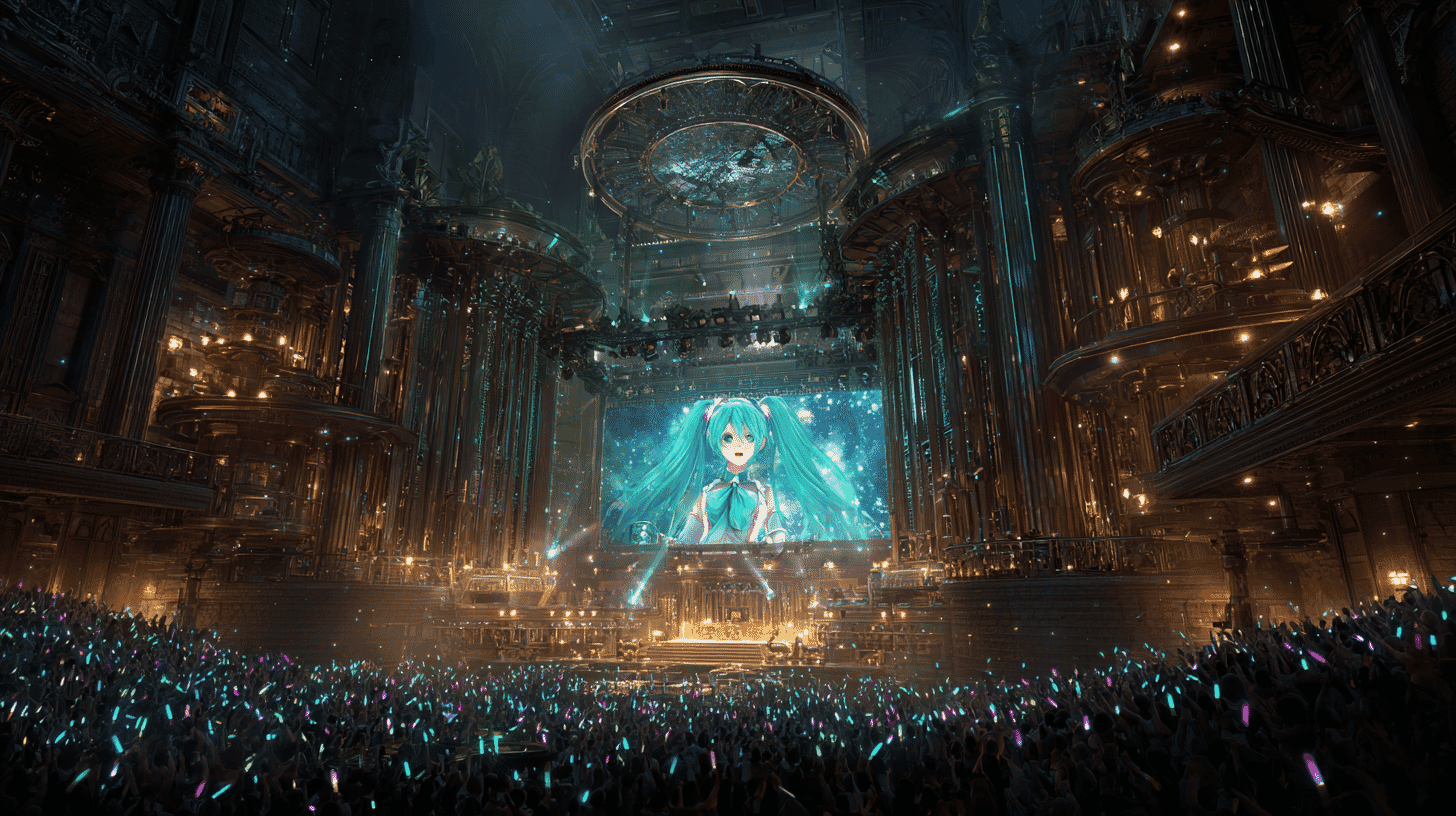
A digital singer born from software is about to headline a 20,000-seat arena in London. Created in Sapporo, Japan, in 2007, Hatsune Miku is a virtual singer who has racked up 120 shows across 50 cities worldwide. In November 2026, her first European tour in two years gets under way. The theme is "steampunk," and a stage where the retro and the future sit side by side will travel across early-winter Europe.
Hatsune Miku's European Tour "MIKU EXPO 2026 EUROPE" Confirmed
On February 20, 2026, Crypton Future Media announced a new overseas concert tour featuring Hatsune Miku, "HATSUNE MIKU EXPO 2026 EUROPE." Kicking off with a London show on November 12, 2026, and touring seven European cities over about two weeks, it will be the largest number of cities the series has covered in Europe.
The London venue, The O2, is one of the UK's largest arenas, with a capacity of about 20,000. It is the first time a virtual artist will headline a solo show at the venue.
Tickets for each show went on general sale at 9 a.m. local time on February 27, 2026.
The Full Seven-City Schedule
The tour will hold shows in the following seven cities.
- November 12 (Thu) London (The O2)
- November 14 (Sat) Brussels (ING Arena)
- November 15 (Sun) Amsterdam (AFAS Live)
- November 17 (Tue) Berlin (Velodrom)
- November 20 (Fri) Düsseldorf (PSD Bank Dome)
- November 22 (Sun) Paris (Accor Arena)
- November 25 (Wed) Madrid (Palacio Vistalegre)
The UK, Belgium, the Netherlands, Germany (two cities), France, and Spain: a single loop around western Europe's main markets.
[Update] Responding to demand after the announcement, two more shows were confirmed on April 7, 2026. A second Madrid date was added on November 24, and Lisbon (Sagres Campo Pequeno, November 27) joined as an eighth city, the first Crypton concert ever held in Portugal. The final scale is eight cities and nine shows, with tickets for the added dates going on sale on April 10, 2026. (As of August 2026)
The Theme Is "Steampunk": Retro Meets the Future
The visual theme of this European tour is "steampunk." The world of a heavy, refined classic style fused with intricate gears and retro gadgets is an original creation by illustrator suzunosuke.
Steampunk, a retro-futuristic aesthetic based on the steam engines of the Industrial Revolution, has a deep affinity with Europe's cultural background. The contrast of a virtual singer at the cutting edge of digital technology deliberately wrapping itself in an analog aesthetic creates a unique appeal.
12 Years of "MIKU EXPO": 50 Cities, 120 Shows
Hatsune Miku's overseas live series "HATSUNE MIKU EXPO" opened with a 2014 show in Jakarta, Indonesia. Since then, it has toured around the world across North America, Europe, and Oceania, and in November 2025 it completed the series' first Asia tour. The running total now stands at 120 shows across 50 cities worldwide.
The 2024 London show drew over 8,000 at Wembley Arena, MIKU EXPO's highest-attended performance to date. The move up to the larger O2 tracks growing European demand. In the series' 12th year, a tour of 15 North American cities already ran from April into May 2026, making the European leg the second world tour of the year.
The domestic event "Magical Mirai" has also drawn over 580,000 cumulatively since 2013, and in 2026 it is scheduled for three cities: Osaka, Tokyo, and Hamamatsu.
What Is Hatsune Miku? From Software to Cultural Phenomenon
Hatsune Miku is a singing-voice synthesizer software planned and developed by Crypton Future Media in 2007. Enter lyrics and a melody and the computer sings them back. The package art shows a character with blue-green twin tails.
When songs made with this software were posted one after another to the video-sharing sites Niconico and YouTube, a chain of creation spread outward into illustration, singing, and dance. The open system in which anyone could freely create using "Hatsune Miku" gave rise to a huge wave of user-generated content (UGC).
As a result, artists who started as "VocaloPs" (creators who make songs using Vocaloid), such as Kenshi Yonezu, Ayase (YOASOBI), and Eve, advanced one after another into the mainstream. Hatsune Miku went beyond being mere software to become a symbol of Japan's home-grown music culture itself.
A new version, "Hatsune Miku V6," was released on April 14, 2026, with Japanese, English, and Chinese voicebanks that allow singing across languages in a single track.
The International Spread of Vocaloid Culture
Hatsune Miku's popularity does not stop within Japan. "VocaloPs" exist overseas too, and creators making songs in English and Spanish are increasing. In the MIKU EXPO Song Contest, songs made in English and Spanish have won prizes, and the spread to many languages and cultures is steadily advancing.
The smartphone game "Project SEKAI: Colorful Stage! feat. Hatsune Miku" has also expanded internationally, mainly in Asia, and functions as an entry point for younger generations to encounter Vocaloid culture. Cross-genre and cross-border collaborations are also active, such as the K-pop artist YENA releasing a song featuring Hatsune Miku.
From April 30 to May 4, 2026, Yokohama hosted "Project Circles," a roaming Vocaloid-culture art event staged across six venues near Shin-Takashima Station. Over five days it made the depth of a creative community spanning music, illustration, and video visible at street level.
What Is Virtual Culture Like in Your Country?
Born as software, Hatsune Miku acquired a "personality" through what fans made of her. Those 19 years trace how far entertainment can stretch in the internet age. The first solo show by a virtual artist at The O2 is one marker along that line.
In your country, how are virtual singers and digital artists received? As AI and hologram technologies evolve, how do you think the future of live entertainment will change? We'd love to hear your thoughts.









Global Discussion
15 comments