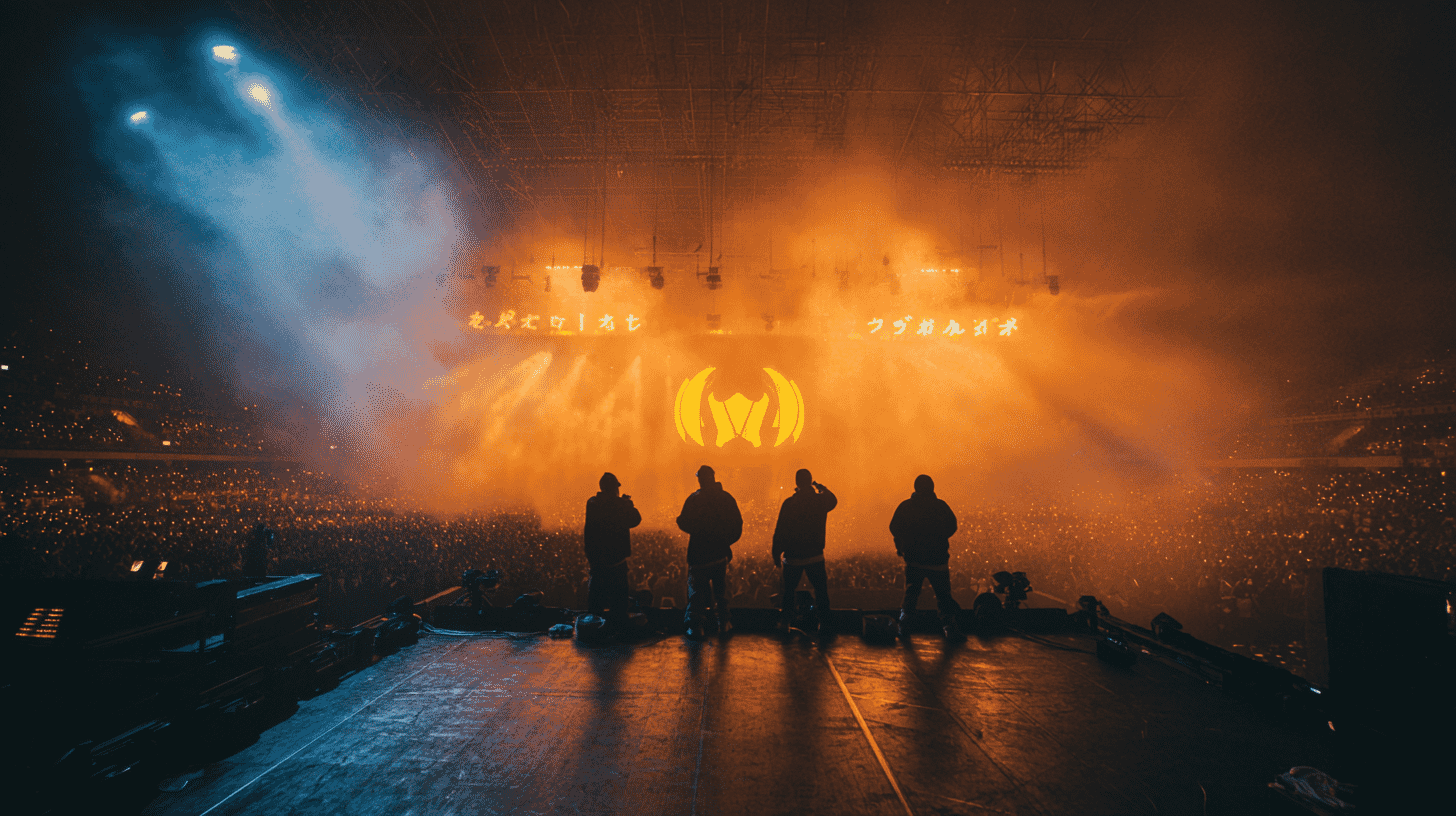
The most legendary crew in hip-hop history is returning to Japan after 29 years. It's their last time. And sharing the stage will be four artists who represent four different generations of Japanese hip-hop. Wu-Tang Clan × King Giddra × Awich × Hannya × ¥ellow Bucks This isn't just a concert. It's a historic summit between American and Japanese hip-hop.
The Final Chamber Comes to Japan
On May 24, 2026, Wu-Tang Clan will perform at K-Arena Yokohama as part of their farewell world tour, "Wu-Tang Forever: The Final Chamber." It will be the group's first solo show in Japan in approximately 29 years, billed in Japanese as "Saraba Wu-Tang, Saigo no Kaikou" (Farewell Wu-Tang, The Last Encounter).
The lineup features original members RZA, GZA, Raekwon, Ghostface Killah, Method Man, Inspectah Deck, U-God, and Masta Killa, joined by longtime affiliate Cappadonna and Young Dirty Bastard, the son of the late Ol' Dirty Bastard.
Tickets range from 15,000 yen (about $99) for A Reserved seats to 28,000 yen (about $185) for Gold Standing. Doors open at 4:00 PM, show starts at 5:30 PM.
Four Generations of Japanese Hip-Hop Take the Stage
What makes this show truly extraordinary is the guest lineup. Four Japanese hip-hop acts spanning different eras and styles will perform a 60-minute "BACK TO BACK" set before Wu-Tang takes the stage.
King Giddra: The founding fathers of Japanese-language rap. Consisting of Zeebra, K DUB SHINE, and DJ OASIS, King Giddra released their landmark album "Kuu Kara no Chikara" (Power from the Sky) in 1995, a record widely considered the cornerstone of Japanese hip-hop. They were building Japan's rap scene at the exact same time Wu-Tang Clan was revolutionizing American hip-hop, making this a meeting of two pioneering forces from the same era, separated only by an ocean.
Awich: Born in Okinawa and arguably the most important figure in Japanese hip-hop today. Her international profile has soared in recent years: she performed at Coachella 2024 on the 88rising Futures stage, appeared at 88rising's Head in the Clouds Festival in New York, and was featured in 88rising's documentary "Asia Rising." Most significantly, her 2025 album "Okinawan Wuman" was entirely produced by RZA, the first time Wu-Tang's mastermind has ever produced a full album for a Japanese rapper. The record features collaborations with Joey Bada$$, Westside Gunn, FERG, and Lupe Fiasco. This concert represents the live culmination of the Awich-RZA creative bond.
Hannya: A rapper from Sangenjaya, Tokyo, known as one of the greatest freestyle battle MCs in Japanese history. He embodies raw street authenticity and has been a dominant force in the scene since the 2000s. Think of him as Japan's battle rap equivalent, a figure respected across all generations for keeping it real.
¥ellow Bucks: A rapper from Aichi Prefecture representing the Tokai region and Japan's new generation. His melodic trap style has made him hugely popular among younger fans, and his presence on this bill signals how far Japanese hip-hop has diversified from its boom-bap roots.
Together, these four acts tell the entire story of Japanese hip-hop on a single stage: the 1990s pioneers (King Giddra), the 2000s battle culture (Hannya), the 2020s international breakout (Awich), and the next generation (¥ellow Bucks).
Who Are Wu-Tang Clan?
For readers less familiar with hip-hop history, Wu-Tang Clan is one of the most influential music groups of all time. Emerging from Staten Island, New York in the early 1990s, the collective fused gritty street narratives with cinematic production, Shaolin martial arts philosophy, and a business model that allowed each member to pursue solo deals, revolutionary at the time.
Their 1993 debut "Enter the Wu-Tang (36 Chambers)" is considered one of the greatest hip-hop albums ever made. The 1997 follow-up "Wu-Tang Forever" sold over 6 million copies worldwide. Beyond music, they've influenced fashion, film, and pop culture at large. Their famous motto: "Wu-Tang is for the children."
To commemorate the Japan visit, their debut album will be re-released as a limited-edition cassette tape on May 13 ($14.50), complete with Japanese liner notes.
The Awich-RZA Connection Makes This Personal
The relationship between Wu-Tang Clan and Japan runs deeper than most fans might realize. RZA has long drawn from Eastern philosophy and martial arts cinema, elements woven into Wu-Tang's DNA. But Awich's collaboration with RZA turned that cultural affinity into a concrete creative partnership.
Awich spent time at RZA's Wu Mansion working on "Okinawan Wuman," and has described him as a "master" (師, shi). In her own words: "I am proud as a rapper to have shaped my journey toward the world by connecting the soul of Okinawa with the spirit of hip-hop alongside my master, RZA."
When Awich takes the stage before Wu-Tang in Yokohama, it won't just be an opening act, it will be a student performing in front of her teacher's audience, with both sides sharing the same night.
What About Hip-Hop in Your Country?
In Japan, this announcement has electrified fans far beyond the usual hip-hop crowd. A once-in-a-lifetime farewell, a 29-year gap between visits, and a guest lineup that reads like a who's-who of Japanese rap history.
How big is Wu-Tang Clan in your country? Does your local hip-hop scene have moments where different generations share the same stage? We'd love to hear your thoughts, share your perspective in the comments!








Global Discussion
14 comments