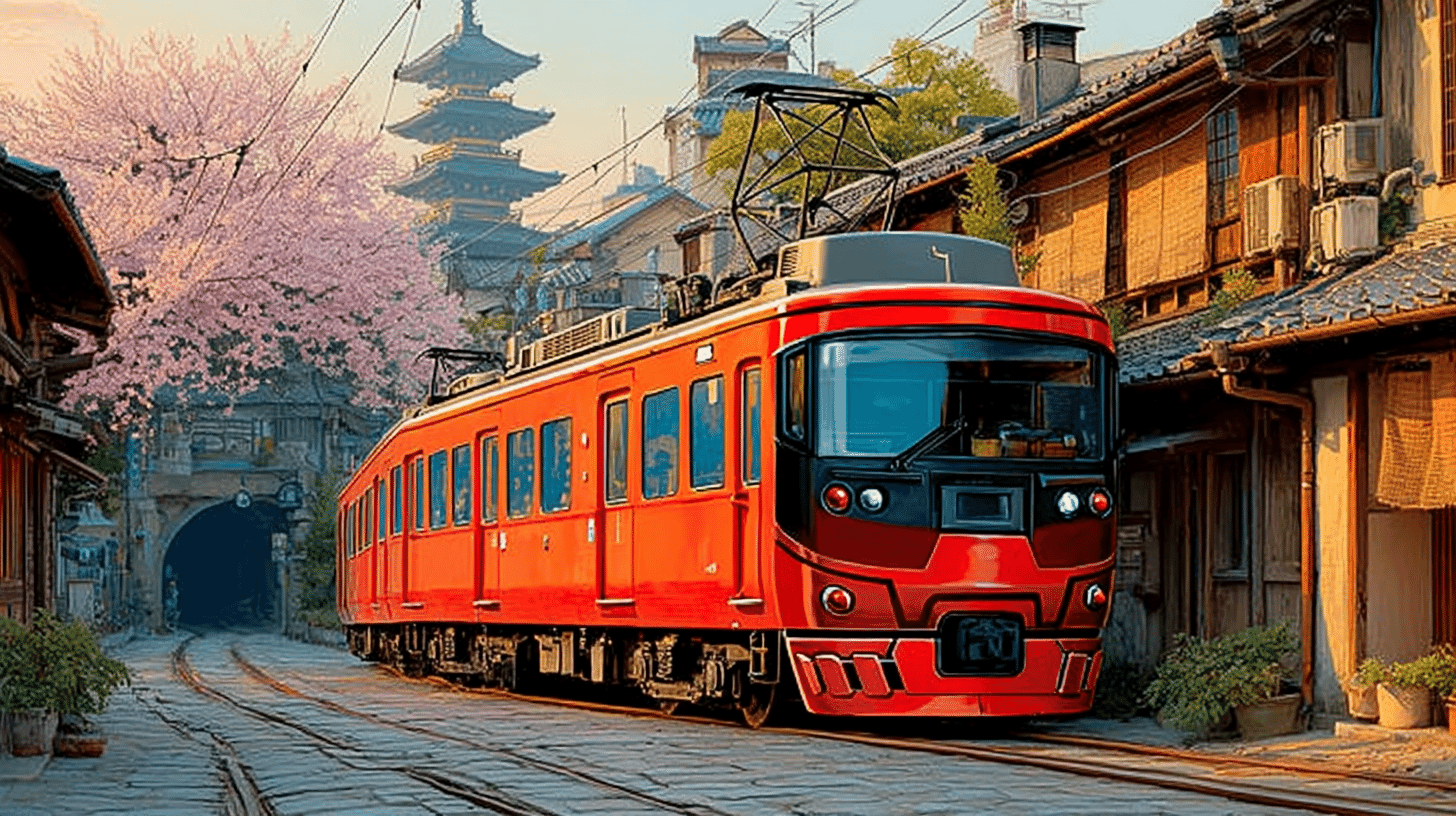
The man who designed Gundam's Mobile Suits is now designing a real train.
On April 21, 2026, Seibu Railway announced that Kunio Okawara, the legendary mechanical designer behind Mobile Suit Gundam, will design a new tourist limited express set to debut in fiscal year 2028. It's the first time Okawara has overseen both the exterior and interior design of a real-world railway vehicle.
Within hours of the announcement, Japanese social media erupted with one recurring joke: "Red Arrow = Red Comet." For Gundam fans, that phrase alone carries enough weight to launch a thousand retweets. Here's why this train is already a cultural event before it's even been built.
What Seibu Actually Announced
The new tourist train is a full renovation of one existing Series 10000 "New Red Arrow" trainset (formation 10112, seven cars) currently running as the limited express "Koedo" on the Seibu Shinjuku Line.
The route will connect Seibu-Shinjuku Station in central Tokyo with Hon-Kawagoe Station in Saitama Prefecture, a 46-minute journey that already functions as the main tourism artery between the capital and the Edo-period town of Kawagoe.
The interior will be rebuilt from scratch. Gone are the standard commuter-limited-express seats; in their place, passengers will find regular seating plus semi-private compartments and sofa seats, along with a newly installed bar counter serving light meals and drinks. The idea is that the ride itself becomes the destination.
Service launches in FY2028 (April 2028 – March 2029). Fares, booking methods, and the official train name will be announced later.
Who Is Kunio Okawara?
For international readers unfamiliar with the name, a quick orientation.
Kunio Okawara, born 1947 in Inagi, Tokyo, started his career as a fashion designer at apparel company Onward Kashiyama. In 1972, he joined Tatsunoko Productions and designed the enemy mecha for Science Ninja Team Gatchaman. That single credit made him the first person in the Japanese animation industry to be credited specifically as a "mechanical designer", the profession itself didn't exist before him.
In 1979, teaming up with director Yoshiyuki Tomino at studio Sunrise, Okawara designed the mecha for Mobile Suit Gundam. The RX-78-2 Gundam, the Zaku II, Dom, Gouf, Char's Custom Zaku, pretty much every Mobile Suit silhouette that has sold billions of dollars in plastic model kits ("Gunpla") over the past four decades originated from Okawara's drafting table.
His portfolio spans over 100 titles, including Yatterman, Armored Trooper VOTOMS, Fang of the Sun Dougram, GaoGaiGar, and the entire Brave Series. In 2011, he received the Distinguished Service Award at the Japan Media Arts Festival.
What defines an Okawara design? Not flashiness, but functional believability. His machines look like mass-produced military hardware, with modular parts that can be swapped into endless variants. That industrial-grade realism is what made Gunpla a serious hobby rather than a toy line, and it's what Seibu is now betting on for a real passenger train.
Why This Collaboration Is a Big Deal
Celebrity designers working on Japanese trains aren't unusual. JR Kyushu has Eiji Mitooka. Seibu's own Laview (Series 001) was designed by Pritzker-winning architect Kazuyo Sejima. JR East's Shinkansen E5 involved multiple famous architects.
So what's new here?
This is the first time an anime mecha designer has overseen both the exterior and interior of a real Japanese passenger train. Not as a decorative skin, not as a temporary wrap, a fundamental design supervision role.
Okawara himself acknowledged the weight of it in his official comment: "In anime I've designed many mechanisms, including trains. I've had many experiences designing trains that transform into robots, but I am grateful, and I feel the responsibility, of being given the chance to work on an actual railway project."
The translation from fiction to reality is exactly what's electrifying fans. Someone who has spent 50+ years imagining how fictional machines would work if they existed is now designing a machine that will actually work.
Fan Reactions: The "Red Comet" Meme Explodes
When Seibu's official X (Twitter) account posted Okawara's handwritten concept sketch, the response was instant and intense.
The train is red. In Gundam lore, the most iconic red machines belong to Char Aznable, the franchise's most beloved antagonist, nicknamed "Red Comet" (赤い彗星). Char pilots red Mobile Suits that move three times faster than standard models, a detail that is, at this point, Japanese pop-culture common knowledge.
The reactions wrote themselves:
- "Red Arrow = Red Comet. Flawless."
- "Char's Custom Red Arrow has arrived in reality."
- "Please get Shuichi Ikeda (Char's voice actor) for the automated announcements."
- "Only Okawara could make it look like it might transform into a robot mid-journey."
- "Surely Kamiigusa Station will now become a limited express stop." (Kamiigusa is the station nearest Sunrise's headquarters, a Gundam-fan pilgrimage site.)
The jokes are affectionate and knowing. This isn't being received as "another limited express announcement", it's being received as a cultural event hosted by the Gundam fandom.
What's Along the Route
The train's destination, Hon-Kawagoe Station, puts you a 15-minute walk from "Little Edo" Kawagoe (小江戸川越), one of the best-preserved Edo-period townscapes in the greater Tokyo area.
Must-visit Kawagoe spots
- Kurazukuri Street (Ichibangai): Rows of storehouse-style merchant buildings from the late Edo to Meiji era. Designated a national preservation district.
- Toki no Kane (Bell of Time): Kawagoe's iconic wooden bell tower, ringing four times daily, a sound continuously heard since the Edo period.
- Kashiya Yokocho (Candy Alley): A narrow lane of retro Japanese candy shops, a Showa-era time capsule.
- Kawagoe Hikawa Shrine: Famous for love-related fortune-telling and its photogenic summer wind-chime festival (furin matsuri).
- Kitain Temple: Contains rooms physically relocated from the original Edo Castle, including the room where Shogun Iemitsu was born.
From Shinjuku, you can be standing in a 17th-century streetscape in 46 minutes. That's Little Edo's entire pitch.
Onward to Chichibu
For deeper adventures, transfer at Tokorozawa to the Ikebukuro Line → Seibu Chichibu Line, reaching the mountain-shrine region of Chichibu:
- Mitsumine Shrine and Chichibu Shrine: Among Kanto's most revered spiritual sites.
- Hitsujiyama Park: Legendary carpet of moss phlox flowers in spring.
- Ashigakubo Icicles: A winter-only illuminated ice formation.
- Nagatoro River: Traditional wooden-boat rafting through a scenic gorge.
Chichibu is also the setting of the anime Anohana: The Flower We Saw That Day, making the whole Seibu network a natural anime-pilgrimage route.
Japan's Long History of Anime × Train Collaborations
This isn't a new idea, just the latest and most ambitious iteration. Some highlights from the genre:
500 TYPE EVA (2015–2018)
JR West repainted a 500 Series Shinkansen in the purple-and-green livery of Evangelion Unit-01, with interior "cockpit" experience zones. Originally planned for 18 months, it was extended to 30 months due to enormous international demand. This is probably the most globally famous anime-train in history.
Girls und Panzer × Kashima Rinkai Railway
A small freight/passenger line in Ibaraki Prefecture wrapped its trains with characters from the WWII-tank-combat anime Girls und Panzer. The anime's setting, Oarai Town, became a major pilgrimage destination, and non-commuter ridership rose measurably in subsequent years.
Shinkalion
A multimedia franchise (anime, toys, video games) by Takara Tomy and JR East featuring transforming-robot Shinkansen. It's a children's property, but the crossover with real train operations, including cameos by the 500 TYPE EVA, has deep cultural resonance.
Others
Toyama Chitetsu's "Canyon Express" (a former Seibu New Red Arrow, in fact!), various regional railways with character-themed trains, character × train crossovers are a well-established marketing genre in Japan.
What makes the Seibu × Okawara project different is the "fictional mecha designer draws a real mecha" angle. No one has done that at this scale before.
The Business Logic Behind the Choice
In its press release, Seibu said it chose Okawara because his designs convey "warmth" and "approachability" within refined functional aesthetics, a fit for the evolving Shinjuku Line.
But zoom out and the strategy is clearer:
- Ikebukuro Line's flagship limited express was modernized in 2019 with the Series 001 "Laview" (Kazuyo Sejima design)
- Shinjuku Line's flagship limited express gets a brand-new "Tokiiro" (Series 40000-based) in spring 2027
- Then, in FY2028, the retiring Red Arrow returns in a second career as a branded tourism experience
In other words: the "everyday" limited expresses get fresh trains, while the old trains are repositioned as premium leisure products. The New Red Arrow debuted in 1993; retiring it outright would waste a perfectly good vehicle. Converting it into a tourism train extracts more revenue from an asset that's already been largely paid for.
With inbound tourism crossing 30 million visitors in 2024 and the Japanese government pushing for tourist dispersion beyond the Tokyo-Kyoto golden route, there's also a clear inbound play: selling "easy Little-Edo day trip, by Gundam's designer" internationally is a powerful hook.
Fares: Rough Estimates
Fares haven't been announced. For context, the current Koedo limited express supplement between Seibu-Shinjuku and Hon-Kawagoe is roughly ¥600 (~$3.80) one-way. The new tourist version will certainly cost more.
Looking at the existing Laview supplement on the Ikebukuro Line (~¥700–900 for Ikebukuro-Chichibu), we'd speculate the new train lands in the ¥1,000–2,000 (~$6–13) range per trip, still well within day-trip affordability. (At current rates of ~¥158/$1.)
This is emphatically not the $1,000+ ultra-luxury tier represented by JR Kyushu's Seven Stars cruise train. It's a premium day-trip experience, not a multi-day onboard hotel.
How to Ride It (Practical Info, Best Guesses for 2028)
Seibu will almost certainly continue using its Smooz app for reservations. International travelers have several useful options:
- SEIBU 1 Day Pass: Unlimited rides on Seibu lines, sold only to non-Japanese passport holders (limited-express supplements sold separately)
- SEIBU Limited Express Ticket Center at Ikebukuro and Seibu-Shinjuku stations
Only one trainset of seven cars will be converted, so service frequency will be limited. Expect intense competition for tickets during the debut period, especially from international Gundam fans who will absolutely be booking flights around this.
One Red Line Connecting Fiction and History
Sometime in 2028, a red train will slide into the underground platforms at Seibu-Shinjuku. On the outside, it will carry the design language of a man whose Mobile Suits have fought across countless fictional battlefields for nearly 50 years. Inside, passengers will drift out from central Tokyo, bar counter to one side, semi-private lounge to the other, toward a town whose streetscape has barely changed since the Tokugawa shogunate.
46 minutes later, they'll step out into the 17th century.
If there's a single thing Japan has mastered, it's this, the seamless stitching together of pop fantasy and deep tradition, riding on the same set of rails.
Does your country have anime, game, or pop-culture train collaborations? France has had TGV-Asterix partnerships; Germany's ICE has hosted Netflix promotions; Disney runs themed trains at its parks. What anime × train collaboration would you pay to ride? Let us know in the comments.
References
- Seibu Railway official announcement: https://www.seiburailway.jp/newsroom/news/20260421_10000renewal/
- Seibu Railway official PDF (detailed press release): https://www.seiburailway.jp/newsroom/news/file/20260421_10000renewal.pdf
- https://www.timeout.jp/tokyo/ja/news/a-tourist-train-designed-by-gundam%E2%80%99s-kunio-okawara-is-set-to-enter-service-in-2028-042126
- https://news.yahoo.co.jp/articles/b4eafdb6d8a115fec426fd11e11fb7a2adbd0531
- https://www.watch.impress.co.jp/docs/news/2103386.html
- https://www.oricon.co.jp/news/2450334/full/
- https://en.wikipedia.org/wiki/Kunio_Okawara
- https://www.seiburailway.jp/railways/tourist/english/ride/access/kawagoe.html



Global Discussion
14 comments