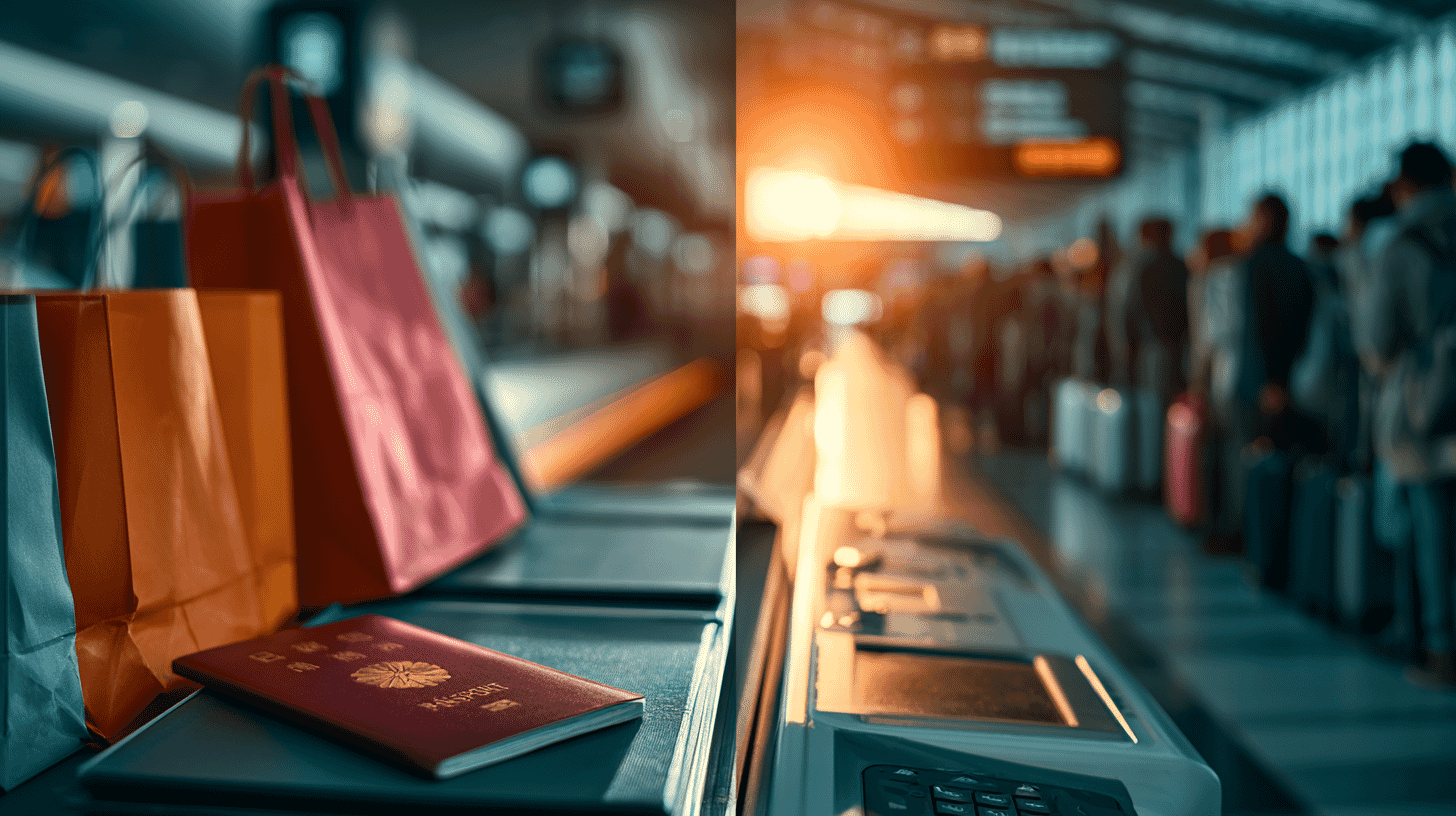
🛍️ Buying a camera in Akihabara or an armful of skincare in Shinsaibashi has always come with one distinctly Japanese perk: show your passport and the 10% consumption tax simply vanishes at the register. From November 1, 2026, it stops vanishing. You pay the full price, and the tax only comes back after customs confirms at the airport that the goods are actually leaving with you. Skip that step and the money stays where it is.
What actually changes on November 1
As of the end of September 2025, 64,499 stores nationwide held tax-free licences, from department stores to drugstores to neighbourhood electronics shops, and all of them have been taking the consumption tax off the price on the spot.
That instant discount disappears. Under what Japan is calling the refund method, shops will sell to tourists at the full tax-included price, exactly as they sell to residents. The exemption becomes real only when customs confirms at departure that you are taking the goods abroad. Then, and only then, does the shop or a refund company acting on its behalf send the tax back.
The spending threshold is unchanged. You need at least ¥5,000 (about $31) before tax at one store on one day. Consumption tax runs at 10% on most goods and 8% on food and drink, and that is what you get back.
The deadline is new. Customs confirmation has to happen within 90 days of the purchase date. Buy something on day one of a long stay, fly out on day 91, and the refund never happens.
The new airport routine
Two steps now sit between you and your money, and both are easy to get wrong.
The first is in the shop. At checkout you will be pointed to a registration page, usually via a QR code on the receipt or at the counter, where you specify how you want to be paid: bank transfer, credit card, a payment app, or cash at the airport. Which of those exist depends entirely on the shop and whichever refund operator it works with.
The second is at the airport, and the timing is unforgiving. You must complete customs confirmation before you check your bags. Kiosk terminals go in the international departure lobby, landside, ahead of the baggage drop. You present your passport, and the screen returns either a green result, which ends the process, or a red one, which sends you to a customs inspection point with your purchases. At Narita, Haneda, Kansai, Chubu, Fukuoka, New Chitose and Naha you can skip the kiosk line entirely and do it on your phone through Visit Japan Web, provided you are inside the airport's dedicated Wi-Fi zone before security.
Once a suitcase is on the belt, it is over. The Japan Tourism Agency spells it out: airlines will not retrieve checked baggage so you can finish a tax refund, and nobody compensates you if the queue makes you miss your flight.
Confirmation happens per receipt, not per item. If a single receipt lists five things and you have eaten, used or given away one of them, the entire receipt fails and none of it is refunded. Already opened the snacks? Do not use the kiosk at all. Tell a customs officer at the counter instead.
What actually gets easier
It is not all friction. The split between "general goods" such as electronics, bags and clothes, and "consumables" such as cosmetics, food and medicine, is gone. So is the ¥500,000 (about $3,140) ceiling that used to cap consumable purchases, and so is the sealed bag you were forbidden to open until you left the country. From November you can buy ¥800,000 of cosmetics in one transaction and nobody tapes them shut.
Shop staff also stop having to judge whether what you are buying counts as "for ordinary personal use," a vague test that produced awkward exchanges at counters. According to the government's own briefing paper, that risk pushed some retailers to impose private purchase limits and drove others to abandon tax-free selling altogether rather than face a tax audit.
There is one addition. For items priced at ¥1 million (about $6,290) or more before tax, shops now register identifying details such as serial numbers, to stop an expensive watch being swapped for a cheap one somewhere between the shop and the gate.
The problem Japan is trying to fix
A joint briefing paper from Japan's finance ministry, tax agency, industry ministry and tourism agency puts numbers on it. Between April 2022 and March 2024, about 19.59 million departing visitors made tax-free purchases worth ¥2.4979 trillion (about $15.7 billion). Within that, 690 shoppers each bought ¥100 million or more, accounting between them for ¥233.2 billion (about $1.47 billion). Fewer than one in 28,000 tax-free shoppers took roughly 9% of the money.
Customs caught only a fraction of them. The paper's own chart shows close to nine in ten of those ¥100-million-plus buyers were never intercepted at departure. Of the few who were checked, more than 90% could not demonstrate they were exporting the goods and were assessed for the tax, and nearly all of them left the country owing it. Under current law, customs inspection is voluntary and nobody can be barred from boarding for declining it.
The suspected mechanic is simple: buy tax-free, resell inside Japan, pocket the difference.
Reversing the sequence closes the loop. Under the refund method, unclaimed tax is not a debt to chase across borders. It is money that never leaves the shop.
How this compares with the rest of the world
For most travellers, "pay first, claim later" will not be new. It is how the EU works. Non-EU residents recover VAT only if the goods are presented to customs on departure within three months, with every claim validated digitally or physically before leaving. The EU deliberately leaves the mechanics unharmonised, which is why forms, operators and fees differ from country to country.
Japan joins that model with one advantage. Its purchase records are already fully electronic, and the government's briefing paper notes that travellers therefore will not have to feed paper receipts into a terminal the way they do in Europe. Passport scan, done.
South Korea is the interesting counter-example. It runs a departure refund too, with a ₩15,000 minimum and a three-month export window, but it has also spent a decade expanding instant in-store refunds, now available on single purchases under ₩1 million and capped at ₩5 million per trip. Seoul has been pushing the money back toward the shop counter. Tokyo is moving it the other way.
Great Britain sits at the other end of the spectrum. It withdrew the VAT Retail Export Scheme on 1 January 2021, leaving Northern Ireland with its own separate rules, and tourists shopping on Oxford Street now simply pay the VAT.
What nobody can tell you yet
The biggest unknown is cost. Japan's National Tax Agency states plainly that tax law sets no rules for how refunds are carried out. Bank transfer, card, app and cash at the departure port are all listed as possibilities, and shops may either handle it themselves or delegate the job to an operator, which has to register as a funds-transfer business and run anti-money-laundering checks before it can pay anyone. Nothing in that framework says the refund has to arrive whole. Whether it does will come down to whose name is printed on your receipt.
Then there are the queues. November 1 falls on a Sunday, and the Japan Shopping Tourism Organization has warned retailers to brace for a rush of last-minute buying through late October. As of mid-August 2026, which airports get how many kiosks, and where those kiosks sit, had still not been announced.
The largest question sits above all of this. The ruling coalition's fiscal 2026 tax package keeps the tax-free system under review, with its effectiveness to be assessed once the refund method is running. In late 2025, seventeen tourism bodies filed a joint submission opposing calls to scrap tax-free shopping outright as a way of funding overtourism measures. November 1 is not the end of that argument. It is the experiment the argument will be judged on.
Plenty of countries have made visitors queue at a customs desk for decades, and plenty of travellers have quietly decided the refund is not worth twenty minutes of their departure. Is tax-free shopping something you actually claim when you travel, or paperwork you skip? And where you live, do visitors get the tax knocked off at the till, or only after they have proved they are leaving?
References
- https://www.travelvoice.jp/20260815-160318
- https://www.mlit.go.jp/kankocho/tax-free/page01_000001_00021.html
- https://www.mlit.go.jp/kankocho/tax-free/page01_000001_00023.html
- https://www.nta.go.jp/publication/pamph/shohi/menzei/201805/format/002.htm
- https://www.mlit.go.jp/kankocho/content/001858413.pdf
- https://www.mlit.go.jp/kankocho/tax-free/about.html
- https://www.travelvoice.jp/20251222-158972
- https://www.travelvoice.jp/20251003-158491
- https://europa.eu/youreurope/citizens/consumers/shopping/vat/index_en.htm
- https://english.visitseoul.net/taxrefund
- https://www.gov.uk/government/publications/the-travellers-allowances-and-miscellaneous-provisions-eu-exit-regulations-2020/the-travellers-allowances-and-miscellaneous-provisions-eu-exit-regulations-2020








Global Discussion
4 comments