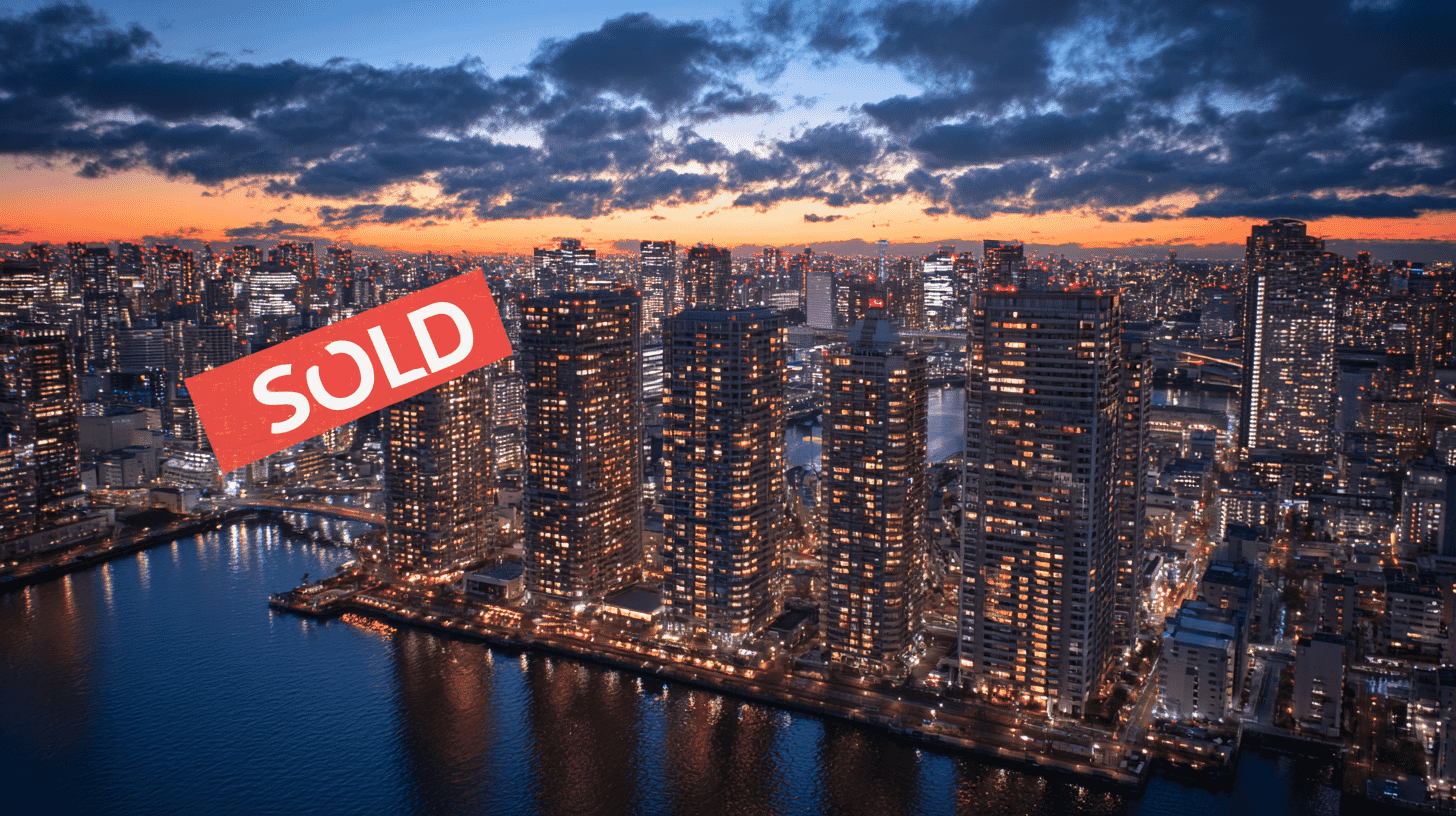
Imagine buying an apartment for $400,000 and flipping it for $1.3 million, without ever moving in. That's been the reality in Japan's "tower mansion" market. But now the game is changing: resale listings are stalling, inventory has doubled, and banks are refusing mortgages to flippers. Is Japan's luxury high-rise bubble about to burst?
What's Happening at Harumi Flag?
Harumi Flag is a massive residential complex in Tokyo's waterfront district, built on the site of the 2021 Olympic Athletes' Village. With sale prices set 20-30% below surrounding market rates, units drew lottery odds that peaked at 266 to 1. It became the poster child of Japan's tower mansion frenzy.
But in early 2026, a different story is emerging. Across social media and YouTube, reports of "resale struggles" and "the start of a price decline" are spreading rapidly. Resale units listed at roughly double their original sale price are sitting unsold for months, with sellers gradually cutting their asking prices. Some reports suggest hundreds of units in the complex have no actual residents living in them.
Industry expert Kenichi Shibasaki, COO of Osaka-based real estate intelligence firm TOWERZ, describes the situation as "a correction, not a crash." He explains that some sellers set wildly inflated prices and are now being forced to lower them. Even at reduced prices, these units are still worth considerably more than their original purchase price. Yet the fact that a correction is happening at all shows the market's underlying premise, that prices only rise, has started to wobble.
What the Statistics Miss About Foreign Ownership
One of the most debated factors behind Japan's tower mansion price surge is the influx of foreign money, particularly from wealthy Chinese investors. As China's economy has slowed, rumors have spread that these investors are pulling out of Japanese real estate entirely.
Government statistics paint a reassuring picture. In a survey of condominium transactions released in November 2025, Japan's Ministry of Land, Infrastructure, Transport and Tourism (MLIT) found that only 3.5% of new condo buyers in Tokyo's 23 wards had overseas addresses. In Osaka City, the figure was 4.3%.
However, TOWERZ's independent research tells a dramatically different story. By individually checking property registration records at Japan's Legal Affairs Bureau, the firm discovered that in some tower mansions completed in central Osaka during 2024-2025, over 40% of units were owned by foreign nationals. The government's statistics only count people with overseas addresses, completely missing foreign buyers who reside in Japan.
The majority of these buyers come from mainland China, Hong Kong, and Taiwan. Despite China's strict capital outflow controls, buyers reportedly move money into Japan by other routes, including entering the country wearing high-end watches and converting them to cash once inside.
Simultaneous Registration, the Zero-Capital Flip
This robust foreign demand provides "exit confidence" for domestic speculators, fueling the rapid growth of so-called "tenbai-ya" (転売ヤー), resale flippers who buy tower mansion units purely to resell them at a profit.
A key technique enabling this phenomenon is called "renken tōki" (連件登記), or simultaneous registration. Normally, buying property requires the purchaser to provide their own funds and register ownership. But with simultaneous registration, the purchase and resale registrations are processed at the same time, using the end buyer's funds. This means a flipper can acquire and sell a property without investing a single dollar of their own money, pocketing the price difference, often tens of millions of yen (hundreds of thousands of dollars).
This practice reportedly occurred at Grand Green Osaka, a major redevelopment project in the Umekita district. Purchase rights acquired for about ¥120 million ($800,000) reportedly ballooned to over ¥200 million ($1.33 million) by completion, generating windfall profits of roughly ¥80 million ($530,000) with zero effort or capital.
The numbers show how far this has gone. At one tower mansion completed near Osaka's Umeda district in 2025, more than 40 units, roughly 20% of the building, appeared as resale listings immediately after delivery. The resale ratio, once around 5%, has passed 20%. Developers now compete for buyers against the very people they sold to.
Banks Start Turning Flippers Away
Perhaps the most significant development is the tightening of mortgage screening by Japanese banks. Until recently, mortgage applicants with adequate income and acceptable debt ratios could expect approval. Now, applicants with three or more short-term property flips in the past five years are being denied.
Banks have recognized that housing loans, intended for people to buy homes they actually live in, have been systematically diverted for speculation. Their crackdown represents a fundamental shift in the financial infrastructure that enabled the flipping boom.
In July 2025, Tokyo's Chiyoda Ward went further, issuing an official request to developers to implement anti-flipping measures. With both financial institutions and local government moving to close the exits, the speculative pipeline is being squeezed from multiple directions.
Inventory Has Doubled and Sales Have Slowed
Real estate professionals watching for a price decline focus on two key indicators: unsold inventory levels and average time to sale.
In the Osaka metropolitan area, tower mansion inventory has doubled from roughly 500 units two years ago to about 1,100 today. The average time from listing to sale has stretched from three months to 4.5. When sales volumes drop and inventory piles up, cash-strapped flippers cut prices, and the markdowns spread to neighboring buildings.
Update: Figures published by the Real Estate Economic Institute in July 2026 put the average price of a newly built condominium in the greater Tokyo area at ¥101.35 million for the first half of 2026, the first time the half-year figure has topped ¥100 million. Tokyo's 23 wards averaged ¥142.49 million, up 9.1% year on year and a record for a first half. Prices are still climbing, but the underlying indicators point the way this article describes. Units released fell to 7,989, a fifth straight first-half decline; the first-month contract rate slipped 1.8 points to 64.8%, a third consecutive year in the 60s; and inventory rose by 363 units to 6,389. For fiscal 2025 (April 2025 to March 2026), releases totaled 21,659 units, the lowest since fiscal 1973, with a first-month contract rate of 62.9%, down 3.9 points. Prices and sales momentum are now moving in opposite directions.
Even more concerning is the widening gap between sale prices and rental yields. In a healthy market, purchase prices and rents move roughly in tandem. But in today's tower mansion market, sale prices have skyrocketed while rents have risen only modestly. Rents are ultimately constrained by tenants' actual salaries, they can't be inflated through speculation. If sale prices continue outpacing rents, the investment math collapses, and as Shibasaki puts it, "the bubble's mask comes off."
Where Does the Ceiling Sit?
The average price of a tower mansion in Osaka currently stands at about ¥90 million ($600,000). Even ordinary salaried workers are taking on mortgages of 12-13 times their annual income, paying roughly ¥300,000 ($2,000) per month.
Shibasaki predicts the breaking point will come when the average price exceeds ¥130 million ($870,000) and monthly payments reach ¥400,000-500,000 ($2,700-3,300). His timeline: within 2 to 3 years.
Adding to the pressure, over 19,000 tower mansion units are scheduled for completion in the Tokyo metropolitan area in 2026 alone, approaching the 2007 supply peak. After 2007, the Lehman Brothers shock combined with overpricing sent the market into a deep freeze. Some analysts see worrying parallels with the present situation.
The average price of newly built condominiums in Tokyo's 23 wards reached ¥136.13 million ($907,000) in 2025, up 21.8% year on year, and the median crossed ¥100 million for the first time at ¥113.8 million. Used condominium asking prices in the same area also topped ¥100 million for the first time. The question of where the ceiling lies, and who bears the cost when it's finally hit, may be answered sooner than many expect.
In Japan, the belief that "tower mansions will always appreciate" became a kind of urban myth over the past few years. Has your country experienced a real estate bubble before? How does your country handle speculative trading in high-rise condominiums, or the influence of foreign investors on housing prices? We'd love to hear your perspective, what's the situation like where you live?





Global Discussion
15 comments