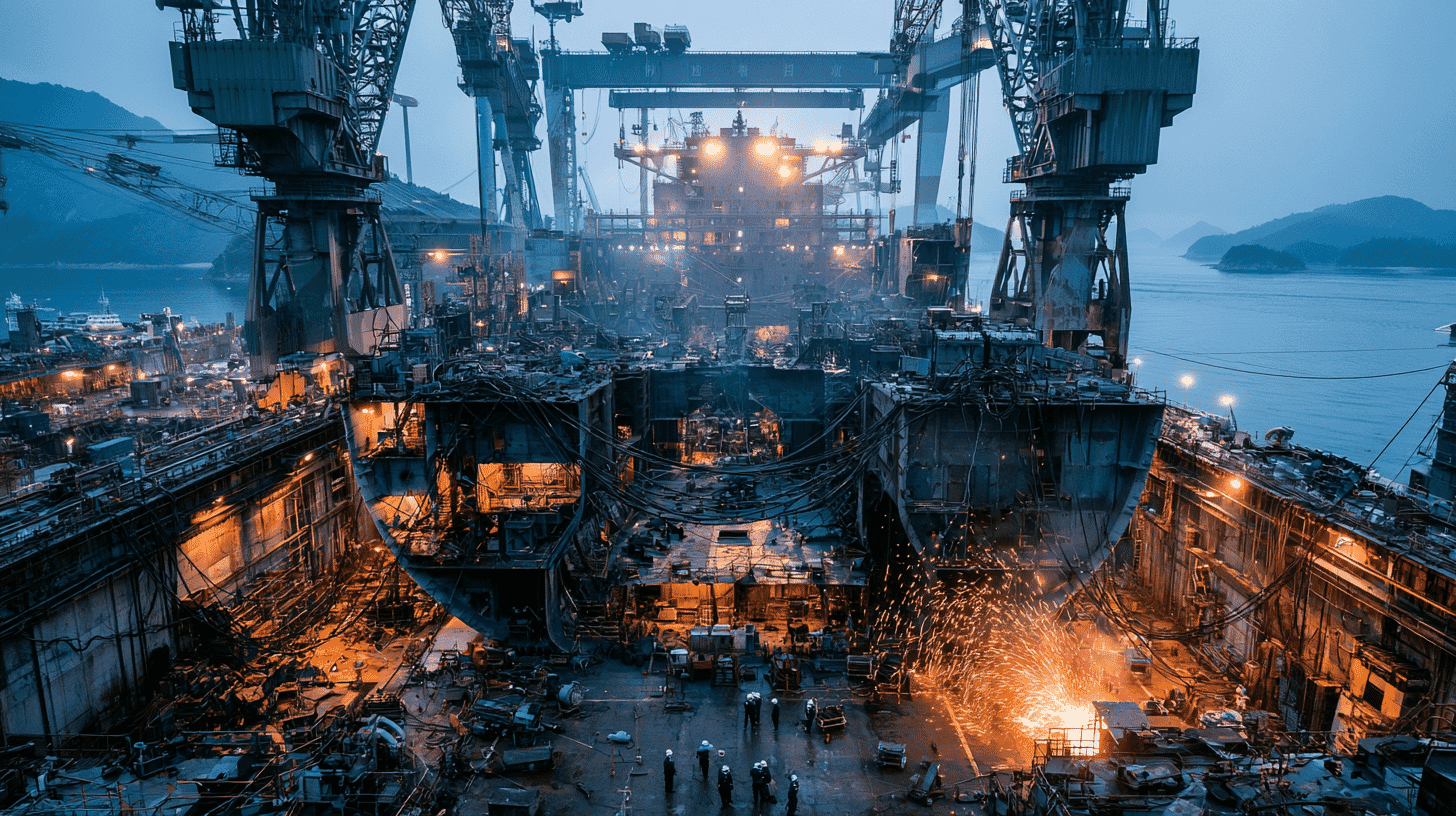
🚢 Japan's largest shipbuilder just reached a scale it had never reached: roughly a trillion yen in group revenue, about $6.4 billion. But the number wasn't the most consequential thing said at the press conference. A clause had been deleted from a contract, and that turned out to matter more.
What the trillion is made of
Imabari Shipbuilding is headquartered in Imabari, a mid-sized city on the Seto Inland Sea in Ehime Prefecture. On July 23, 2026, the company reported revenue of 600.5 billion yen (about $3.8 billion) for fiscal 2025, up 29 percent. That was a fourth consecutive year of growth, and the highest figure in the company's history.
Then there is Japan Marine United. Imabari raised its stake to 60 percent in January 2026, turning its longtime rival into a subsidiary. JMU, run by Takashi Hirose out of Yokohama, booked 398 billion yen (about $2.5 billion), up 22 percent. Add the two and you get roughly a trillion yen.
The two companies are not the same animal. Imabari builds volume: bulkers, tankers, boxships, one after another. JMU builds the hard stuff, including destroyers and icebreakers, and in a consortium with Imabari it delivered the six 24,000 TEU container ships ordered by ONE from 2023, among the largest boxships ever built. President Yukito Higaki credited the record year to deliveries of large container ships finally starting to land, plus a weak yen.
He also said the group has filed a ten-year capital spending plan with Japan's transport ministry worth more than 100 billion yen, over $630 million, according to the trade paper Kaiji Press.
The clause that disappeared
In 2021, Imabari and JMU set up a jointly owned sales and design company in Tokyo called Nihon Shipyard. Its remit covered general merchant ships and offshore floating structures across the board, with one carve-out written into the definition: LNG carriers excluded.
At the July press conference, Higaki said that carve-out is gone. The words were removed when JMU became a group company. LNG carriers, he said, are now in scope.
He was careful about what that does and doesn't mean. On actually restarting domestic construction of LNG carriers, he would say no more than that several companies are still working out whether and how the industry could go back. That is not a decision. Reading the deletion itself as a statement of intent seems fair, though.
2017, and a loss of 69.4 billion yen
The carve-out existed for a reason, and the reason still stings. JMU took four LNG carriers as a single batch of orders. The insulation work around the cargo tanks, done in cramped spaces to tolerances that matter when the cargo sits at minus 162 degrees Celsius, ran badly over schedule. Costs followed. A rising yen then wrecked the economics of the foreign-currency contracts. In fiscal 2017 JMU posted a net loss of 69.4 billion yen on revenue of 298.7 billion yen, roughly $440 million and $1.9 billion at today's rates. IHI, then a co-owner, swallowed 32 billion yen in investment losses of its own. Diamond, a Japanese business magazine, reported at the time that IHI's president said the losses had simply been too large.
Japan has not delivered a domestically built LNG carrier since 2019. That gap is now the country's problem rather than one company's, because Japan imports almost all of its natural gas and every cargo of it arrives by ship.
Something is moving. In June 2026, Nikkei reported that Imabari, Kawasaki Heavy Industries and Namura Shipbuilding are working toward restarting LNG carrier construction in Japan around 2035, aiming for three to five vessels a year, and are prepared to ask South Korean builders for manufacturing know-how that Japanese yards no longer possess. Nikkei also reported that South Korea's technology-outflow prevention law stands in the way of exactly that transfer.
A third the size of one Korean group
HD Korea Shipbuilding & Offshore Engineering, the shipbuilding holding company inside South Korea's HD Hyundai group, reported 2025 revenue of 29.93 trillion won, about $20.5 billion, up 17.2 percent, with operating profit of 3.9 trillion won. Japan's newly merged national champion is roughly a third that size. And HD KSOE is one of three major Korean players.
China is a different order of magnitude again. Japan's transport ministry puts China at about 50 percent of world shipbuilding output in 2024 and more than 70 percent of new orders. Nikkei reported that in the first quarter of 2026, China took around 85 percent of global orders by tonnage, against 12.8 percent for South Korea and 0.9 percent for Japan. One quarter is one quarter, and the figures swing. The direction does not.
The most uncomfortable statistic comes from the ministry's own slides. Japanese shipowners order roughly 12 million gross tons of ships a year. Japanese yards can build about 10 million. Japan cannot supply its own fleet. The same ministry document notes that since 2022, Japanese owners have placed 30 to 40 percent of their orders with Chinese yards.
The yen, and the next ten years
Higaki named the weak yen as a reason for the record, which is honest and slightly ominous. The yen slid to around 163 to the dollar in July 2026 and was near 157 in early August, still close to its weakest in four decades. Newbuilding contracts are written in dollars while wages and steel are paid in yen, so a cheap yen flatters Japanese yards against Korean and Chinese competitors without anyone getting better at anything. Nothing guarantees it stays there.
That is why the capital plan and the deleted clause deserve more attention than the revenue line. Revenue in a good year with a cheap currency is a snapshot. Spending more than 100 billion yen over a decade to reopen a capability the industry walked away from after it nearly broke a company is a bet. As of late July 2026 it is still only that: the restart is penciled for around 2035, the technology transfer isn't secured, and the welders who used to do that work have long since retired or moved on.
Japan let this one go and is now trying to get it back. Has your country ever tried to rebuild an industry it had already given up on? You can buy the equipment back, but what happened to the lost years of skilled hands?
References
- https://newswitch.jp/p/49832
- https://www.kaijipress.com/news/shipbuilding/2026/07/203103/
- https://www.nikkei.com/article/DGXZQOUC15AJE0V10C26A4000000/
- https://www.nikkei.com/article/DGXZQOUC239390T20C26A6000000/
- https://www.nikkei.com/article/DGXZQOGM193690Z10C26A5000000/
- https://diamond.jp/articles/-/169831
- https://www.koreaherald.com/article/10672799
- https://wwwtb.mlit.go.jp/tohoku/content/000366415.pdf
- https://jp.one-line.com/en/news/ocean-network-express-takes-bold-step-towards-sustainable-shipping-24000-teu-container-ship








Global Discussion
4 comments