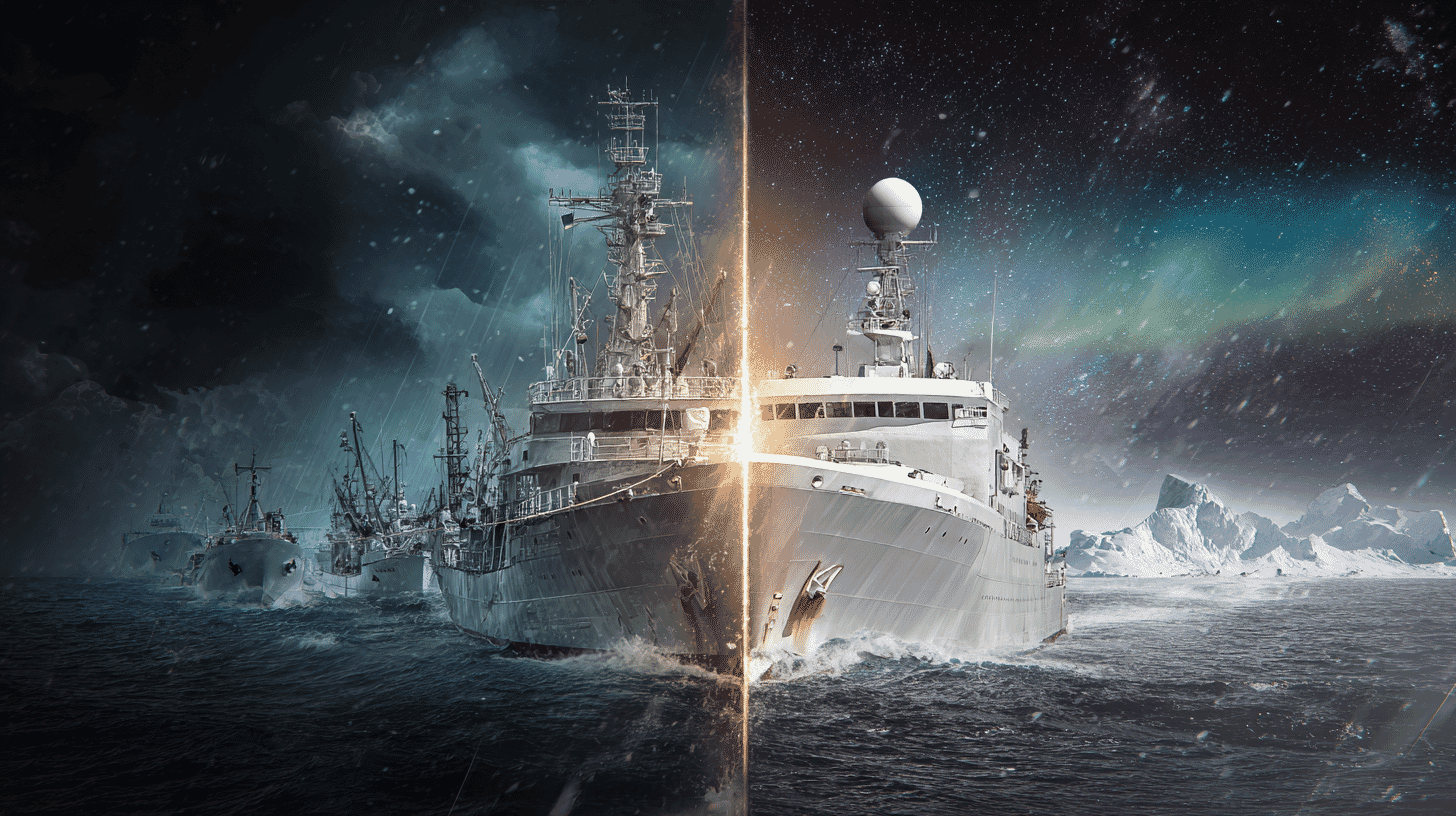
Did you know Japan's first nuclear ship was reborn as one of the world's largest ocean research vessels? In 1974, the nuclear-powered ship "Mutsu" suffered a radiation leak and became a symbol of failure. But engineers literally cut the hull in half, removed the reactor, and spent roughly $130 million transforming it into the ocean research vessel "Mirai." Over the next 28 years, it sailed 2.3 million km, equivalent to 58 trips around Earth, and became a cornerstone of global ocean science. This is the story of how a failed project became Japan's pride in marine research.
The Birth and Fall of Japan's Nuclear Dream Ship
In the 1960s, the world was captivated by the peaceful potential of nuclear energy. Following the Soviet Union's icebreaker "Lenin" and America's cargo-passenger ship "Savannah," Japan embarked on building its own nuclear-powered vessel. In 1963, the Japan Nuclear Ship Development Agency was established, and construction began at Ishikawajima-Harima Heavy Industries (now IHI) in Tokyo.
On June 12, 1969, the nuclear ship "Mutsu" was launched in a grand ceremony attended by the Crown Prince and Princess, Prime Minister Eisaku Sato, and thousands of spectators. A commemorative stamp was even issued to mark the occasion, it was that big of a national event. Named after the city of Mutsu in Aomori Prefecture (where its home port was located), the ship measured approximately 130 meters in length with a gross tonnage of about 8,200 tons, powered by a pressurized water reactor built by Mitsubishi Atomic Power Industries.
But trouble came swiftly. On September 1, 1974, during a power-increase test in the Pacific Ocean, a radiation leak was detected, fast neutrons were escaping through gaps in the shielding structure due to a design flaw. Critically, this was a "radiation leak" (escaping neutrons), not a "radioactive material leak" (nuclear fuel escaping). However, Japanese media at the time frequently conflated the two terms, and public backlash was fierce. Over 100 fishing boats blockaded the ship's home port of Ominato, preventing Mutsu from returning. The vessel was forced to drift in the Pacific for approximately 50 days.
Shielding repair work was eventually carried out in Sasebo, Nagasaki Prefecture. A new home port was constructed at Sekine-hama in Mutsu City at a staggering cost of roughly $650 million (at the time). Mutsu finally began its experimental voyages in 1991, covering approximately 82,000 km (about twice around the Earth) under nuclear power. The technical results were impressive, but by then, the decision to decommission the ship had already been made. All voyages ended in 1992, and the total project cost had ballooned to roughly ten times the original budget.
The Unprecedented "Rebirth Surgery"
While Mutsu's nuclear career was over, its robust hull was still in excellent condition. As it happened, the Japan Marine Science and Technology Center (now JAMSTEC, Japan Agency for Marine-Earth Science and Technology) desperately needed a large research vessel. The devastating El Niño events of the 1980s had caused worldwide agricultural damage, and the urgency of climate change research was growing rapidly.
Some argued it would be cheaper to build a brand-new ship from scratch. But the desire to preserve and repurpose Mutsu won out, and an unprecedented conversion project was set in motion.
The conversion was nothing short of surgical. Engineers cut the hull apart at the front and back of the reactor compartment. After removing the reactor section, the front half was loaded onto a barge and transported by sea from Aomori to Tokyo Bay. At IHI's Tokyo shipyard, the very place where Mutsu was born, the forward hull was fitted with ice-strengthened bow plating for Arctic operations, along with bow thrusters and a sonar dome.
The rear hull was essentially rebuilt from the ground up at Mitsubishi Heavy Industries' Shimonoseki shipyard, equipped with four diesel engines and twin variable-pitch propellers. In August 1996, the two halves were joined together, and the vessel was christened "Mirai" (meaning "future" in Japanese) in its second launch ceremony, 27 years after the first. The conversion cost approximately $130 million. Engineers from IHI and Mitsubishi Heavy Industries reportedly shared even their proprietary trade secrets with each other to make this extraordinary project succeed.
JAMSTEC's Yuta Yamamuro reflected: "If we had built a completely new ship from scratch, it wouldn't have been this large. It was precisely because we converted Mutsu that we ended up with such a big, storm-resistant vessel."
Mirai: A Giant of Ocean Research
When Mirai entered service in October 1997, it was Japan's largest and one of the world's premier ocean research vessels. At 8,706 gross tons and 128.58 meters long, it could travel approximately 22,000 km without refueling and conduct observation voyages lasting up to 60 days without stopping at any port. The ship could accommodate 34 crew members and 46 researchers, with 13 dedicated laboratories onboard.
Mirai's greatest strength was its versatility. It could simultaneously conduct research across ocean, atmosphere, biology, and seafloor domains. The ship was equipped with a large CTD water sampling system for analyzing seawater composition, multi-narrow beam echo sounders for precise seafloor mapping, and a ship-mounted Doppler weather radar, one of only a handful of such installations worldwide, alongside NOAA's research vessel "Ronald H. Brown."
The sturdy hull inherited from Mutsu, combined with a roll-reduction system, allowed Mirai to collect high-quality data even in rough seas where other research ships couldn't operate. During a 2009 trans-Pacific voyage, Mirai successfully conducted observations near latitude 40°S, the notorious "Roaring Forties", demonstrating its exceptional seaworthiness to the global scientific community.
The numbers from Mirai's 28-year career are staggering: 268 voyages, approximately 2.3 million km sailed (about 58 times around the Earth), and over 8,157 researchers carried. The ship completed 23 Arctic Ocean expeditions and traversed every major ocean, from the equatorial Pacific and Indian Ocean to the Atlantic and all the way around the Southern Hemisphere.
A Strange Twist of Fate: Surveying Fukushima
Perhaps the most poignant chapter in Mirai's story came in March 2011, when the ship was deployed to survey marine contamination following the Fukushima Daiichi nuclear disaster. A vessel that had ended its nuclear career because of a radiation incident was now investigating the ocean impact of a nuclear power plant meltdown.
JAMSTEC senior researcher Makio Honda remarked: "I felt a strange connection in the fact that Mutsu, which had been 'imprisoned' for so long after its radiation leak, was reborn as Mirai and then mobilized to investigate the Fukushima nuclear accident." The irony of a ship once derailed by nuclear controversy becoming an instrument of nuclear disaster science remains one of the most moving episodes in this vessel's extraordinary story.
Ghosts of Mutsu on the Bow
On Mirai's bow, the name "MIRAI みらい" was painted over the faintly visible letters "MUTSU むつ", the old name deliberately left as a ghost trace. Amidships, the welding seam where the front and rear hull sections were joined was clearly visible. According to those involved, these marks were intentionally preserved so that "those who knew Mutsu could feel a sense of nostalgia."
For the researchers who sailed on her, Mirai was far more than a scientific tool, it was like a second home. JAMSTEC Arctic researcher Amane Fujiwara shared: "My total time aboard Mirai is nearly two years. Since becoming an adult, I've spent more time on Mirai than visiting my parents' house. Maybe that's why just stepping aboard and smelling the diesel fumes makes me happy."
Retirement, and the Torch Passes to Mirai II
On November 29, 2025, Mirai returned to Shimizu Port after a 35-day Arctic research voyage, bringing the curtain down on 28 years of active service. On January 25, 2026, the ship's final public viewing was held at Yokosuka Port, where approximately 3,300 visitors lined up from early morning to tour the vessel one last time. More than 55 years after its launch as Mutsu, the long, long voyage had finally come to an end.
But the story doesn't end there. At JMU (Japan Marine United) shipyard in Isogo, Yokohama, construction is underway on the successor vessel, the Arctic Research Ship "Mirai II." At 13,000 gross tons and a construction cost of approximately $220 million, it will be Japan's first research ship with icebreaking capability, able to navigate through sea ice up to 1.2 meters thick. It will also serve as a mother ship for underwater drones and can function as a hospital ship during natural disasters. Delivery is scheduled for November 2026.
From Mirai to Mirai II. The legacy born from failure has been woven over 28 years and will now be carried forward by the next generation. This story, a triumph of Japan's mottainai philosophy (the deep-rooted belief that nothing should go to waste), stands as a remarkable example of how failure and reinvention can coexist in science and technology.
Does your country have examples of repurposing assets from failed projects into major successes? What ocean research initiatives exist in your part of the world?
References
- https://trafficnews.jp/post/631614
- https://www.jamstec.go.jp/mirai1997-2025/
- https://www.jamstec.go.jp/j/about/equipment/ships/mirai.html
- https://www.jiji.com/jc/v8?id=202409hokkyoku-r-03
- https://www.jamstec.go.jp/j/pr/topics/explore-20251210/
- https://en.wikipedia.org/wiki/Mutsu_(nuclear_ship)
- https://en.wikipedia.org/wiki/RV_Mirai





Global Discussion
15 comments