
EVs, data centers and renewable energy all depend on one component most people have never heard of: the power semiconductor. These chips control how electricity flows through everything from an air conditioner to a bullet train. Japan is now staging one of the biggest shakeups in the industry's history.
Rohm, Toshiba and Mitsubishi Electric have opened talks to merge their power semiconductor businesses. If the deal goes through, it would create the world's No. 2 power semiconductor alliance, behind only Germany's Infineon. And in the background, Toyota-affiliated Denso had thrown an $8.3 billion buyout bid for Rohm into the mix.
What Power Semiconductors Actually Do
Think of power semiconductors as the "traffic controllers" of electricity. Unlike the processors in your phone that handle calculations, power semiconductors manage how electrical energy is converted, regulated, and distributed.
They're in your refrigerator (making the compressor energy-efficient), in electric trains (controlling massive motors), and critically, in every electric vehicle on the road. An EV uses several times more power semiconductor content than a gasoline car, making these chips essential to the clean energy transition.
The global power semiconductor market was worth roughly $20 billion in 2023 and is projected to grow to over $50 billion by 2035, according to Fuji Keizai research. The explosive growth is driven by EVs, AI-powered data centers, and renewable energy infrastructure.
A No. 2 Alliance, On Paper
On March 27, 2026, Rohm, Toshiba, Mitsubishi Electric and Toshiba's owners, Japan Industrial Partners (JIP) and TBJ Holdings, announced they had signed a basic agreement to open discussions on merging their power semiconductor operations.
According to market research firm Omdia, in 2024 global power semiconductor sales rankings, Mitsubishi Electric ranked 4th, Toshiba 10th, and Rohm 12th. Combined, they would hold roughly 10% of the global market, making them the No. 2 player behind Germany's Infineon Technologies, at about 25%.
The merger scope includes Rohm's entire operations, Toshiba Device & Storage's semiconductor business, and Mitsubishi Electric's power device division. In revenue terms, Rohm (projected ¥480 billion / ~$3.1 billion for fiscal year 2026), Mitsubishi Electric's semiconductor division (~¥290 billion / ~$1.9 billion), and Toshiba's semiconductor business (¥445.4 billion / ~$2.9 billion in fiscal 2023) would combine into a powerhouse exceeding $7 billion.
The parties said the deal should "achieve a business scale and technological foundation capable of competing in the global market," and will explore options including a joint venture, factory consolidation and streamlined production. Rohm and Toshiba Device & Storage are also due to receive up to ¥129.4 billion in METI subsidies to secure power semiconductor supply, a plan Rohm says Mitsubishi Electric's arrival does not change.
Why These Three Companies Fit
The merger makes strong technical sense because each company brings distinct strengths that complement the others.
Rohm is a pioneer in next-generation SiC (silicon carbide) power semiconductors. It achieved the world's first mass production of SiC-MOSFETs in 2010, and has built a vertically integrated supply chain around German SiC wafer maker SiCrystal, which it acquired in 2009. On GaN (gallium nitride), TSMC's decision to exit the GaN foundry business forced Rohm's hand: on February 26, 2026, Rohm took a technology license from TSMC and said it would move 650V GaN production in-house on an 8-inch line at its Hamamatsu plant.
Toshiba has extensive product lines in conventional silicon power semiconductors and operates cutting-edge 300mm wafer production lines at its Kaga factory. Its strength lies in high-voltage products for EVs and industrial equipment.
Mitsubishi Electric is Japan's top power semiconductor company by market share, renowned for high-voltage, high-capacity IGBT modules used in railway systems and industrial machinery.
Together, the three would cover silicon, SiC, and GaN materials, voltage ranges from tens of volts to several thousand volts, and applications across automotive, industrial, and consumer markets.
The Denso Subplot: An $8.3 Billion Buyout Bid
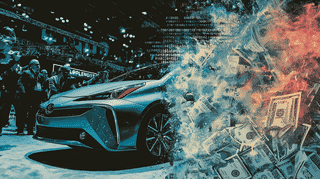
Behind the merger talks ran a dramatic subplot. Denso, Toyota Group's core automotive components company, proposed to acquire all of Rohm's shares. Rohm confirmed on March 6, 2026, that it had received the proposal; reporting put it at roughly ¥1.3 trillion ($8.3 billion) via a tender offer. Rohm's stock closed limit-up that day, 18% higher.
The two companies' relationship dates to a September 2024 tie-up in analog semiconductors, followed by a strategic partnership agreement in May 2025 and, by July 2025, a Denso stake in Rohm of just under 5%.
Denso's strategy was vertical integration. It holds the world's leading share in automotive inverters but buys in the power semiconductors that determine how well those inverters perform, and it wanted that dependency gone. The Rohm-Toshiba-Mitsubishi Electric plan is horizontal integration: peers combining to reach scale.
The battle for Rohm is already settled. On April 28, 2026, Denso withdrew the proposal, saying it had not obtained Rohm's agreement and that the deal would not raise its own corporate value. The same day it announced a buyback of its own shares worth up to roughly ¥313.6 billion. Rohm chose the horizontal path.
The Infineon Gap: Reality Check
Even if the merger succeeds, the gap with Infineon remains substantial. The German giant generates roughly €9 billion (~$9.8 billion) in power semiconductor revenue alone, commanding about 25% of the global market. It's followed by onsemi (US, ~10%) and STMicroelectronics (France/Italy), both investing aggressively.
In the SiC space, competition is particularly fierce. Infineon is building a massive facility in Malaysia with over €2 billion in investment. STMicro has new factories in Italy and a joint venture with China's Sanan Optoelectronics. Onsemi is expanding production in the Czech Republic and the United States.
Japan's individual companies have been stuck in single-digit market shares, unable to match the investment scale of Western rivals. Japan's Ministry of Economy, Trade and Industry (METI) has actively encouraged industry consolidation, and there is a shared understanding between government and industry that "only through integration can Japan compete globally."
The Demand Explosion: EV, AI, and Green Energy
Three mega-trends are fueling power semiconductor demand.
Electric vehicles are the biggest driver. Every EV needs power semiconductors for its inverter, the device that converts battery power to drive the motor. SiC chips are especially prized because they dramatically reduce energy loss, extending driving range without adding battery weight. Tesla popularized SiC adoption, and nearly every major automaker is following suit.
Data centers are the second growth engine. The AI boom is driving unprecedented demand for energy-efficient server power supplies, where power semiconductors play a crucial role.
Renewable energy rounds out the trio. Solar inverters, battery storage systems, and smart grid infrastructure all rely heavily on power semiconductors.
Next-generation power semiconductors (SiC and GaN) are projected to account for about 45% of the total market by 2035, up from a fraction today. Technological leadership in these materials will determine future market positions.
Lessons from Japan's Past: Will History Repeat?
Japan's government-led semiconductor restructuring has a mixed track record. Japan Display Inc. (JDI), formed in 2012 by merging display businesses from Sony, Toshiba, and Hitachi, eventually lost to Korean and Chinese rivals and fell into financial distress. Elpida Memory, Japan's last DRAM maker, met a similar fate.
For this merger to avoid the same trap, it has to deliver technological fit rather than combined headcount. The complementary strengths are clear enough: Rohm's SiC vertical integration, Toshiba's 300mm lines, Mitsubishi Electric's module expertise. That sets it apart from past patchwork mergers.
However, challenges remain: aligning three different corporate cultures, managing the time-consuming integration process, and maintaining competitive speed in a rapidly evolving market. China's aggressive price competition won't wait for Japan to get organized.
The Shape of the Merger Is Still Undecided
With Denso out, Rohm has committed to the horizontal path. What that path looks like in practice is another matter. On April 28, 2026, Mitsubishi Electric President Kei Uruma said he wanted to carve out all three companies' power semiconductor businesses into a single joint venture, and that this would have to proceed separately from the broader semiconductor merger Rohm and Toshiba are pursuing first.
In other words, the three are not necessarily looking at the same picture. "World No. 2" is a number you get by adding shares together; whether it becomes one company is a matter of negotiation. The reason JDI and Elpida still come up is that in both cases the scale argument arrived first and the substance came later.
What's the power semiconductor situation like in your country? Are there similar industry consolidation stories in the EV or clean energy supply chain? We'd love to hear your perspective.
References
- https://www.nikkei.com/article/DGXZQOUC272BV0X20C26A3000000/
- https://www.nikkei.com/article/DGXZQOUC2686Z0W6A320C2000000/
- https://xtech.nikkei.com/atcl/nxt/column/18/00001/11624/
- https://www.bloomberg.com/jp/news/articles/2026-03-27/TBYSEGT96OSY00
- https://response.jp/article/2026/03/27/409220.html
- https://www.meti.go.jp/press/2024/12/20241227006/20241227006-13.pdf








Global Discussion
12 comments