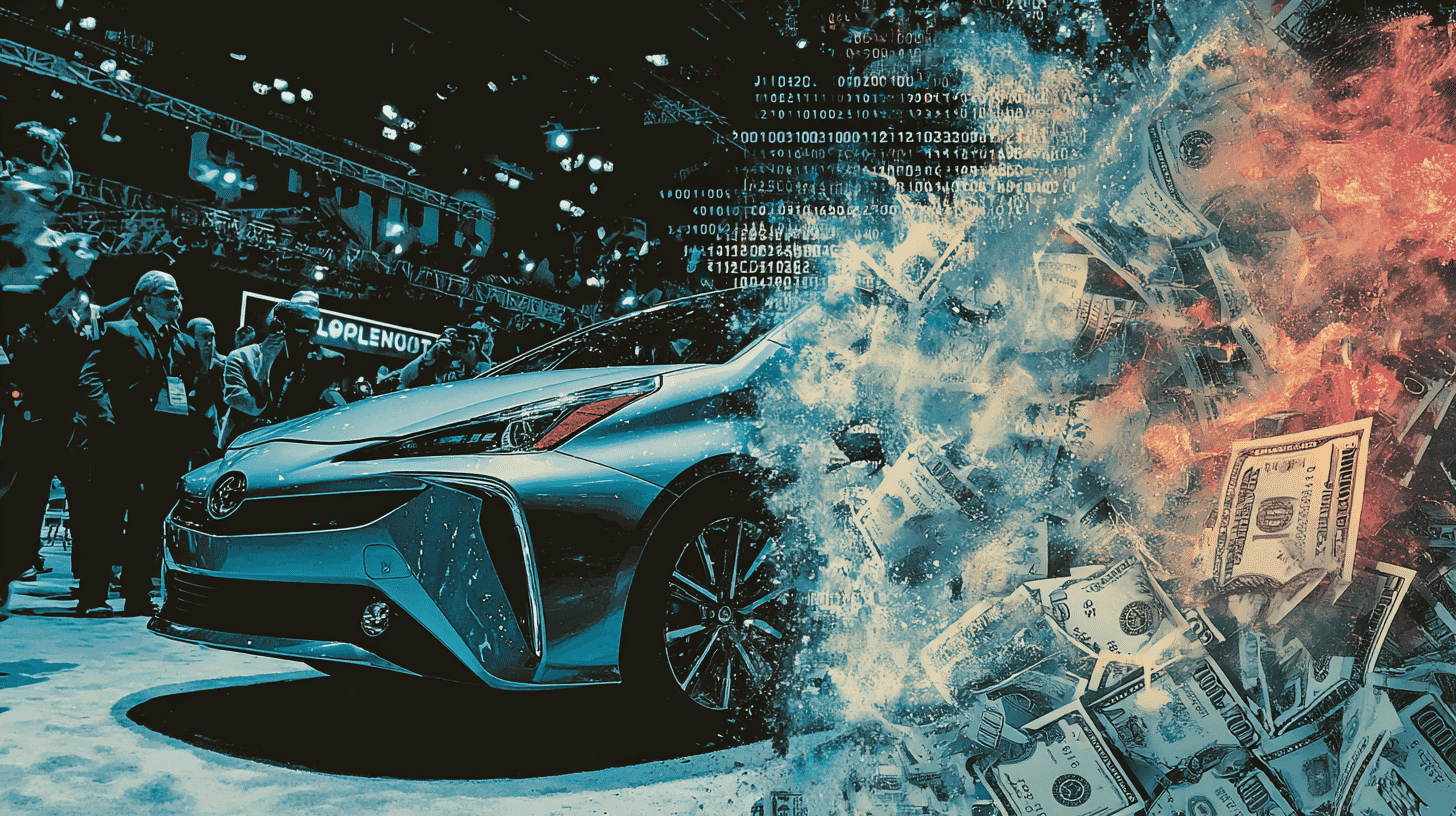
Two months after a flashy debut at CES 2026, Sony and Honda pulled the plug on their joint EV, AFEELA. Not a single car will reach a customer. Behind the collapse: Honda's first annual loss since going public, a US EV policy reversal, and a Chinese EV industry that changed the maths.
The Dream Dies Before Launch Day
On March 25, 2026, Sony Honda Mobility (SHM) announced a decision that stunned the industry: the complete cancellation of development and sales for both the AFEELA 1 sedan and its upcoming SUV variant.
The AFEELA 1, priced at roughly $90,000, was supposed to start deliveries in California later this year. Reservation holders will receive full refunds. A second model, an SUV prototype unveiled just two months earlier at CES 2026, has also been scrapped entirely.
At that same CES show in January, SHM proudly displayed pre-production vehicles, showed off PS5 Remote Play integration for in-car gaming, and announced bold plans for a 2028 SUV launch. The mood was celebratory, forward-looking, optimistic.
So what went wrong in just 60 days?
Honda's "Zero Engine" Pledge Unravels
The story begins in 2021 when Honda CEO Toshihiro Mibe made a bold promise: by 2040, every new Honda sold worldwide would be either an EV or a fuel-cell vehicle. No more gasoline engines. It was the most aggressive electrification commitment among Japanese automakers.
Honda poured billions into this vision. The company launched the "Honda 0 Series" brand for next-generation EVs targeting North America. It partnered with General Motors and South Korea's LG Energy Solution on battery joint ventures. Everything was oriented toward an all-electric future.
Then the ground shifted.
When Donald Trump returned to the White House, his administration systematically dismantled the EV-friendly policies of the Biden era. Federal EV tax credits were eliminated. California-led emissions regulations were rolled back. The U.S. EV market, which was supposed to be AFEELA's primary battleground, began contracting sharply.
Meanwhile, Honda's aggressive pivot toward EVs had starved its conventional car lineup of development resources. In Asian markets, Honda's gasoline and hybrid vehicles lost competitiveness. Its automotive division bled profitability.
As we reported earlier, on March 12 Honda announced the cancellation of three North American EV models, the Zero SUV, Zero Saloon, and Acura RSX. The stated reason: with California's emissions rules effectively withdrawn, there was no longer a visible path for EV sales.
Honda booked an additional ¥820 billion to ¥1.12 trillion in operating costs into its fiscal 2026 forecast, plus ¥110 billion to ¥150 billion in equity-method investment losses. Counting plant write-offs, development impairments and supplier compensation, total losses have been estimated at up to ¥2.5 trillion (about $16 billion). The result: a net loss of up to ¥690 billion (about $4.6 billion) for fiscal 2026, Honda's first annual loss since going public.
Honda has also effectively abandoned its 2040 zero-engine target.
What AFEELA Meant for Sony
For Sony, AFEELA was never just about building cars. It was about creating a new entertainment space on wheels.
The vision: passengers would stream PlayStation games, watch anime, enjoy spatial audio, turning every car ride into an entertainment experience. As autonomous driving matures, Sony reasoned, commute time becomes content consumption time. The car becomes a living room.
But there was a fundamental dependency. Honda provided the vehicle platform, battery technology, production lines, and manufacturing expertise. Sony brought the software and entertainment layer. When Honda pulled the plug on its EV architecture, the hardware foundation for AFEELA simply ceased to exist.
Honda had reportedly asked Sony whether it wanted to continue the venture independently. Sony concluded it was no longer viable.
SHM had already accumulated an estimated $362 million in losses. The final tally could be significantly higher.
The Global EV Winter
AFEELA is far from the only casualty. The global EV market is experiencing what many analysts are calling an "EV winter."
Ford ended F-150 Lightning production in December and recorded $19.5 billion in EV-related write-downs. Stellantis scrapped multiple battery-electric programs, taking over $26 billion in one-time charges. More than 20 brands, including Hyundai, Nissan, Volkswagen, Volvo, Kia, and Polestar, have delayed or cancelled EV projects.
The contrast with China couldn't be starker. BYD, backed by massive government support and ruthless cost efficiency, surpassed Tesla in global EV sales in 2024. BYD's mainstream EVs sell for $15,000 to $30,000, a fraction of AFEELA's $90,000 price tag. A recent survey by the China Automobile Dealers Association found that 56% of Chinese dealers lost money in 2025, highlighting the brutal price war even in the world's largest EV market.
Tesla, meanwhile, has built competitive advantages through vertical integration, direct sales (bypassing traditional dealerships), and aggressive cost-cutting. Japanese automakers like Honda, which rely on conventional dealer networks and lack Tesla's manufacturing scale in EVs, face structural disadvantages that go beyond product development.
Honda's Plan B
With its EV ambitions in retreat, Honda is pivoting to what it calls a "pragmatic" strategy centered on hybrid vehicles (HVs).
Starting in 2027, Honda plans to roll out a new generation of hybrid models in the U.S. market. India is being positioned as a key growth market to replace slowing Chinese sales. The Japanese concept of "zenhōi senryaku" (全方位戦略, or "all-direction strategy"), championed by rival Toyota, is now being grudgingly adopted by Honda too.
But Honda faces steep challenges. It currently offers only about four hybrid models in North America, compared to Toyota's 17 and Hyundai's 15. Building out a competitive hybrid lineup from this position will require massive new investment on top of the $16 billion already lost on EVs.
It's a painful irony: Toyota, long criticized for being slow on EVs, is now in the strongest position among Japanese automakers precisely because it never abandoned hybrids and gasoline vehicles. The tortoise, it seems, has won this race.
What Happened Next: SHM Scales Down
The answer came a month later.
On April 21, 2026, Sony, Honda and SHM announced they had agreed on the joint venture's direction. The conclusion: for the time being, SHM will restructure and scale down its operations. Under the existing framework, the three concluded, bringing products and services to market in line with SHM's founding purpose was not achievable in the short to medium term.
SHM's employees will, in principle, all be reassigned to Sony, Honda and related companies, taking their own preferences into account. This is not dissolution. But SHM as a company that builds and sells electric cars ended here.
The three companies say the founding principle, contributing to and leading the evolution of mobility, is unchanged, and that they will keep working with software as advanced driver assistance becomes mainstream. You could read that as the product moving from the car to the code.
A Bell That Never Rang
As one Japanese business publication put it, the Sony-Honda partnership, a tag team of two iconic companies born in the entrepreneurial spirit of postwar Japan, never even heard the opening bell.
SHM was founded in September 2022. Three and a half years later, it has been unwound without selling a single car.
The AFEELA saga crystallizes the challenges facing Japan's auto industry: navigating unpredictable policy shifts in key markets, competing on cost against Chinese manufacturers, adapting to direct-to-consumer sales models, and making the right bet on which technology will power the next generation of vehicles.
In Japan, reactions range from "Toyota's balanced approach was right all along" to "Honda should focus on its dominant motorcycle business" to "EVs are still inevitable in the long run." What's the EV situation like in your country? How do you feel about automakers reversing their electrification plans? We'd love to hear your perspective!
References
- https://www.shm-afeela.com/en/news/2026-03-25/
- https://techcrunch.com/2026/03/25/sony-honda-mobility-afeela-ev-project/
- https://global.honda/jp/news/2026/c260312.html
- https://insideevs.com/news/791060/sony-honda-afeela-evs-canceled/
- https://www.engadget.com/transportation/evs/sony-and-honda-kill-its-afeela-evs-100426852.html







Global Discussion
15 comments