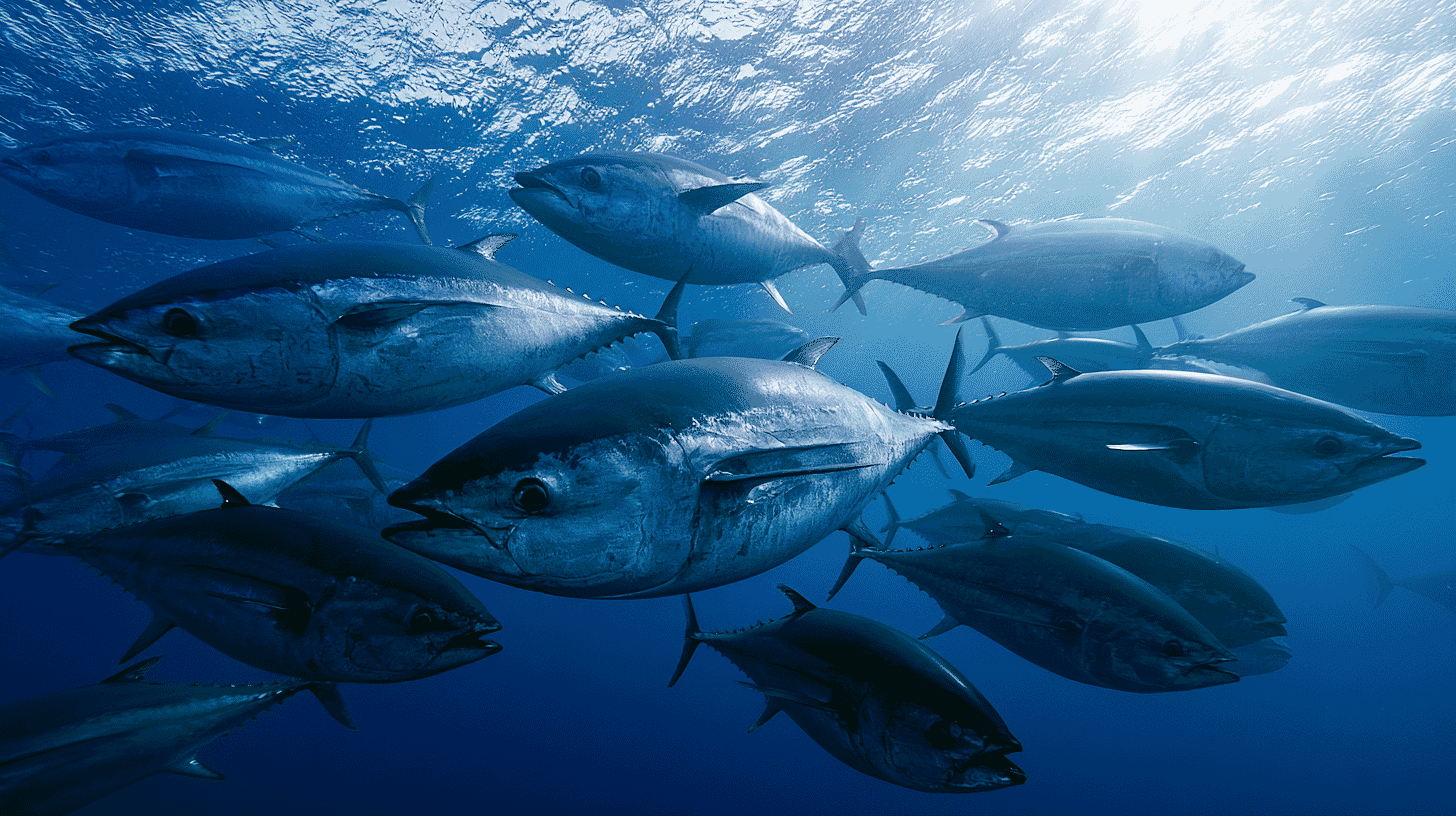
🐟 For ten years, the story of Pacific bluefin tuna was a rescue operation. On August 18, the countries that fish it agreed on something different: a 25 percent increase in the quota for big adult tuna. Japan spent a month of hard diplomacy getting there. The same deal also installs a rule that recalculates quotas automatically from the size of the stock.
What the deal actually says
Pacific bluefin (Thunnus orientalis) is managed across two halves of an ocean by two separate bodies. The Western and Central Pacific Fisheries Commission covers the side where Japan, South Korea and Taiwan fish. The Inter-American Tropical Tuna Commission covers the eastern side, where Mexico and the United States operate. Since the fish swims across both, the two commissions negotiate through a joint working group, which is what met online on August 18.
On the western side, the annual quota for tuna weighing 30 kilograms or more rises from 11,869 to 14,836 metric tons. That is the headline 25 percent, and in absolute terms it means 2,967 extra tons of adult tuna a year. Going the other way, the quota for fish under 30 kilograms drops from 5,125 to 4,823 tons, a cut of roughly 6 percent. In the east, where catches are not split by size, the ceiling nudges up from 7,581 to 7,740 tons. The limits cover 2027 and 2028, and still need formal approval at the IATTC annual meeting in Lisbon from August 31 to September 4 and at the WCPFC annual meeting in November, both in 2026.
Juveniles are the fish that would have spawned later, so cutting them protects the future stock. Adults are the fish that end up on a sushi counter.
Members also signed off on a new management system that recalculates quotas automatically from the measured size of the stock, rather than sending diplomats back into a room to argue every couple of years. Fisheries scientists and conservation groups have wanted this for Pacific bluefin for a long time.
The deal that collapsed in July
This was not supposed to take until August. In Nagasaki, from July 8 to 14, the two commissions' joint working group had the Japanese proposal essentially settled. Then, near the end, Mexico raised the balance between the eastern and western halves of the Pacific and the talks fell apart. That balance is not an abstraction. WCPFC material puts the western and central Pacific fleets at roughly 83 percent of the total fishing impact on the stock in 2022, against about 17 percent for the eastern side, and how that ratio is written into the new rules decides how big the quotas come out. According to negotiators cited by Kyodo News, Mexico had hardened over a worry that the western side, Japan included, would land more fish than the numbers implied.
Japan's Fisheries Agency did not hide its irritation. Deputy Director-General Takumi Fukuda told reporters at the time that one country's unreasonable conduct had blocked an agreement and that he felt strong anger about it.
In late July, Vice-Minister of Agriculture, Forestry and Fisheries Yuhei Yamashita flew to Mexico City to meet his counterpart at the agriculture and rural development ministry. TV Asahi reported that the conversation ranged well past tuna, into diversifying Mexican farm exports such as cacao, coffee, avocados and honey. Mexico reversed its position, an online session was called for August 18, and the text that passed was close to what Japan had wanted in the first place. Asked why Mexico moved, a Fisheries Agency official declined to elaborate, saying only that nothing had been altered in response to the objection.
From 2 percent to 23 percent
Around 2010 the spawning stock of Pacific bluefin bottomed out at roughly 12,000 tons. NOAA Fisheries describes the level in those years as about 2 percent of the population's estimated unfished size, which is close to the point where a commercial fishery stops being a fishery. From 2015, catches of fish under 30 kilograms were cut to half the 2002 to 2004 average. From 2017, catches of fish over 30 kilograms were capped at that same average.
The 2024 stock assessment by the International Scientific Committee found the spawning stock at about 144,000 tons in 2022, or 23.2 percent of the unfished level, roughly twelve times the 2010 floor. The rebuilding target had been 20 percent by 2034. It was reached in 2021, thirteen years ahead of schedule.
The boats that had to throw tuna back
Japan's stake in this is not subtle. WWF Japan describes Japan as the world's largest consumer of Pacific bluefin, taking more than 70 percent of it.
Recovery has produced a problem Japanese fishing towns did not have a decade ago: too many tuna. Bluefin now show up in such volume that they interfere with set nets meant for mackerel and yellowtail, and crews that hit their quota have had to release fish back into the water rather than land them. The head of a Hakodate market association told TV Asahi that a bigger quota was welcome news, since more tuna landed means cheaper tuna sold, and both the trade and the consumer come out ahead.
Japan's own national allocation currently sits at 8,421 tons of large fish and 4,407 tons of small. How the enlarged western quota gets divided among Japan, South Korea and Taiwan has not been settled, and that negotiation is still to come.
Will sushi actually get cheaper?
Japanese broadcasters ran the quota news alongside cheerful shots of tuna counters, and restaurant operators told them they hoped to pass savings on. But Asahi Shimbun notes that Pacific-caught bluefin is a modest share of Japan's domestic market, and that any price effect is more likely to arrive indirectly, through cheaper imports from countries whose quotas also went up. A lot of what reaches Japanese counters is farmed or imported, and total supply came to around 33,000 tons in 2022. An extra 2,967 tons across the entire western Pacific is meaningful without being transformative.
A 243-kilogram bluefin sold for 510.3 million yen, about 3.2 million dollars, at Toyosu's New Year auction on January 5, 2026. That was a ceremonial price paid for publicity, not a signal about supply.
What conservation groups are still watching
The Pew Charitable Trusts called for a moratorium on commercial Pacific bluefin fishing in 2016. Pew has since campaigned for the kind of automatic rulebook that August 18 delivered, arguing that pre-agreed rules let managers respond to a downturn before it becomes a crisis, instead of negotiating their way out of one.
When the July meeting failed, Dave Gershman, who leads Pew's work with Pacific fisheries bodies, said governments had put near-term commercial gain and bigger quotas ahead of the fishery's long-term health, and noted that Pacific bluefin was the only bluefin stock still without a modernized precautionary system. Pew's broader concern has been that under the old arrangement, managers could raise quotas outside of scientific advice, and that a recovery this young can reverse quickly.
Atlantic bluefin got the same kind of rulebook from ICCAT in November 2022, which left the Pacific stock as the last one waiting. The August package now gives conservationists the mechanism they asked for and hands the fishing nations the increase they asked for. Whether those two things sit comfortably together is the question the next stock assessment will answer.
In the Atlantic, the numbers are larger
Atlantic bluefin (Thunnus thynnus) is a different species with a similar history: near-collapse, a recovery plan launched by the EU and ICCAT in 2007, and a comeback. At ICCAT's annual meeting from November 17 to 24, 2025, members agreed to raise the total allowable catch for eastern Atlantic and Mediterranean bluefin by 17 percent, to 48,403 tons a year for three years. The EU's own share went up by 3,661 tons to 25,164 tons.
Add every Pacific bluefin quota together, east and west, large and small, and the 2027 figure comes to roughly 27,400 tons. The eastern Atlantic and Mediterranean alone will be catching nearly twice that.
Japan's argument is that its restraint since 2015 earned this increase. Critics counter that the surest way to lose a recovery is to spend it. Where you live, is bluefin talked about as something to protect, or as something to eat?
References
- https://news.yahoo.co.jp/articles/0b3c7416d3d28bbed7843b679783edc75e305545
- https://japantoday.com/category/business/deal-reached-to-expand-bluefin-tuna-fishing-quotas
- https://www.nikkei.com/article/DGXZQOUA1416M0U6A810C2000000/
- https://news.yahoo.co.jp/articles/6f9701fd2e3bc21d1ae928add10143c79dcef59c
- https://news.yahoo.co.jp/articles/aaa2d299616fc710615ce9723a4d8b47c56873d9
- https://www.wcpfc.int/sustainability/conservation-and-management-tuna-and-billfish-species/pacific-bluefin-tuna-extended
- https://www.fisheries.noaa.gov/feature-story/overfished-sustainable-harvests-pacific-bluefin-tuna-rebound-new-highs
- https://www8.cao.go.jp/kisei-kaikaku/kisei/meeting/wg/2210_04local/230518/local07_02.pdf
- https://www.wwf.or.jp/activities/news/5718.html
- https://www.seafoodsource.com/news/pacific-bluefin-tuna-working-group-meeting-ends-without-recommendations
- https://www.pew.org/en/research-and-analysis/articles/2026/08/04/eastern-pacific-tunas-poised-for-significant-progress-on-sustainability
- https://www.fisheries.noaa.gov/feature-story/us-leadership-iccat-contributes-adoption-historic-management-procedure-atlantic
- https://oceans-and-fisheries.ec.europa.eu/news/eu-secures-17-increase-bluefin-tuna-fishing-quota-iccat-annual-meeting-2025-11-27_en
- https://s.mxtv.jp/tokyomxplus/mx/article/202601061020/detail/









Global Discussion
4 comments