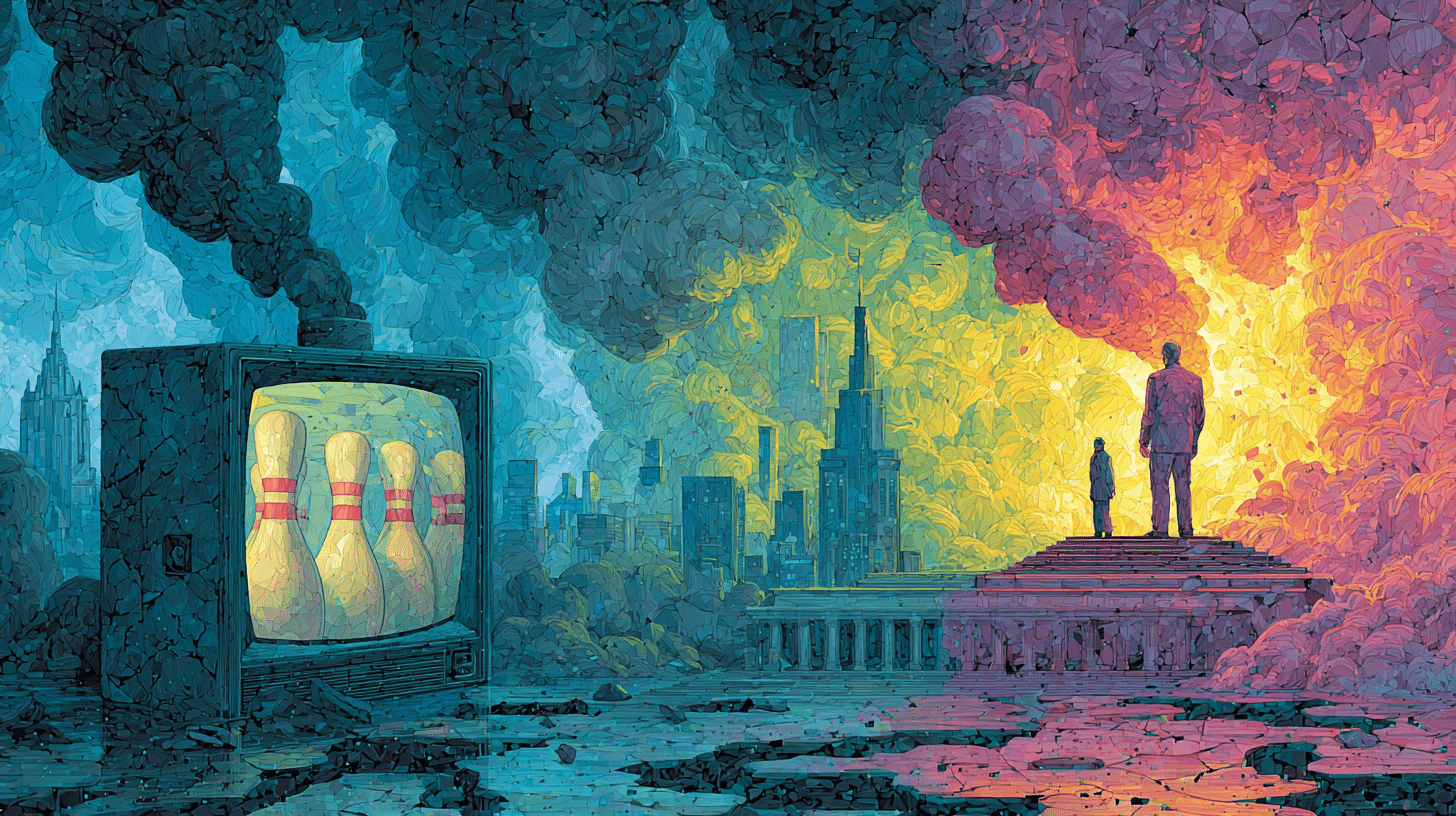
Upbeat Wii Sports music, cartoon characters hitting balls, cheerful "Hole in One" and "Strike" graphics, all cut with real footage of U.S. strikes killing people in Iran. That's the propaganda video the White House posted on X, and now Japan's top diplomat has stepped into the fray, publicly scolding the Trump administration at a Diet committee hearing. With Nintendo already suing the U.S. government over tariffs, the question everyone's asking is what happens next.
What Happened at the April 17 Diet Committee Meeting
On April 17, 2026, Japanese Foreign Minister Toshimitsu Motegi formally addressed the White House's controversial video during a House of Representatives Foreign Affairs Committee session. The video in question, posted to the White House's official X account on March 12, splices gameplay footage that appears to be from Nintendo's Wii Sports with real footage of U.S. military strikes on Iran. It racked up over 56 million views and 15,000 comments, the overwhelming majority of them negative.
Motegi avoided commenting on the video's content directly, but on the copyright angle, he was clear: "Generally speaking, even for public institutions, it is not appropriate to reproduce copyrighted works without the rightsholder's permission."
It sounds mild at first glance. But for Japan's Foreign Minister to publicly call out a specific action by an allied government, on the floor of the Diet, no less, is a notable diplomatic move. Read between the lines, and it's Tokyo signaling that this is not something it plans to quietly let slide.
The Video: "Operation Epic Fury" Meets Wii Sports
The Trump administration has branded the current Iran military campaign "Operation Epic Fury," and the video opens with that name rendered over a mock-up of the Wii's iconic startup screen. From there, it cycles through Wii Sports tennis, golf, bowling, baseball, and boxing gameplay. The moment a ball is struck, a pin falls, or a punch connects, the screen cuts to actual bombing footage of targets in Iran.
A golf hole-in-one? The explosion comes with a "Hole in One" caption. A bowling strike? "Strike!" appears over the bombing clip. A home run gets a flashy "Out of the Park" treatment. The entire thing plays against the cheerful Wii Sports theme music. The caption: a single word, "UNDEFEATED."
Nintendo has not issued a statement, and based on reporting from major Japanese and U.S. outlets, no evidence suggests the company granted permission for any of this.
Not a One-Off: A Pattern of Unauthorized Japanese IP Use
What makes this incident more than just another viral controversy is that it follows a clear pattern. Trump-era federal social media accounts have been helping themselves to Japanese IP for months now.
In September 2025, the Department of Homeland Security used Pokémon anime footage and music in a promotional video for ICE deportation raids. The Pokémon Company issued a statement clarifying it "has not authorized the use of our intellectual property."
On March 5, 2026, the White House posted an image mimicking the packaging of Nintendo's Pokémon title "Pokopia" (the localized title varies by region) with the slogan "MAKE AMERICA GREAT AGAIN" superimposed. On March 6, footage from the anime Yu-Gi-Oh! appeared in another White House video. The Yu-Gi-Oh! official account publicly rebuked the post, stating that "the rightsholders were not involved in any way, and no permission to use the intellectual property has been granted."
Then DHS posted a generative-AI video in the style of Animal Crossing: New Horizons, a game for which Nintendo explicitly published anti-political-use guidelines back in 2020.
The cumulative pattern makes the Wii Sports video impossible to dismiss as a one-time prank. Beloved Japanese franchises, many of them synonymous with peace, family, and joy, are being repurposed as vehicles for messages about military strikes and immigration crackdowns.
Nintendo Is Already Suing the U.S. Government
Context matters here: Nintendo and the U.S. government are already in open legal conflict.
On March 6, 2026, Nintendo of America filed suit in the U.S. Court of International Trade, demanding a full refund (with interest) of tariffs paid under Trump's IEEPA executive orders. The suit followed a February 2026 Supreme Court ruling that the IEEPA tariffs were unconstitutional. Nintendo is one of over 1,000 companies, including Costco, FedEx, and Toyota, to file similar cases.
Those tariffs forced Nintendo to delay Switch 2 preorders and raise accessory prices, causing significant financial damage estimated in the billions of yen. Which creates an almost absurd scenario: the same administration whose tariffs are squeezing Nintendo is also lifting Nintendo's IP for propaganda. Kotaku's writer observed that the White House seems to be "almost antagonizing" Nintendo in the wake of the lawsuit, and it's hard to disagree with that read.
Western Reaction: "War Is Not a Video Game"
The backlash online was immediate and near-universal. HuffPost reported that by the time the post had reached around 11.7 million views, the comments were "almost none of them positive." The criticism fell into several recognizable buckets:
Legal skepticism: "Does the U.S. government think copyright law doesn't apply to it?" "This clearly exceeds any fair use defense." "Nintendo sues fan emulator creators into oblivion, are they really going to let this slide?"
Rejection of the framing itself: "War is not a video game." "Whoever greenlit layering kid-friendly game footage over bombing is morally broken." "This video is itself a war crime in visual form." "I cannot believe an official account posted this."
Brand-damage concern: "This has ruined my perception of the Nintendo brand. I will never buy another Nintendo product." Many users replied directly to @NintendoAmerica's account, asking sarcastically, "Is this an official collaboration?"
On Reddit, r/gaming and r/politics both had multi-thousand-comment threads dissecting the legal, ethical, and political dimensions. A recurring observation: "Trump-era accounts seem to be deliberately provocative with IP use, as if daring rightsholders to sue."
Japanese Public Reaction: A Quieter, Sadder Anger
The Japanese-language reaction on social media carried a different tone from the English-speaking backlash. Wii Sports holds a unique place in Japanese households, it launched alongside the Wii in 2006 and became one of the few games that grandparents, parents, and kids all played together. The emotional bond is strong.
Comments centered on a few specific themes: deep disappointment ("seeing bombing footage synced to the bowling pin falling is genuinely painful"), betrayal of memory ("our family laughed together playing this game, now it's used like this"), and cultural awareness ("the whole world knows Nintendo hates political use of its IP, how was this approved?").
A uniquely Japanese angle also emerged: lively debate over what Nintendo itself should do. Nintendo is famously aggressive in defending its IP against emulators, fan projects, and even YouTube videos. The question "can they, or will they, take the same stance against the U.S. government?" has become a talking point, with some arguing that silence would betray the company's long-stated principles.
The Weight of "Even Public Institutions"
The most consequential phrase in Motegi's Diet statement is the small qualifier: "even for public institutions." That clause is doing a lot of work.
U.S. copyright law (the Copyright Act) provides for fair use, and its boundaries are sometimes interpreted generously. But legal scholars observing this case broadly agree that wholesale use of a commercial game's startup UI, music, and character animation, recombined with military footage for state propaganda, would be very difficult to defend as fair use.
When the party doing the using is the executive branch of a national government, the question goes beyond copyright law. An implicit power imbalance arises: a private company, even one as large as Nintendo, may feel reluctant to sue the U.S. government. That's the practical reality that makes a foreign government's public objection meaningful.
In that context, Motegi's "even for public institutions" functions as a kind of diplomatic insurance, a formal note from Tokyo saying: we see what's happening, and we consider this inappropriate. It gives Japanese companies political cover to push back if they choose to.
What Happens Next?
Nintendo remains publicly silent. Given the ongoing tariff lawsuit, its response will likely be measured. But international gaming media and legal commentators have started framing this as seed material for a second Nintendo v. White House case, this time over copyright rather than tariffs. If Nintendo does file, it would create precedent in a thinly explored area: the intersection of state propaganda and commercial IP.
There's also a broader diplomatic dimension. Motegi's statement quietly frames Japanese pop culture (anime, games, manga) as a national asset that deserves protection abroad. Pokémon. Yu-Gi-Oh!. Animal Crossing. Wii Sports. These are Japan's soft-power crown jewels, and the government appears to have decided that watching them get coopted for foreign political campaigns is no longer acceptable.
Games and war. Entertainment and propaganda. Copyright and state communication. Three lines that shouldn't cross are now tangled together in a way that feels uniquely of this moment. How these boundaries get drawn will shape not just Nintendo's next move, but how every country treats its creative industries as assets in an era when any government's social media team can grab anything and post it to millions.
What's the law in your country about government agencies using private companies' characters or game footage without permission? And how do you feel personally about game imagery being paired with real military strikes? Let us know in the comments.
References
- https://automaton-media.com/en/news/japans-foreign-affairs-minister-criticizes-white-house-over-unauthorized-use-of-nintendo-gameplay-footage-in-iran-war-campaign-video-on-x/
- https://automaton-media.com/articles/newsjp/20260417-438111/
- https://automaton-media.com/articles/newsjp/20260313-428810/
- https://www.timeextension.com/news/2026/03/war-is-not-a-video-game-white-house-social-media-post-mixing-iran-war-footage-with-nintendos-wii-sports-triggers-outcry
- https://kotaku.com/white-house-video-wii-sports-iran-israel-nintendo-lawsuit-2000678455
- https://www.huffpost.com/entry/iran-war-nintendo-wii-propaganda_n_69b306fde4b05a3e2aa50b78
- https://www.itmedia.co.jp/news/articles/2603/13/news072.html








Global Discussion
14 comments