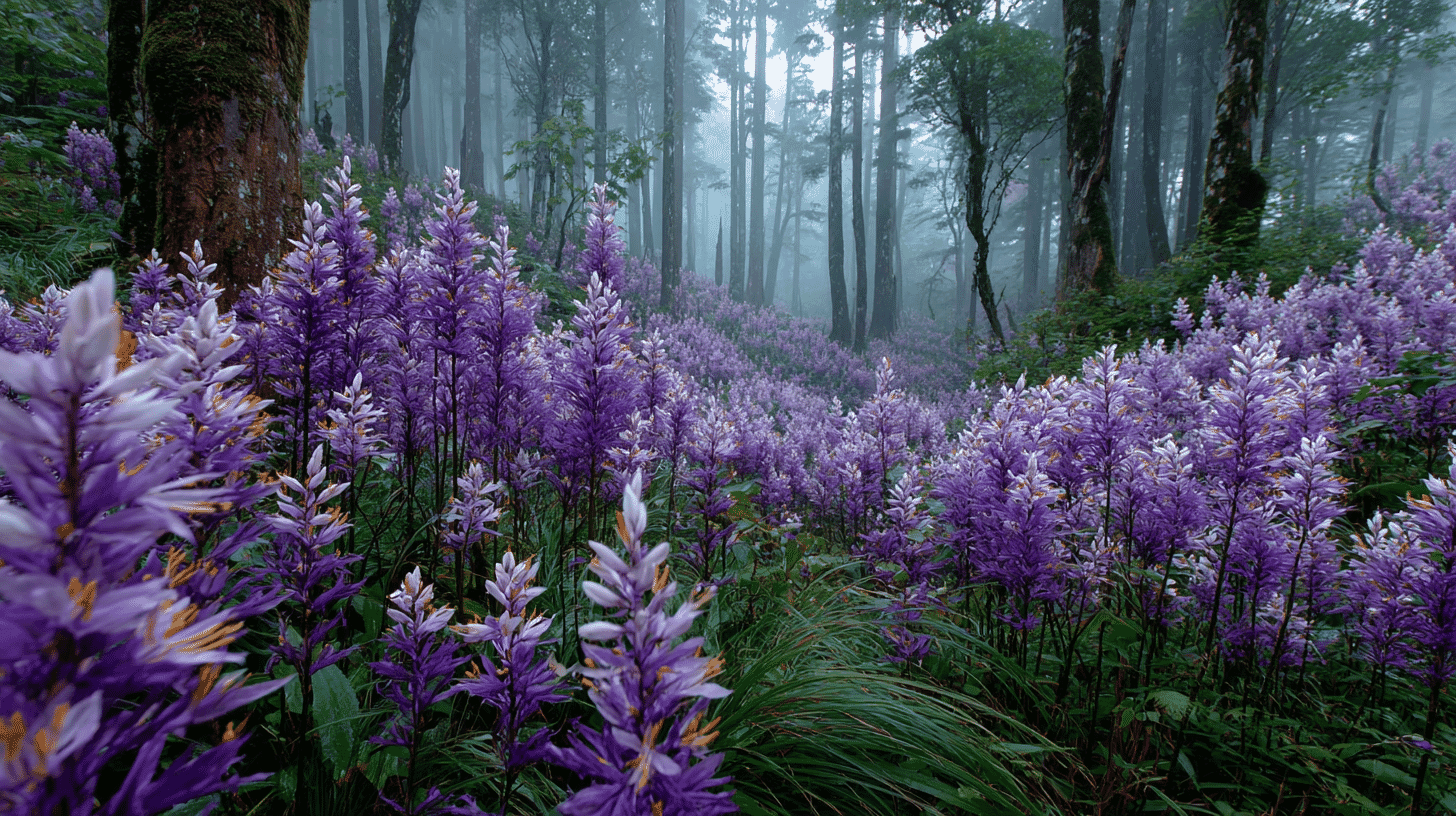
There is a plant in Japan said to bloom roughly once every 120 years: a dwarf bamboo called Suzutake, native to central and southern Nagano Prefecture. In the northern Kamiina area the last recorded flowering was in 1906, shortly after the Russo-Japanese War.
Now, in the mountains of central Japan, it is bursting into bloom again. For botanists it is a once-in-a-career chance. For most people watching, it is likely the only time they will ever see it.
What's Happening in the Mountains of Nagano
In May 2026, something extraordinary is unfolding in central Japan.
According to the Shinano Mainichi Shimbun, a dwarf bamboo called Suzutake (Sasamorpha borealis) is undergoing its once-in-roughly-120-years mass flowering across the northern Kamiina, Suwa, Matsumoto and Kiso regions of Nagano Prefecture. The prefectural forestry research centre says flowering has been confirmed at sites across the region since April, alongside reports of other species such as black bamboo blooming at the same time.
Leading the field investigation is Keito Kobayashi, 33, a researcher in the Forest Ecology Research Group at the Kansai Research Center of the Forestry and Forest Products Research Institute (FFPRI) in Kyoto, who began surveying the area two years ago. On April 30 he visited Shinshu University's Tera-sawayama Experimental Forest in Ina City and found dark-purple flowering spikes about 10 centimetres long across the entire Suzutake habitat. Depending on elevation, full bloom is expected in early May.
The crucial point: this is not a few individual stalks happening to flower at once. Suzutake plants across a wide area bloom synchronously, which is why researchers cannot afford to miss the moment.
What Is Suzutake?
Suzutake (Sasamorpha borealis) belongs to the grass family (Poaceae) and is technically a dwarf bamboo, or sasa in Japanese. The plants grow up to 2.5 meters (about 8 feet) tall, with two or three leaves at the tip of each stalk. The culms are typically less than 1 cm (0.4 inches) in diameter, and their flat nodes make them especially flexible.
That flexibility made Suzutake a prized material for Japanese traditional crafts for centuries. While the snow-country regions of Nagano (such as Togakushi and Yamanouchi) became famous for crafts using nemagari-take (Sasa kurilensis), the Pacific-side craft culture relied on Suzutake for baskets, sieves and woven trunks called kori.
In the Meiji era (late 19th century), when raw material grew scarce around Matsumoto, craftsmen migrated to Gotemba at the foot of Mount Fuji and built a thriving bamboo kori industry there. By the Taisho era (early 20th century), bamboo trunks from eastern Shizuoka, centred on Gotemba, reportedly accounted for 80% of national production, much of it exported.
But another role matters more to this story: Suzutake was a famine food. When it flowers, it produces rice-grain-shaped seeds called takegome, literally "bamboo rice." In years of crop failure, villagers gathered these seeds in bulk and ate them. Because such harvests were too significant to forget, flowering events were recorded in old documents.
How Do We Know It's "Every 120 Years"?
You might wonder how anyone could verify a 120-year cycle. The answer: archival records.
In 1906 (Meiji 39), a major Suzutake fruiting was recorded in the mountains of southern Shinshu. Across parts of Kamiina, Shimoina, Nishi-Chikuma, and Suwa, entire villages turned out to harvest the seeds. According to the records, men, women and children, including those who had left to work elsewhere, were called back home. The most productive harvesters collected 4 to 5 to (roughly 72 to 90 litres) per day, and the total haul reportedly more than compensated for that year's poor rice harvest.
Researchers cross-referenced the 1906 event against earlier records in the same regions. Around Kamiina and Matsumoto, flowerings are documented roughly 240 and 120 years ago, an interval of about 120 years. So 1906 plus 120 lands on 2026.
The cycle is not settled science, though. The prefectural forestry centre says the precise interval remains unknown, and FFPRI records another Suzutake mass flowering in central Japan in 2017. Because species and regions flower on different schedules, mass flowering of dwarf bamboo somewhere in Japan is not especially rare. Treat "120 years" as a working figure for these particular stands.
According to Kobayashi, 2025 showed scattered early-bloom precursors across the region, a sign the main event was approaching.
The Mystery: Why Bloom Once, Then Die?
Suzutake's other extraordinary feature is its monocarpic life cycle. The plant grows for decades, sometimes a century or more, then in a single synchronised burst flowers, sets seed and dies.
The Nagano Suzutake now coming into bloom are therefore on track to die en masse within a few years. Dense undergrowth that has carpeted these forests for over a century will likely vanish.
Why synchronise at all? One leading explanation is predator satiation. By not flowering for decades, the plants keep populations of seed-eating rodents and insects low; then a single enormous seed drop overwhelms what those predators can eat, so more seeds survive. FFPRI surveys have found that in mass-flowering years, seed-eating insects appear less frequently and more seed remains than in years when stragglers bloom.
And here is where it gets unsettling.
Professor Toshihiro Yamada at Hiroshima University has been tracking a closely related species, the henon bamboo (Phyllostachys nigra var. henonis), which also has a roughly 120-year flowering interval. Over three years of post-flowering observation, Yamada's team found that flowering henon bamboo produced almost no viable seeds, no shoot regeneration from rhizomes and no detectable recovery. A hundred and twenty years of waiting, and nothing to show for it.
Will Suzutake follow the same path, or will it set viable seed and regenerate? That is the question researchers are racing to answer right now.
A Once-in-a-Career Opportunity, and Citizen Science
Kobayashi's team at FFPRI Kansai, in collaboration with Kyoto University, has launched a citizen science project to track the Nagano flowering event in real time.
The project's website is recruiting local residents, hikers, and nature photographers to report observations: where they have seen Suzutake blooming, where they have not, the timing, the elevation, the density. The reasoning is practical. Suzutake covers vast forested areas across several prefectures, and a small research team cannot cover every site. Only with many pairs of eyes can an event on this scale be documented properly.
Kobayashi is one of the few specialists anywhere studying mass-flowering events in bamboos and dwarf bamboos. His field campaigns include henon bamboo nationwide, the Sasa senanensis mass flowering that swept Hokkaido in 2022 and 2023, and now Suzutake in central Honshu. It amounts to a decade-long stakeout of a phenomenon that refuses to run on human schedules.
Bamboo Flowering Around the World
Mass bamboo flowering happens worldwide, and in some places the consequences are far more dramatic than in Japan.
India's "Mautam" famine is the most famous case. Melocanna baccifera, a tropical bamboo, flowers synchronously across the northeast Indian states of Mizoram, Tripura, and Manipur every 48 years or so. The seed deluge fuels a population explosion of black rats, which after consuming the bamboo seeds turn to standing crops and stored grain, triggering a cyclical famine. Mautam events are recorded in 1815, 1863, 1911, 1959, and 2007. After the 2007 event, the Mizoram state government activated a comprehensive response plan called BAFFACOS (Bamboo Flowering and Famine Combat Scheme), distributing rodenticides and traps to farmers free of charge.
China's giant pandas have repeatedly faced food crises driven by mass bamboo flowering. When bamboo stands flowered and died across Sichuan and Gansu in the mid-1970s and again in the 1980s, pandas cut off from alternative stands by fragmented habitat starved in large numbers. Those episodes drove the argument for corridors linking panda reserves.
North American river cane (Arundinaria) shows similar synchronised flowering and die-off, recorded in Native American oral history and early colonial documents.
By comparison, Japan's Suzutake flowering is so far a rare scientific spectacle rather than a humanitarian crisis. It is still a reminder that bamboo's reproductive timing has reshaped human history, and ecosystems, on several continents.
A Plant Calendar Longer Than a Human Life
There are still plants in Japan that operate on a timescale far exceeding a human lifetime. Suzutake is one of them.
A stand that flowered in the late Meiji era is flowering again now. On the same interval, the next event falls in the middle of the twenty-second century. Nobody reading this will be there for it. The realisation that the bloom in front of you is the only one you will ever see is a rare thing.
Does your country have a plant or natural phenomenon with a similar century-scale rhythm? The 17- and 13-year cicadas in the eastern United States. The Madagascan suicide palm (Tahina spectabilis), which flowers once after decades and dies. The century plant (Agave americana) in Mexico. New Zealand's irregular rimu mast events. Versions of this exist around the world.
What's your country's "almost-never-seen" natural event? We'd love to hear about it in the comments.
References
- https://news.yahoo.co.jp/articles/2e0e358d0d3f6ad8e0c5bc2e146aa769e1a9a36d
- https://www.shinmai.co.jp/news/article/gf01d7pgt4b0a7t8vjjv9ee0
- https://sites.google.com/kyoto-u.ac.jp/nagano-suzutake/
- https://en.wikipedia.org/wiki/Sasamorpha_borealis
- https://www.akita-pu.ac.jp/oshirase/oshirase2022/7441
- https://www.hiroshima-u.ac.jp/en/news/78653
- https://en.wikipedia.org/wiki/Mautam
- https://www.earth.com/news/bamboo-species-blooming-every-120-years-may-vanish-pr25/





Global Discussion
14 comments