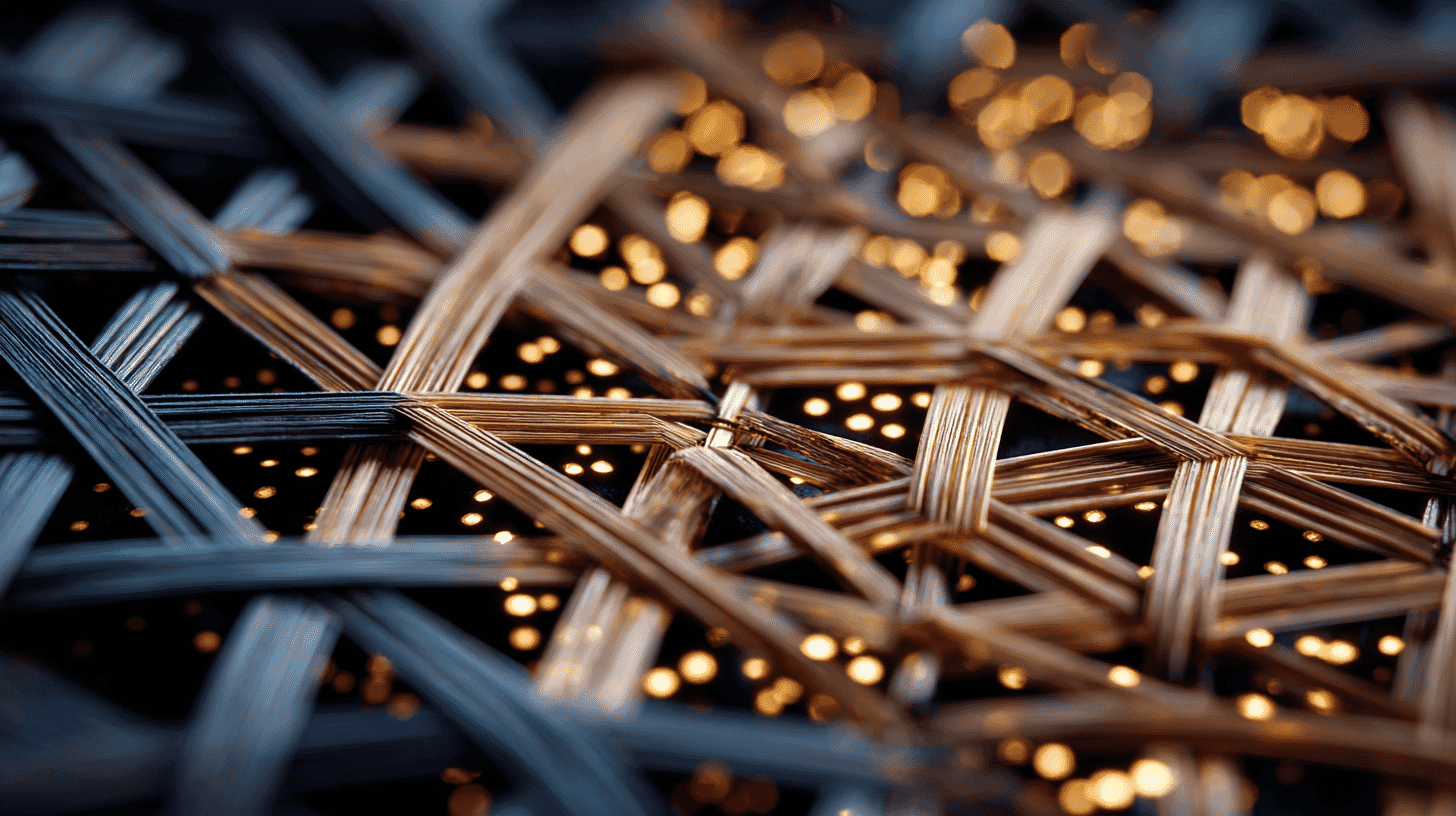
🧺 A Japanese research team says it has built a sheet where some electrons behave as if they weigh nothing and others as if they weigh infinitely much. We read that sentence several times and still weren't sure what it meant. It turns out the key word in this story, kagome, is the name of a Japanese bamboo-basket weave.
First, nobody's electrons got heavier
In September 2026, Newswitch, the news site of the business daily Nikkan Kogyo Shimbun, ran the story under a headline promising two kinds of electron in one material: one with zero mass, one with infinite mass. Taken literally, that is impossible. An electron's mass doesn't change because you put it somewhere new.
What changes is how it moves. Inside a solid, an electron is constantly nudged by the atoms, or here the molecules, around it. Physicists fold all that nudging into one number, the effective mass, which measures how readily the electron moves when pushed rather than how much it weighs. A low effective mass means it moves easily; a high one means it barely moves.
So "zero mass" and "infinite mass" describe two extremes of mobility. As a rough picture, and only a picture: one electron on ice so slick it can't stop, and another stuck in mud so deep it can't take a step.
A honeycomb and a basket weave
Which extreme an electron ends up at depends on the pattern beneath it. One is the honeycomb, a grid of hexagons like a beehive, and its best-known example is graphene, a single layer of carbon atoms. When graphene's discoverers won the 2010 Nobel Prize in Physics, the Royal Swedish Academy of Sciences' explainer for the public said its electrons behave as if they had no mass, moving at a constant speed of about 1,000 kilometers per second. That is the ice.
Another is the kagome pattern, in which triangles touch only at their corners and leave hexagonal gaps between them. On it, some electrons get trapped inside the hexagons, because their quantum waves overlap in a way that cancels every exit route. Physicists describe such electrons as having an effective mass so large it is almost infinite: the mud.
The team at Japan's National Institute for Materials Science (NIMS) built a hybrid of the two, called a diatomic kagome lattice or, because of its shape, a star lattice.
Wait, "kagome" is Japanese?
Yes. Kagome is the woven pattern of a bamboo basket, from kago (basket) and me (eye), as in the holes of the weave.
According to a 2003 letter in Physics Today by the Japanese physicist Mamoru Mekata, the name came from Kodi Husimi of Osaka University, an amateur painter whose interest in art drew him to a craftsman's word. The first physics paper to use it appeared in 1951, written by his young colleague Itiro Syôzi as sole author in the journal Progress of Theoretical Physics. The journal was new and had few readers, so the work caught on only gradually.
Mekata also noted that a newcomer might guess kagome was the surname of a Japanese scientist. It isn't. It's a basket.
Some 75 years later, a Japanese lab has built one out of molecules.
Propeller molecules that line up on their own
The NIMS team, which includes Takashi Uchihashi, deputy director of NIMS's Research Center for Materials Nanoarchitectonics, and principal researcher Ryuichi Arafune, used a triptycene derivative, an organic molecule shaped like a three-bladed propeller.
Nobody placed the molecules one by one. Spread on a surface of lead, they arranged themselves: the propellers linked into hexagons, and the hexagons spread into a flat sheet with the star-shaped pattern.

Source: National Institute for Materials Science (NIMS)
According to NIMS, the vast majority of known quantum materials are inorganic. Organic molecules are easy to design but usually bond to each other too weakly for electrons to pass between them. The propeller shape gets around that: its blades stand upright, so each one presses flat against a blade of the neighboring molecule and electrons can hop across. The paper calls this kind of contact "pancake bonding."
Using a scanning tunneling microscope, which feels a surface with an extremely fine tip, the researchers confirmed signs of both kinds of electron. They also found electrons packed densely along the sheet's straight edges, in a state that appears only at the edge, not in the interior.
Physicists call this a topological edge state. Topology is the branch of math concerned with overall shape rather than fine detail, and this state arises from the pattern of the whole sheet, not from some accident at the border. According to the paper, it corresponds to the edge states known from graphene. NIMS says real-material versions of this lattice are still rare.
The study involved Saga University, Nara Women's University, Toyota College (a national technical college) and Germany's Kiel University, among others. It was published online in the American Chemical Society journal Nano Letters on September 2, 2026. According to NIMS, it was supported by Japanese government research programs, including grants from the Japan Society for the Promotion of Science.
So what is it for?
Nobody knows yet. Even NIMS's own wish list comes with a "maybe." The institute says lattices like this might someday let a material switch between a fast-conducting semiconductor state and superconductivity, enable ultrafast, ultra-low-power optical switches, or carry energy without losses at room temperature. Newswitch described the plan more modestly, as exploring what the material might be useful for. Because changing the molecule's shape adjusts the lattice, the team hopes to learn to use the two kinds of electron on purpose.
Graphene's uses were once uncertain too. Andre Geim and Konstantin Novoselov at the University of Manchester peeled it from pencil-type graphite with ordinary adhesive tape and published in 2004. When they won the Nobel six years later, the Academy's public explainer called graphene computers a distant dream and said that, for now, its uses could only be speculated about. The kagome sheet is at an even earlier stage.
Kagome made its way from a basket maker's vocabulary into physics papers around the world. Is there a word from your language hiding in science the same way?
References
- https://newswitch.jp/p/50321
- https://www.nims.go.jp/press/2026/09/202609140.html
- https://doi.org/10.1021/acs.nanolett.6c03195
- https://arxiv.org/abs/2609.02567
- https://physicstoday.aip.org/letters/kagome-the-story-of-the-basketweave-lattice
- https://www.qst.go.jp/site/press/20221114.html
- https://www.nobelprize.org/prizes/physics/2010/popular-information/
- https://www.eurekalert.org/news-releases/849692
- https://pmc.ncbi.nlm.nih.gov/articles/PMC6239431/






Global Discussion
4 comments