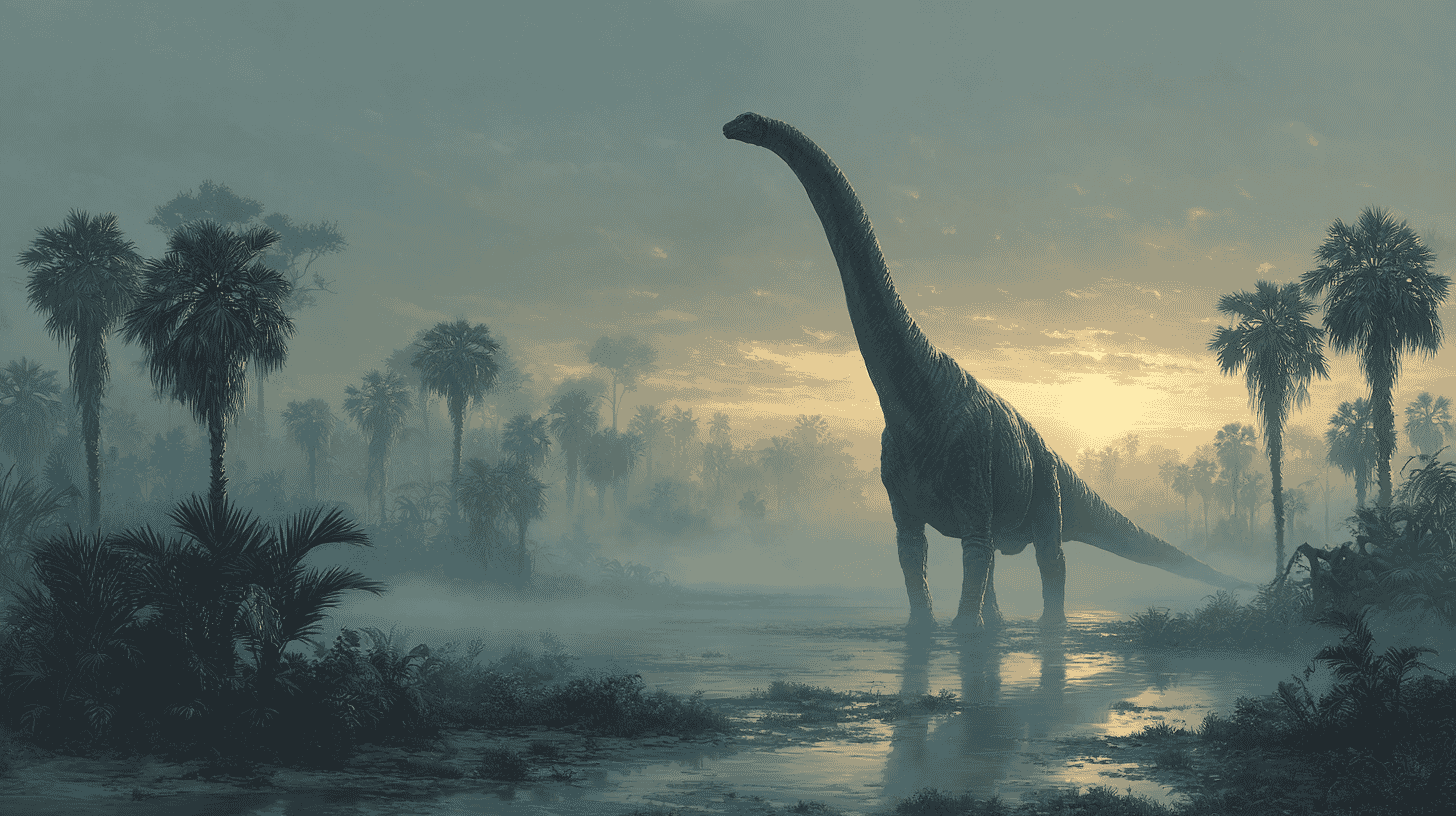
🦕 About 160 million years ago, a big, long-necked dinosaur may have walked across land that is now Minamisoma, a city in Fukushima Prefecture. A team from the Minamisoma City Museum, the Fukushima Museum and outside researchers has dug a footprint about 70 centimeters (2.3 feet) long out of Late Jurassic rock. On October 22, 2026, the city announced it as the largest Jurassic dinosaur footprint yet confirmed in Japan. Almost all of Japan's dinosaur fossils are Cretaceous; finds from the older Jurassic can be counted on one hand.
Found on day five
The tracks came out of the Tochikubo Formation, a band of Late Jurassic rock that runs through the city. It had already yielded plant fossils and small dinosaur footprints, which is why the city started looking there.
In fiscal 2025 the Minamisoma City Museum launched a dinosaur search and education project planned to run about 10 years. After a preliminary survey, full-scale digging began in July 2026. Only five days in, a cluster of footprints turned up.
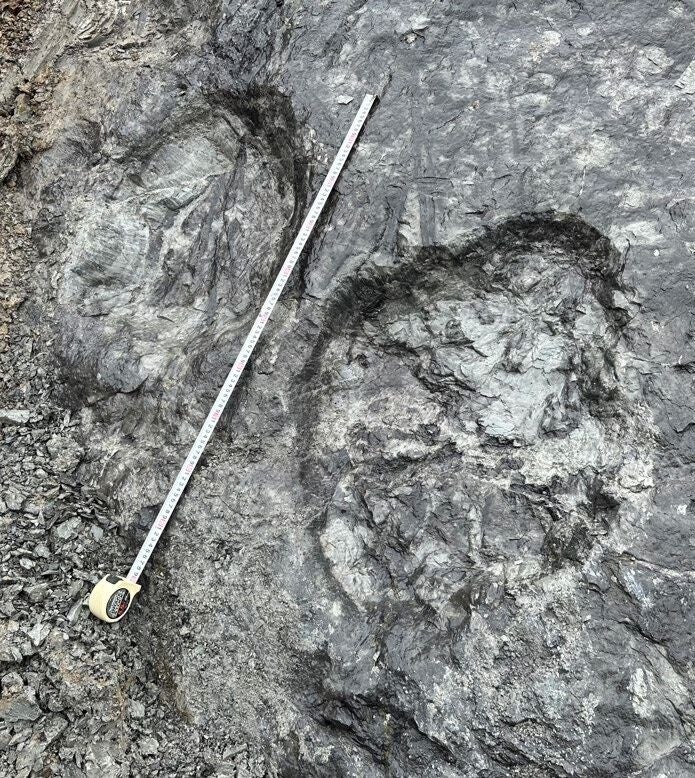
Source: Minamisoma City, Fukushima
According to the Asahi Shimbun, the team found 12 prints spread over an area 7 to 8 meters across, and 5 of them may belong to sauropods. Toe marks on the biggest one suggest a left hind foot. The city's announcement says the trackmaker was most likely a sauropod or a similar large plant-eating dinosaur. Sauropods are the four-legged giants with long necks and tails; think Brachiosaurus.
Junki Yoshida, an assistant chief curator at the Fukushima Museum who led the team, told the broadcaster TUF that he puts the animal's hip height at about 3 meters. The species is still unknown; Yoshida told the Asahi he wants to pin it down and work out what kinds of dinosaurs lived in Late Jurassic Japan.
Largest compared with what?
"Largest" here comes with a time limit. Count the Cretaceous and the record goes to Katsuyama in Fukui Prefecture, where a sauropod hind-foot print found in 2014 measures 63.8 centimeters long and 84.2 centimeters wide, in rock about 120 million years old. Yoshida made the same comparison himself on TUF: he called the Minamisoma print the largest dinosaur footprint in the Tohoku region and said it rivals the big prints known from Japan's Cretaceous rocks.
The previous Jurassic record holder was a footprint from Shimonoseki, Yamaguchi Prefecture. The Asahi, citing the city, says it was found in 1993 and measures 33 centimeters; Kyodo News, citing the team, puts it at about 30 centimeters. The new print is roughly twice that size.
Kyodo also reported it as the first large dinosaur footprint from Japan's Jurassic, and the Asahi described it as the first Jurassic sauropod footprint found in Japan. The city's release stops at "most likely."
A country of Cretaceous fossils
According to the team, as relayed by Kyodo, Jurassic dinosaur fossils have turned up in only two other prefectures: Nagano and Yamaguchi.
Minamisoma was already one of those rare places. A column the city museum published in October 2025 notes that a footprint site in the Tochikubo Formation in Oyamada, Kashima Ward, is protected as a city natural monument, and that footprints have turned up elsewhere in the city too. The surrounding Soma-Nakamura Group of rocks has given scientists 12 new species since 1989, including plants and ammonites.
About the same size as a print on Skye
In 2015, a team led by Stephen Brusatte of the University of Edinburgh reported hundreds of sauropod footprints on the Scottish Isle of Skye, left in what was once a lagoon about 170 million years ago, in the Middle Jurassic. They were Scotland's first sauropod tracks. The largest print is about 70 centimeters across, and the team estimated the animals at least 15 meters long and over 10 tons.
Minamisoma's 70 centimeters is a length and Skye's is a width, but the prints are roughly the same size.
In the village of Plagne, in the Jura Mountains of eastern France, a sauropod about 150 million years ago left a trackway of 110 steps stretching 155 meters. France's national research agency, CNRS, announced it in 2017 as the world's longest known sauropod trackway. Each print measures 94 to 103 centimeters.
Beyond the hip-height guess, no length or weight estimate has been given for the Minamisoma animal yet, and the Skye estimate cannot simply be carried over.
The site is closed, but you can see the print
The dig site is closed to the public to protect the fossils and for safety. Instead, from October 23, 2026, to January 17, 2027, the city is running a dinosaur stamp rally across seven spots. JR Haranomachi Station has a life-size reproduction of the 70-centimeter print, and the Minamisoma City Museum is showing the findings, including a full-size panel.
Next come scientific assessment, 3D analysis, and conservation and safety work. As of October 2026, the city plans a replica, a second dig and an exhibition for fiscal 2027.
Yoshida, who leads the team, is also a co-author of the Nature paper that described Zavacephale, the oldest known pachycephalosaur, found in Mongolia. We wrote about that dinosaur here.
Which era do the dinosaur fossils in your country mostly come from? And is there a place near you where you can stand next to a real dinosaur footprint?
References
- https://prtimes.jp/main/html/rd/p/000000039.000116976.html
- https://www.asahi.com/articles/ASVBP31X9VBPUGTB001M.html
- https://www.daily.co.jp/society/science/2026/10/22/0020955148.shtml
- https://news.yahoo.co.jp/articles/16393ee2d596515d11d4c1d62691e3e0bef3827c
- https://www.city.minamisoma.lg.jp/portal/culture/museum/chosa/31127.html
- https://www.city.minamisoma.lg.jp/portal/sections/61/6150/61503/study/1/shizen/kaseki/29306.html
- https://www.pref.fukui.lg.jp/doc/kouho/kaiken/kaiken140908_d/fil/02.pdf
- https://www.sci.news/paleontology/giant-dinosaur-footprints-isle-of-skye-03480.html
- https://doi.org/10.1144/sjg2015-005
- https://www.cnrs.fr/en/press/worlds-longest-sauropod-dinosaur-trackway-brought-light
- https://doi.org/10.1038/s41586-025-09213-6






Global Discussion
3 comments