🦴 A dinosaur about 1 metre (3.3 ft) long pushed the fossil record of the pachycephalosaurs' bony dome back by at least 14 million years. Its real fossil is now on show in western Japan, billed as the oldest "head-butting dinosaur." Yet the abstract of the paper that named it never mentions head-butting, and whether its kind ever fought that way is still debated.
A small skeleton with a long list of firsts
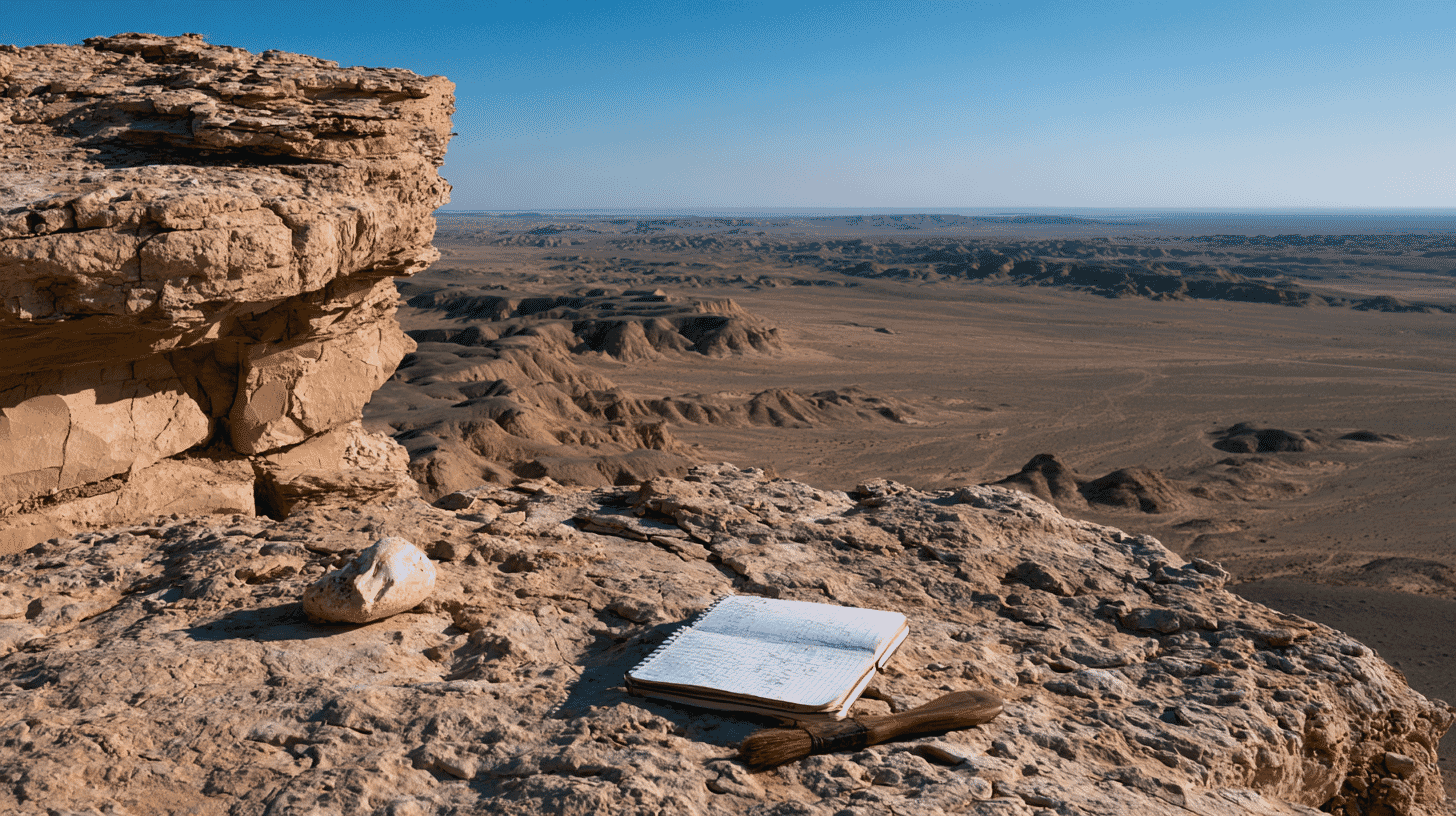
The animal is Zavacephale rinpoche, described in Nature on September 17, 2025. Tsogtbaatar Chinzorig of the Mongolian Academy of Sciences, the lead author, found it at Khuren Dukh, in Mongolia's Eastern Gobi Basin, with the domed skull sticking out of a cliff. The team's Japanese press release dates the find to 2019.
According to NC State University, home of corresponding author Lindsay Zanno, it lived about 108 million years ago (Japanese materials say about 110 million). Older candidates have been proposed, but the paper notes that none is accepted without dispute, which makes this the oldest confirmed pachycephalosaur. Almost every other fossil of the group dates from the final stretch of the dinosaur age, roughly 80 to 66 million years ago.
The paper also calls it the most skeletally complete pachycephalosaur yet found. The group is usually known from thick skull caps alone, but this one has limbs, a complete tail, and the group's first known hand bones and gastroliths, stones swallowed to help grind food. The Japanese release estimates its weight at 5.85 kilograms (12.9 lb). The 4.3 metres (14 ft) and 363 to 410 kilograms (800 to 900 lb) in NC State's release describe large adults of the group, not this animal.
Two of the eight authors work in Japan: Ryuji Takasaki of Okayama University of Science and Junki Yoshida of the Fukushima Museum. The fossil's tour of Japan began at Yoshida's museum.
The genus name joins zava, Tibetan for "root" or "origin," with cephale, head. The species name rinpoche, Tibetan for "precious one," refers to the skull exposed on the cliff like a jewel.
What the paper says, and what it leaves out
The word head-butting never appears in the abstract. It says these dome-headed dinosaurs are thought to have developed "complex sociosexual systems," meaning the dome mattered for mating and social rank. The sources cited for that sentence, though, include the two head-butting studies described below, so "sociosexual" here does not rule out combat.
In NC State's release, Zanno said the consensus is that the dome served socio-sexual behaviour. It would not have helped against predators or with body heat, so its likeliest uses were display and rivalry over mates.
Rivalry over mates can include physical contests, and the publicity leans that way. The Fukushima Museum's Japanese release calls the animal the oldest head-butting dinosaur in its headline and opens with an illustration of two Zavacephale butting heads. NC State's artwork shows young Zavacephale dueling on a lakeshore.
It is a handy label for an unfamiliar animal, and some living animals, such as bighorn sheep and musk oxen, really do fight head-on. But "head-butting dinosaur" describes a hypothesis, and that hypothesis has been argued over since at least 1998.
Nearly three decades of argument over one dome
In 1998, Mark Goodwin of UC Berkeley and colleagues challenged the head-butting idea by comparing pachycephalosaur skulls with those of bighorn sheep. The known skeletons were slight, they argued, poorly built to absorb a head-on blow. If these animals fought, flank-butting like bison seemed more plausible.
In 2004, Goodwin and John Horner of the Museum of the Rockies looked inside the dome. They gathered seven skulls from Montana, ranging from juvenile to adult, and sliced five. Young animals had porous, blood-rich bone in the dome; adults had mostly dense bone. Writing in Paleobiology, they argued that the radiating structures some had read as shock absorbers were simply what a growing dome looks like. Collagen fibres anchored in the bone surface also pointed to a covering of some kind, possibly brightly coloured and used for display and recognition, as some birds use their head ornaments.
In 2011, Eric Snively and Jessica Theodor took the other side. They CT-scanned pachycephalosaur skulls and ran impact simulations against ten living hoofed animals. Stegoceras behaved more like a head-butting duiker or musk ox than like a llama or a giraffe. Their conclusion: some pachycephalosaurs could take head-to-head impacts as well as living animals that fight that way.
In 2013, Joseph Peterson, Collin Dischler and Nicholas Longrich counted skull injuries instead. About 22% of domes carried lesions, clustered near the top. Flat-headed specimens, which the authors read as juveniles or females, had none, roughly the pattern expected if adults struck each other head-first. Bone structure, then, backs the sceptics, while mechanics and injuries back the head-butters.
Why a young animal with a finished dome matters
A long-running problem with this group is telling species from growth stages. Two skulls that look different might be two species, or one species at two ages, and since most pachycephalosaurs are known only from skulls, there is usually no body to show how old the animal was. Zavacephale has both, so skull shape and age can be checked on the same individual.
The team cut thin sections from the dome and the leg bones and read the growth lines. According to the Japanese release, the animal was at least two years old and still growing, yet its dome was already well developed. In the paper's terms, advanced dome development came before the body reached its final size.
For a young animal, display is the obvious candidate for what the dome was doing. Whether the same dome was later used as a ram is something this fossil cannot tell us.
Seeing it in Japan
The real fossil and a mounted skeleton are at the Tamba Dinosaur Museum in Tamba, Hyogo Prefecture, from October 10, 2026, to February 23, 2027. The show, hosted by Tamba City and the Kobe Shimbun newspaper, marks 20 years since the discovery of Tambatitanis, a long-necked sauropod whose rib was found in the bed of the Sasayama River on August 7, 2006. It also includes a cast, about 12 metres long, of the Tyrannosaurus rex known as Wyrex.
Admission is 1,500 yen (about $9.50) for adults and 500 yen (about $3) for elementary and junior high school students, at 158.4 yen to the dollar as of October 14, 2026. Hours are 10:00 to 17:00 (16:00 from November 1), closed Mondays (the next weekday if Monday is a holiday) and December 29 to January 3.
Promotions call it a world premiere. According to the museum's own page, though, this is the exhibition first held at the Fukushima Museum in Aizuwakamatsu from July 11 to September 23, 2026, now touring the Kansai region. The real fossil's first public showing was in Fukushima, and Tamba is the second of four venues in Japan.
Related: Arctic Dinosaurs: A Japanese Climate Model Reproduces the Warm Cretaceous Pole
Do the museum labels where you live tell visitors which dinosaur stories are settled and which are still being argued?
References
- https://doi.org/10.1038/s41586-025-09213-6
- https://news.ncsu.edu/2025/09/teen-pachycephalosaur-butts-into-fossil-record/
- https://general-museum.fcs.ed.jp/file/3243
- https://newsarchive.berkeley.edu/news/media/releases/2004/06/07_pachy.shtml
- https://doi.org/10.1371/journal.pone.0021422
- https://doi.org/10.1371/journal.pone.0068620
- https://www.tambaryu.com/tenji_kyouryu/Special/387.html
- https://prtimes.jp/main/html/rd/p/000000364.000006053.html
- https://kyoryu-zavacephale-rinpoche.com/
- https://media.jreast.co.jp/articles/6526




Global Discussion
4 comments